QUESTION IMAGE
Question
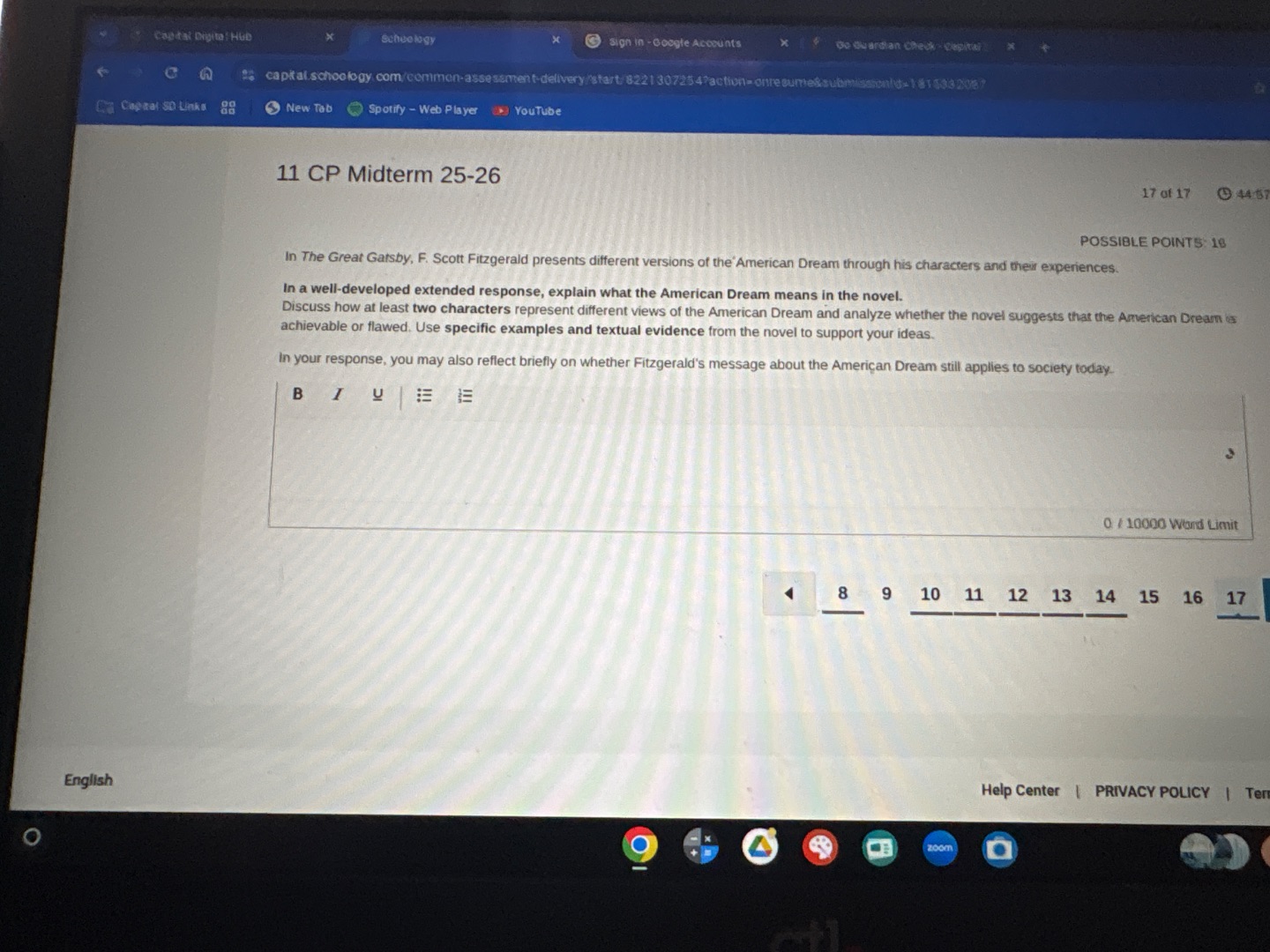
11 cp midterm 25 - 26
17 of 17
44:57
possible points: 10
in the great gatsby, f. scott fitzgerald presents different versions of the american dream through his characters and their experiences.
in a well - developed extended response, explain what the american dream means in the novel.
discuss how at least two characters represent different views of the american dream and analyze whether the novel suggests that the american dream is achievable or flawed. use specific examples and textual evidence from the novel to support your ideas.
in your response, you may also reflect briefly on whether fitzgerald’s message about the american dream still applies to society today.
0 / 10000 word limit
8 9 10 11 12 13 14 15 16 17
english
help center | privacy policy | ter
To answer this, we analyze the American Dream in The Great Gatsby:
1. Definition of the American Dream in the Novel
In the novel, the American Dream initially symbolizes upward mobility—achieving wealth, love, and social status through hard work. However, Fitzgerald critiques how it becomes corrupted by materialism and class divisions.
2. Character 1: Jay Gatsby
Gatsby embodies a romanticized, idealistic version of the American Dream. He rises from poverty (James Gatz) to wealth via bootlegging, believing money will win back Daisy (his lost love). His mansion, parties, and elaborate lies (e.g., claiming Oxford education) reflect his pursuit of a “past perfect” dream. Yet, his dream is flawed: Daisy’s love is tied to his wealth, and she ultimately abandons him. His death (shot in his pool) symbolizes the dream’s demise—his hard work (and illegal means) fail to secure true happiness or acceptance.
3. Character 2: Daisy Buchanan
Daisy represents a cynical, inherited version of the American Dream. Born into old money, she prioritizes status and comfort over love or morality. She chooses Tom (her wealthy husband) over Gatsby, even after admitting she loved Gatsby, because Tom’s class and stability align with her vision of success. Her line, “I hope she’ll be a fool—that’s the best thing a girl can be in this world, a beautiful little fool,” reveals her belief that women’s success lies in conformity, not ambition—highlighting the dream’s gendered and class - based limitations.
4. Is the American Dream Achievable or Flawed?
The novel suggests the American Dream is flawed. Gatsby’s death, the Valley of Ashes (a symbol of poverty and moral decay), and the Buchanans’ careless wealth show that the dream is corrupted by greed, classism, and illusion. Fitzgerald implies that true upward mobility is impossible in a society where old money (Tom, Daisy) looks down on new money (Gatsby), and the poor (George Wilson) are trapped.
5. Relevance Today
Fitzgerald’s message still resonates. Modern society faces income inequality, where “new money” struggles for acceptance, and the “American Dream” often feels like a myth for marginalized groups. Like Gatsby, many today chase wealth/status but find it hollow, echoing the novel’s critique of a dream built on materialism rather than fulfillment.

Snap & solve any problem in the app
Get step-by-step solutions on Sovi AI
Photo-based solutions with guided steps
Explore more problems and detailed explanations
In The Great Gatsby, the American Dream is a complex, often flawed ideal. Jay Gatsby pursues a romanticized version: he rises from poverty to wealth (via bootlegging) to win back Daisy, but his dream is rooted in illusion (e.g., his fake Oxford backstory) and ends in death, showing the dream’s fragility. Daisy Buchanan embodies a cynical, class - based version: born to old money, she prioritizes status over love, choosing Tom (her wealthy husband) over Gatsby and embodying the dream’s gendered, materialistic flaws. The novel suggests the American Dream is flawed: Gatsby’s death, the Valley of Ashes (poverty’s symbol), and the Buchanans’ carelessness expose it as corrupted by greed and classism. Today, Fitzgerald’s message still applies—income inequality and the hollow pursuit of wealth mirror the novel’s critique of a dream that prioritizes materialism over fulfillment.