QUESTION IMAGE
Question
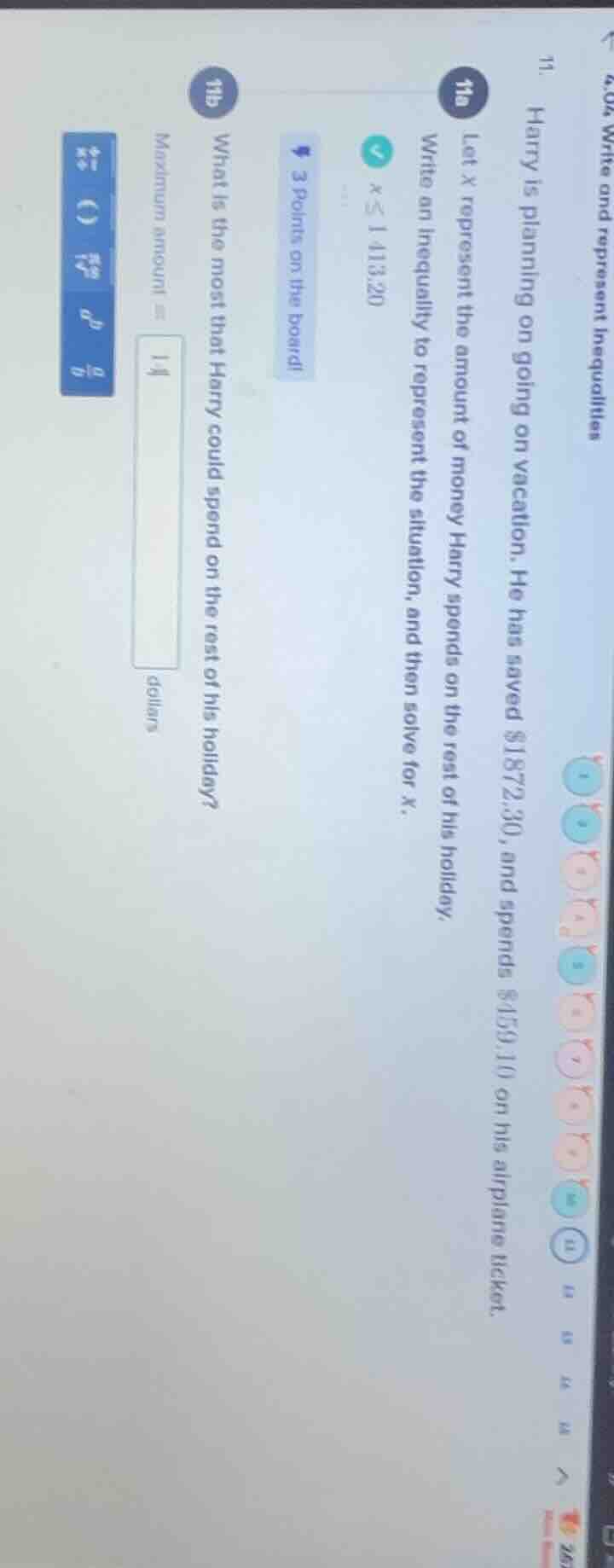
- harry is planning on going on vacation. he has saved $1872.30, and spends $159.10 on his airplane ticket. \
11a let x represent the amount of money harry spends on the rest of his holiday. \
write an inequality to represent the situation, and then solve for x. \
11b what is the most that harry could spend on the rest of his holiday? \
maximum amount = dollars
11a:
Step1: Define the inequality
Harry's total spending (airplane ticket + rest of vacation) must be less than or equal to his savings. Let \( x \) be the amount spent on the rest of the holiday. The airplane ticket is \$159.10, and savings are \$1872.30. So the inequality is \( x + 159.10 \leq 1872.30 \).
Step2: Solve for \( x \)
Subtract 159.10 from both sides: \( x \leq 1872.30 - 159.10 \). Calculate \( 1872.30 - 159.10 = 1713.20 \). So \( x \leq 1713.20 \).
From part 11a, the maximum \( x \) (amount spent on rest of holiday) is when \( x = 1713.20 \) (since \( x \leq 1713.20 \), the maximum is 1713.20). Wait, but the box has 11, maybe a typo? Wait, recalculate: 1872.30 - 159.10 = 1713.20. So maximum amount is 1713.20 dollars.

Snap & solve any problem in the app
Get step-by-step solutions on Sovi AI
Photo-based solutions with guided steps
Explore more problems and detailed explanations
Inequality: \( x + 159.10 \leq 1872.30 \), Solution: \( x \leq 1713.20 \)