QUESTION IMAGE
Question
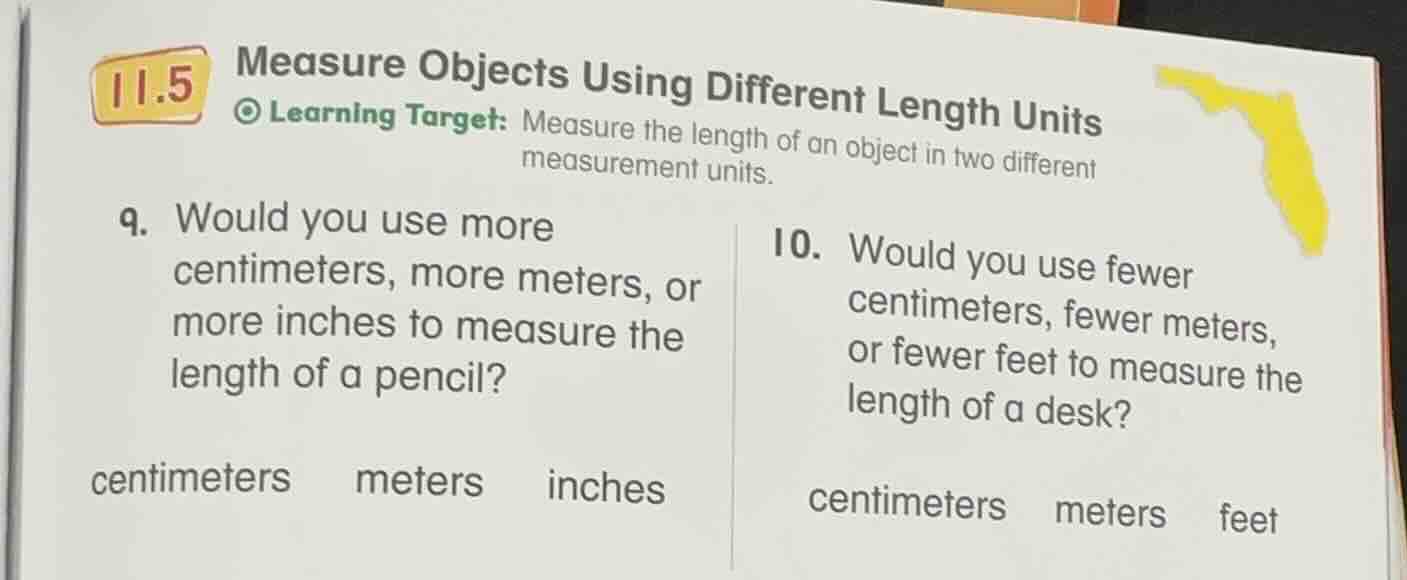
11.5 measure objects using different length units
learning target: measure the length of an object in two different measurement units.
- would you use more centimeters, more meters, or more inches to measure the length of a pencil?
centimeters meters inches
- would you use fewer centimeters, fewer meters, or fewer feet to measure the length of a desk?
centimeters meters feet
Question 9
Step1: Recall unit sizes
1 meter = 100 centimeters, 1 inch ≈ 2.54 centimeters. A pencil is small (e.g., ~15 cm).
Step2: Compare units for pencil
- Meters: 1 meter is too big, so measuring a pencil in meters would need a tiny fraction (e.g., 0.15 m), so "more meters" is wrong.
- Inches: 15 cm ≈ 5.9 inches, so inches are larger than cm here, but we need "more" of which unit. Wait, no—wait, the question is "Would you use more centimeters, more meters, or more inches to measure the length of a pencil?" Wait, no, actually: when the unit is smaller, you need more units. Wait, no—wait, no: if the unit is smaller, the number of units is larger. Wait, no: e.g., a pencil is 15 cm. In meters, that's 0.15 m (so fewer meters). In inches, 15 cm ≈ 5.9 inches (so fewer inches than cm? Wait, no: 15 cm is about 5.9 inches, so 15 cm > 5.9 inches. Wait, maybe I got it reversed. Wait, the question is "use more [unit]"—so which unit would require a larger number? Let's clarify:
If the unit is smaller, the number of units needed is larger. For example, to measure a 10 cm pencil:
- In cm: 10 units.
- In meters: 0.1 units (so fewer meters).
- In inches: 10 cm ≈ 3.94 inches (so fewer inches than cm). Wait, that's the opposite. Wait, no—wait, 1 inch is ~2.54 cm, so 1 cm is ~0.39 inches. So a cm is smaller than an inch. So to measure a length, the smaller the unit, the more units you need. Wait, 10 cm: in cm, 10; in inches, ~3.94 (so fewer inches than cm). Wait, so cm are smaller than inches? No, 1 inch is bigger than 1 cm. So 1 inch = 2.54 cm, so cm is smaller. So for a given length, smaller unit → more units. Wait, 10 cm: in cm, 10; in inches, ~3.94 (so cm is smaller, so more cm than inches). Wait, yes! Because 1 cm is smaller than 1 inch, so to measure the same length, you need more cm than inches. But wait, a meter is way bigger than cm. So for a pencil (e.g., 15 cm):
- Meters: 0.15 m (so very few meters).
- Inches: ~5.9 inches (so fewer than 15 cm).
- Centimeters: 15 cm (the actual count).
Wait, the question is "Would you use more centimeters, more meters, or more inches to measure the length of a pencil?" So which unit requires a larger number?
Meters: 0.15 (very small number) → "more meters" is wrong.
Inches: ~5.9 (smaller than 15) → "more inches" is wrong.
Centimeters: 15 (larger than meters and inches counts) → so you use more centimeters.
Step3: Confirm
A pencil is small. Meters are too large (so you need very few meters), inches are larger than cm (so you need fewer inches than cm), so cm requires the largest number of units. So the answer is centimeters.
Step1: Recall unit sizes
1 meter = 100 cm, 1 foot ≈ 30.48 cm. A desk is, say, 120 cm (1.2 m, ~3.94 feet).
Step2: Compare units for desk
- Centimeters: 120 units.
- Meters: 1.2 units (fewer than 120).
- Feet: ~3.94 units (fewer than 120, but more than meters? Wait, no—the question is "fewer [unit]": which unit would require the fewest number of units? Wait, no: the question is "Would you use fewer centimeters, fewer meters, or fewer feet to measure the length of a desk?" Wait, no—"fewer" of which unit? Wait, no: when the unit is larger, the number of units is smaller. For example, a desk is 120 cm:
- In meters: 1.2 m (so fewer meters than cm).
- In feet: ~3.94 ft (fewer than cm, but more than meters? Wait, 1.2 m is less than 3.94 ft? No, 1.2 m is 3.937 ft, so almost the same. Wait, maybe a desk is ~1.5 m (150 cm). Then:
- Meters: 1.5 m (so 1.5 units).
- Feet: 150 cm / 30.48 cm/ft ≈ 4.92 ft (so more feet than meters).
- Centimeters: 150 units.
Wait, the question is "fewer [unit]"—so which unit has the smallest number of units? Meters: 1.5 (smallest), then feet (~4.92), then cm (150). So you use fewer meters than centimeters or feet. Wait, let's check:
A desk is typically around 1 - 2 meters long. So in meters: 1 or 2 units. In centimeters: 100 - 200 units. In feet: ~3 - 6 units. So meters are the largest unit here (since 1 meter > 1 foot? No, 1 meter is ~3.28 feet, so 1 meter is larger than 1 foot. Wait, 1 meter = 3.28 ft, so 1 meter is bigger than 1 foot. So meters are larger than feet? No, 1 foot is ~0.3048 meters, so 1 meter is about 3.28 feet. So meters are larger than feet. Wait, no—1 meter is longer than 1 foot. So a meter is a larger unit than a foot. So for a desk (e.g., 1.5 m):
- Meters: 1.5 (smallest number).
- Feet: ~4.92 (more than meters).
- Centimeters: 150 (most).
So "fewer meters" than centimeters or feet. Wait, but the options are "fewer centimeters, fewer meters, or fewer feet". Wait, no—wait, the question is "Would you use fewer centimeters, fewer meters, or fewer feet to measure the length of a desk?" Wait, no—maybe I misread. Wait, the options are "fewer centimeters, fewer meters, or fewer feet"—so which one is true? Wait, no—when measuring, the larger the unit, the fewer units you need. So:
- Meters are larger than feet? No, 1 meter is ~3.28 feet, so 1 meter is larger than 1 foot. So meters are larger than feet, which are larger than centimeters. Wait, no: 1 cm < 1 inch < 1 foot < 1 meter? No, 1 inch ≈ 2.54 cm, 1 foot = 12 inches ≈ 30.48 cm, 1 meter = 100 cm. So order of unit size (from smallest to largest): cm < inch < foot < meter. Wait, no: 1 cm (smallest), then inch (2.54 cm), then foot (30.48 cm), then meter (100 cm). So unit size: cm < inch < foot < meter.
So for a desk (e.g., 100 cm = 1 m):
- Centimeters: 100 units.
- Feet: 100 / 30.48 ≈ 3.28 units.
- Meters: 1 unit.
So the number of units: cm (100) > feet (~3.28) > meters (1). So "fewer meters" than centimeters and feet? Wait, no—"fewer" of which unit? Wait, the question is "Would you use fewer centimeters, fewer meters, or fewer feet to measure the length of a desk?" Wait, no—maybe it's "fewer" in the sense of which unit requires the least number. So meters require the least number (1), then feet (~3.28), then cm (100). So you use fewer meters than centimeters (and fewer than feet? Wait, 1 meter is less than 3.28 feet, so yes, fewer meters than feet. Wait, but the options are "fewer centimeters, fewer meters, or fewer feet". Wait, no—maybe the desk is ~2 meters (200 cm). Then:
- Meters: 2 units.
- Feet: 200 / 30.48 ≈ 6.56 units.
- Centimete…

Snap & solve any problem in the app
Get step-by-step solutions on Sovi AI
Photo-based solutions with guided steps
Explore more problems and detailed explanations
centimeters