QUESTION IMAGE
Question
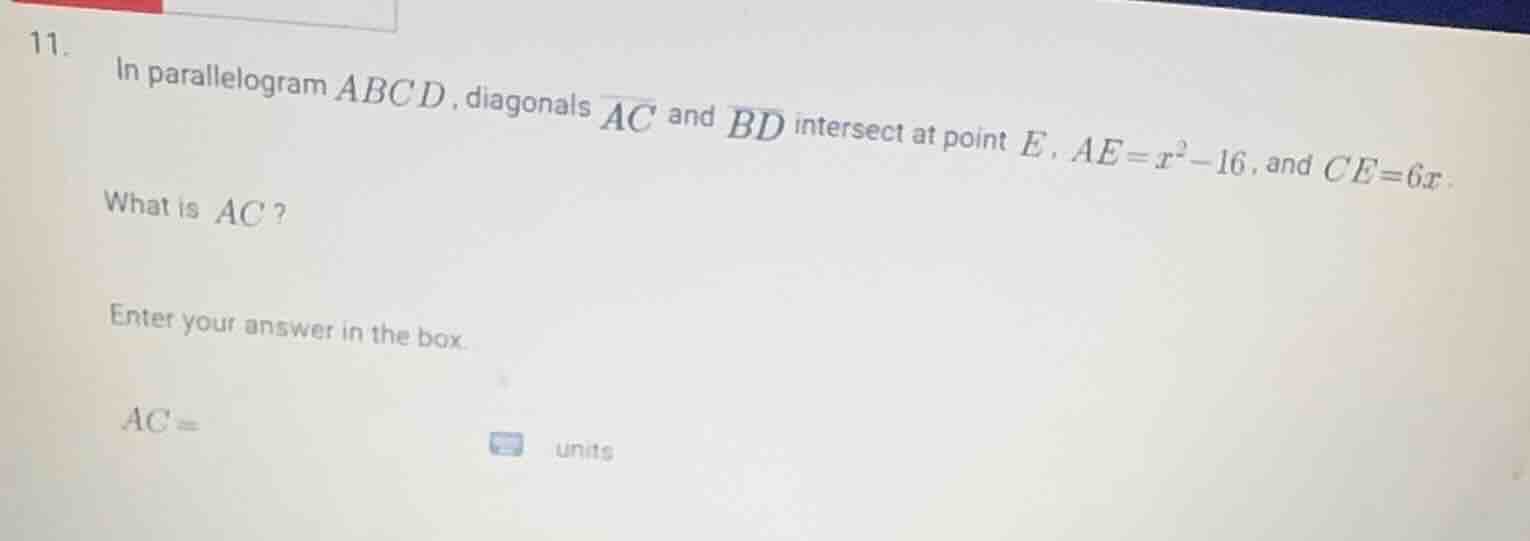
- in parallelogram (abcd), diagonals (overline{ac}) and (overline{bd}) intersect at point (e), (ae = x^2 - 16), and (ce = 6x). what is (ac)? enter your answer in the box. (ac =) (square) units
Step1: Recall the property of parallelogram diagonals
In a parallelogram, the diagonals bisect each other. So, \( AE = CE \).
Given \( AE = x^{2}-16 \) and \( CE = 6x \), we set up the equation:
\( x^{2}-16 = 6x \)
Step2: Solve the quadratic equation
Rearrange the equation to standard quadratic form \( ax^{2}+bx + c = 0 \):
\( x^{2}-6x - 16 = 0 \)
Factor the quadratic:
We need two numbers that multiply to -16 and add to -6. The numbers are -8 and 2.
So, \( (x - 8)(x + 2)=0 \)
Set each factor equal to zero:
\( x - 8 = 0 \) or \( x + 2 = 0 \)
Solving these, we get \( x = 8 \) or \( x=-2 \)
Step3: Check for valid length
Length cannot be negative. Let's check \( x \) values:
- If \( x = -2 \), then \( CE = 6x = 6(-2)=-12 \), which is invalid (length can't be negative).
- If \( x = 8 \), then \( CE = 6x = 6(8)=48 \) and \( AE = x^{2}-16 = 8^{2}-16 = 64 - 16 = 48 \), which is valid.
Step4: Calculate \( AC \)
Since \( AC = AE + CE \) and \( AE = CE = 48 \) (when \( x = 8 \)):
\( AC = 48 + 48 = 96 \)

Snap & solve any problem in the app
Get step-by-step solutions on Sovi AI
Photo-based solutions with guided steps
Explore more problems and detailed explanations
\( 96 \)