QUESTION IMAGE
Question
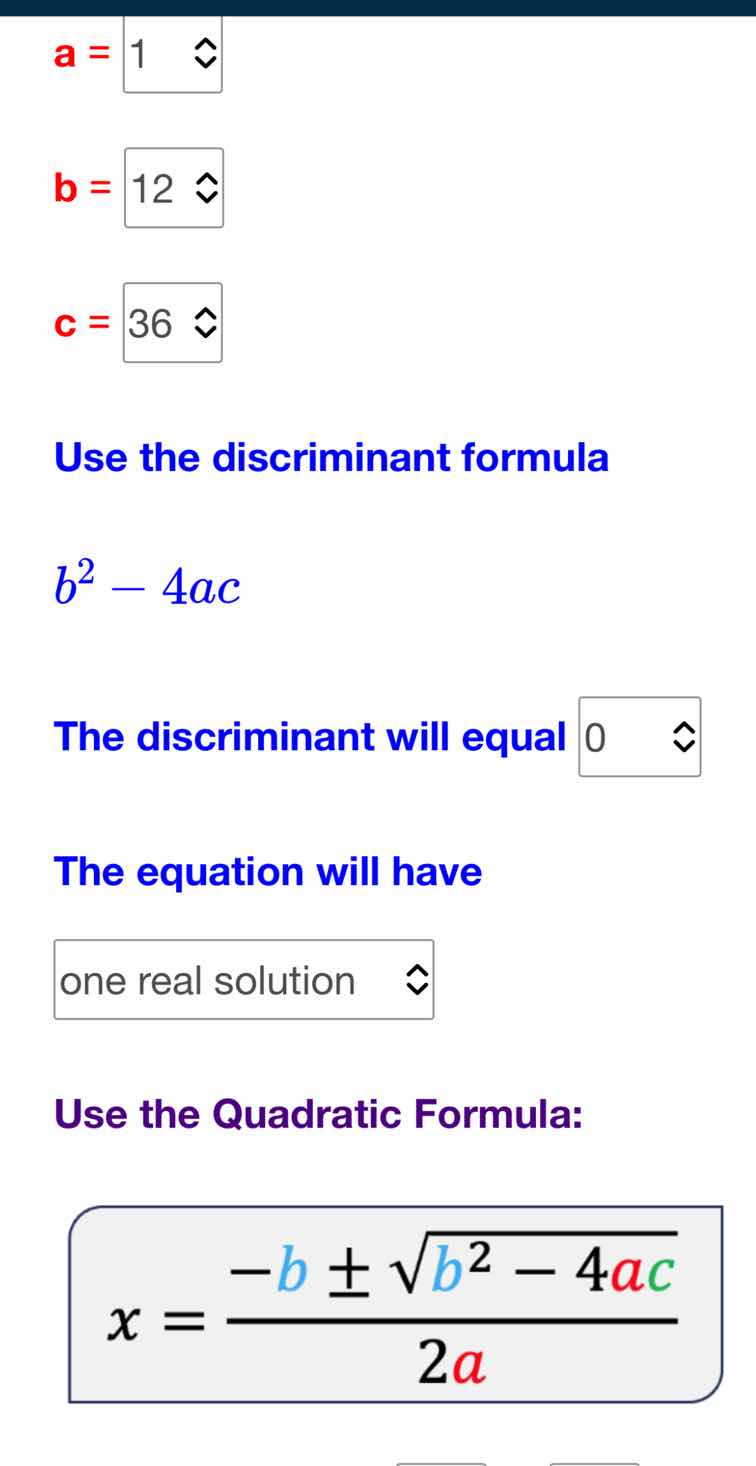
a = 1
b = 12
c = 36
use the discriminant formula
$b^2 - 4ac$
the discriminant will equal 0
the equation will have
one real solution
use the quadratic formula:
$x = \frac{-b \pm \sqrt{b^2 - 4ac}}{2a}$
Step1: Identify values of a, b, c
Given \( a = 1 \), \( b = 12 \), \( c = 36 \).
Step2: Substitute into discriminant formula
The discriminant formula is \( b^2 - 4ac \). Substitute the values:
\( (12)^2 - 4\times1\times36 \)
Step3: Calculate each term
First, \( 12^2 = 144 \), and \( 4\times1\times36 = 144 \).
Step4: Compute the discriminant
\( 144 - 144 = 0 \)
Step5: Analyze the number of solutions
For a quadratic equation \( ax^2 + bx + c = 0 \), if the discriminant \( D = 0 \), the equation has one real solution (a repeated root).
Step6: Use quadratic formula to find the root
The quadratic formula is \( x=\frac{-b\pm\sqrt{b^2 - 4ac}}{2a} \). Substitute \( a = 1 \), \( b = 12 \), \( c = 36 \) and \( b^2 - 4ac = 0 \):
\( x=\frac{-12\pm\sqrt{0}}{2\times1}=\frac{-12\pm0}{2}=-6 \)

Snap & solve any problem in the app
Get step-by-step solutions on Sovi AI
Photo-based solutions with guided steps
Explore more problems and detailed explanations
The discriminant is \( 0 \), the equation has one real solution (\( x = - 6 \) (a repeated root)).