QUESTION IMAGE
Question
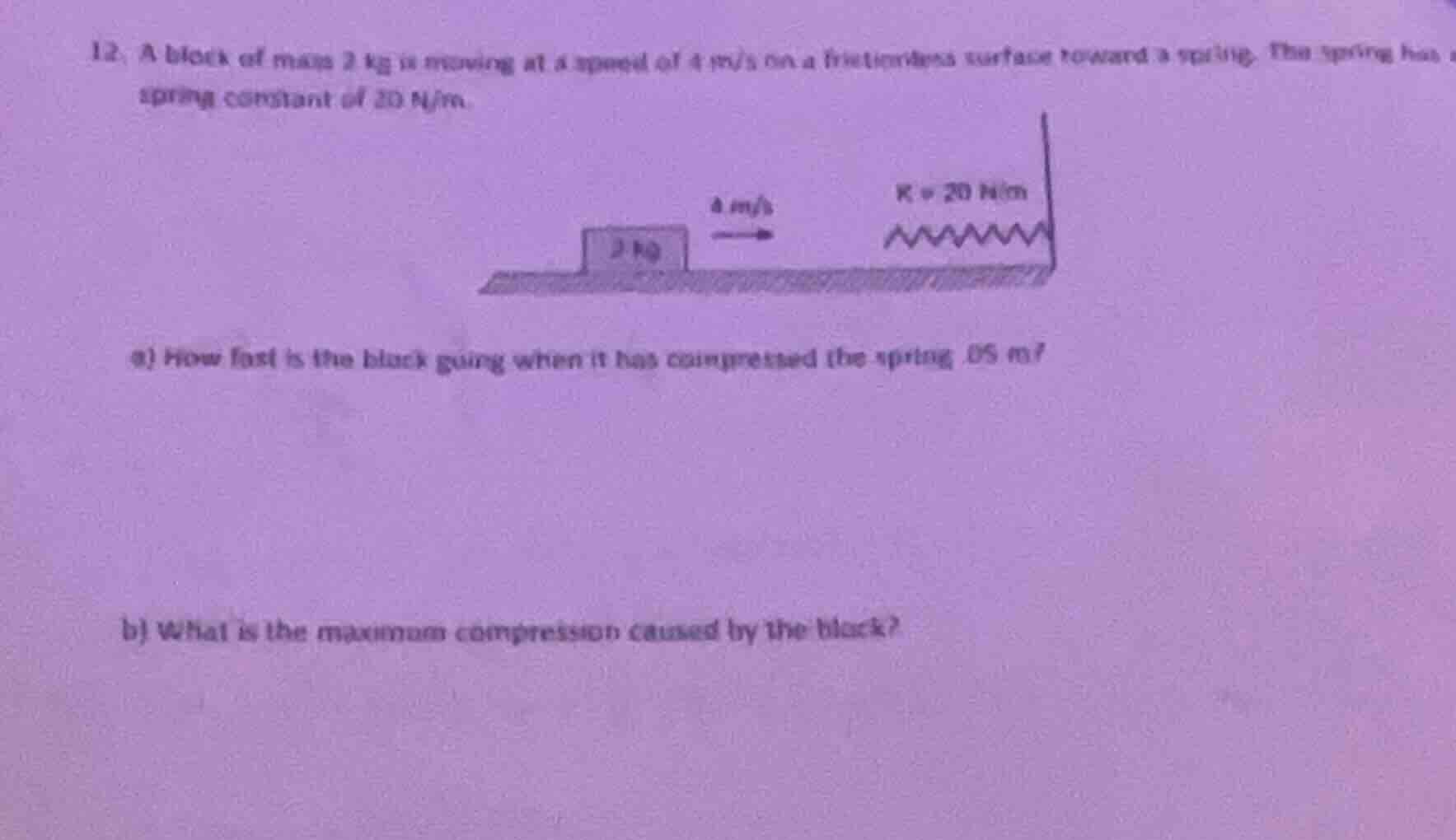
- a block of mass 2 kg is moving at a speed of 4 m/s on a frictionless surface toward a spring. the spring has a spring constant of 20 n/m.
a) how fast is the block going when it has compressed the spring 0.5 m?
b) what is the maximum compression caused by the block?
Part (a)
Step1: Identify Energy Conservation
We use the conservation of mechanical energy (kinetic + elastic potential). Initial energy: $KE_i = \frac{1}{2}mv_i^2$, final energy: $KE_f + PE_f = \frac{1}{2}mv_f^2 + \frac{1}{2}kx^2$. Set equal: $\frac{1}{2}mv_i^2 = \frac{1}{2}mv_f^2 + \frac{1}{2}kx^2$.
Step2: Plug in Values
Given $m = 2\,\text{kg}$, $v_i = 4\,\text{m/s}$, $k = 20\,\text{N/m}$, $x = 0.5\,\text{m}$. Cancel $\frac{1}{2}$: $mv_i^2 = mv_f^2 + kx^2$.
Step3: Solve for $v_f$
Rearrange: $mv_f^2 = mv_i^2 - kx^2$.
$v_f^2 = \frac{mv_i^2 - kx^2}{m}$.
Substitute: $v_f^2 = \frac{2(4)^2 - 20(0.5)^2}{2} = \frac{32 - 5}{2} = \frac{27}{2} = 13.5$.
$v_f = \sqrt{13.5} \approx 3.67\,\text{m/s}$.
Step1: Maximum Compression Condition
At maximum compression, $v_f = 0$, so all kinetic energy converts to elastic potential energy: $\frac{1}{2}mv_i^2 = \frac{1}{2}kx_{max}^2$.
Step2: Solve for $x_{max}$
Cancel $\frac{1}{2}$: $mv_i^2 = kx_{max}^2$.
$x_{max}^2 = \frac{mv_i^2}{k}$.
Substitute: $x_{max}^2 = \frac{2(4)^2}{20} = \frac{32}{20} = 1.6$.
$x_{max} = \sqrt{1.6} \approx 1.26\,\text{m}$.

Snap & solve any problem in the app
Get step-by-step solutions on Sovi AI
Photo-based solutions with guided steps
Explore more problems and detailed explanations
$\approx 3.67\,\text{m/s}$