QUESTION IMAGE
Question
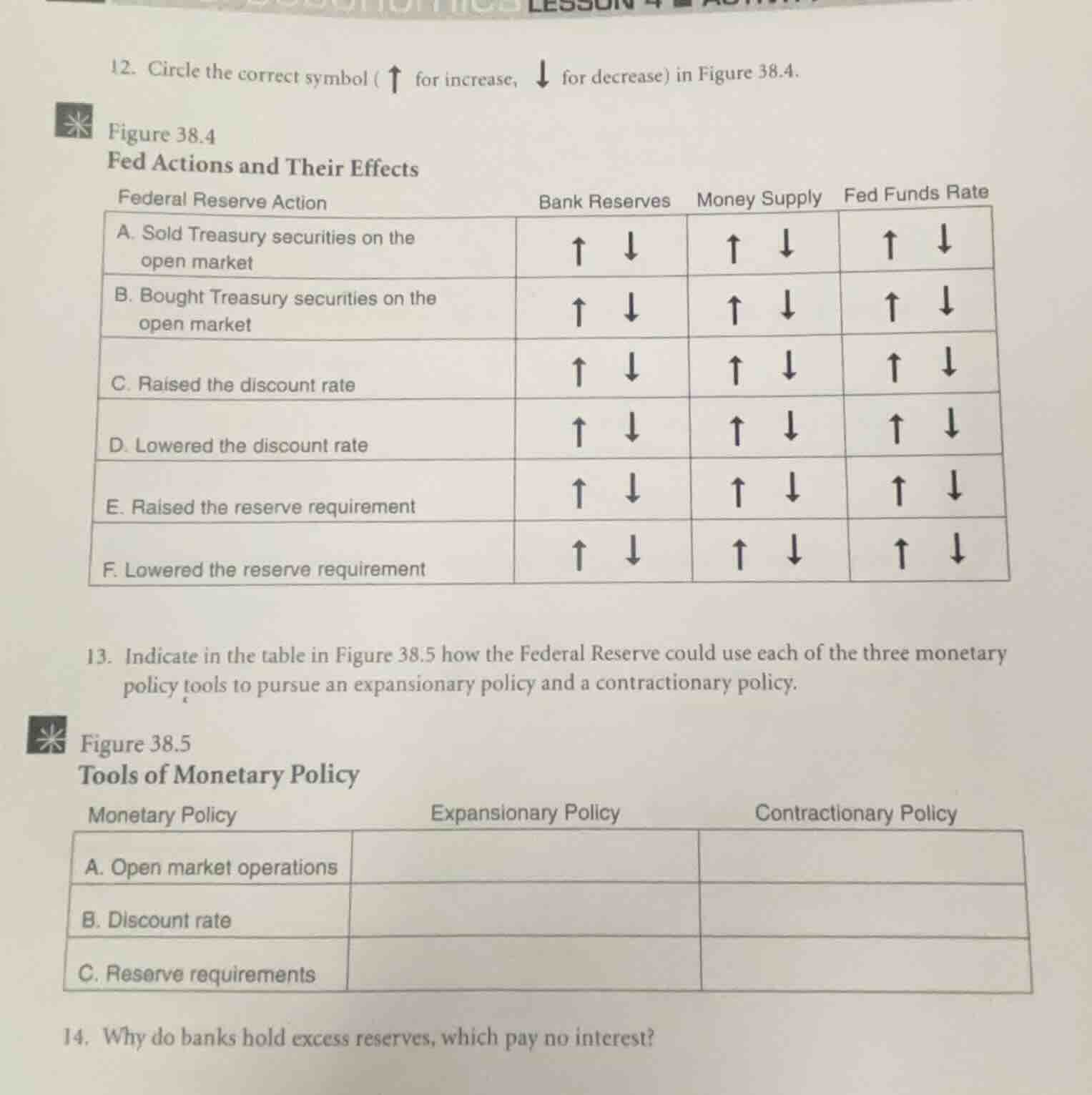
- circle the correct symbol ( ↑ for increase, ↓ for decrease) in figure 38.4.
figure 38.4
fed actions and their effects
federal reserve action | bank reserves | money supply | fed funds rate
a. sold treasury securities on the open market | ↑ ↓ | ↑ ↓ | ↑ ↓
b. bought treasury securities on the open market | ↑ ↓ | ↑ ↓ | ↑ ↓
c. raised the discount rate | ↑ ↓ | ↑ ↓ | ↑ ↓
d. lowered the discount rate | ↑ ↓ | ↑ ↓ | ↑ ↓
e. raised the reserve requirement | ↑ ↓ | ↑ ↓ | ↑ ↓
f. lowered the reserve requirement | ↑ ↓ | ↑ ↓ | ↑ ↓
- indicate in the table in figure 38.5 how the federal reserve could use each of the three monetary policy tools to pursue an expansionary policy and a contractionary policy.
figure 38.5
tools of monetary policy
monetary policy | expansionary policy | contractionary policy
a. open market operations | |
b. discount rate | |
c. reserve requirements | |
- why do banks hold excess reserves, which pay no interest?
Question 12
Step1: Analyze open market sale
When the Fed sells Treasury securities, banks pay for them, so bank reserves decrease, money supply decreases, and the fed funds rate increases.
- Bank Reserves: $\boldsymbol{\downarrow}$
- Money Supply: $\boldsymbol{\downarrow}$
- Fed Funds Rate: $\boldsymbol{\uparrow}$
Step2: Analyze open market purchase
When the Fed buys Treasury securities, it injects money into banks, so bank reserves increase, money supply increases, and the fed funds rate decreases.
- Bank Reserves: $\boldsymbol{\uparrow}$
- Money Supply: $\boldsymbol{\uparrow}$
- Fed Funds Rate: $\boldsymbol{\downarrow}$
Step3: Analyze raised discount rate
A higher discount rate makes borrowing from the Fed more expensive, so banks hold fewer reserves, money supply decreases, and fed funds rate increases.
- Bank Reserves: $\boldsymbol{\downarrow}$
- Money Supply: $\boldsymbol{\downarrow}$
- Fed Funds Rate: $\boldsymbol{\uparrow}$
Step4: Analyze lowered discount rate
A lower discount rate makes borrowing from the Fed cheaper, so banks hold more reserves, money supply increases, and fed funds rate decreases.
- Bank Reserves: $\boldsymbol{\uparrow}$
- Money Supply: $\boldsymbol{\uparrow}$
- Fed Funds Rate: $\boldsymbol{\downarrow}$
Step5: Analyze raised reserve requirement
A higher reserve requirement forces banks to hold more reserves, reducing lendable funds, so money supply decreases, and fed funds rate increases.
- Bank Reserves: $\boldsymbol{\uparrow}$
- Money Supply: $\boldsymbol{\downarrow}$
- Fed Funds Rate: $\boldsymbol{\uparrow}$
Step6: Analyze lowered reserve requirement
A lower reserve requirement lets banks hold fewer reserves, increasing lendable funds, so money supply increases, and fed funds rate decreases.
- Bank Reserves: $\boldsymbol{\downarrow}$
- Money Supply: $\boldsymbol{\uparrow}$
- Fed Funds Rate: $\boldsymbol{\downarrow}$
Expansionary monetary policy aims to increase the money supply and stimulate economic activity, while contractionary policy aims to reduce the money supply and slow down inflationary pressure. Each tool is adjusted accordingly to achieve these goals.
Banks hold excess reserves (non-interest-bearing) to manage liquidity risks, meet unexpected customer withdrawal demands, comply with potential emergency regulatory requirements, and avoid the costs of quickly borrowing funds in the short-term market if they face a sudden shortage of reserves.

Snap & solve any problem in the app
Get step-by-step solutions on Sovi AI
Photo-based solutions with guided steps
Explore more problems and detailed explanations
| Federal Reserve Action | Bank Reserves | Money Supply | Fed Funds Rate |
|---|---|---|---|
| B. Bought Treasury securities on the open market | $\boldsymbol{\uparrow}$ | $\boldsymbol{\uparrow}$ | $\boldsymbol{\downarrow}$ |
| C. Raised the discount rate | $\boldsymbol{\downarrow}$ | $\boldsymbol{\downarrow}$ | $\boldsymbol{\uparrow}$ |
| D. Lowered the discount rate | $\boldsymbol{\uparrow}$ | $\boldsymbol{\uparrow}$ | $\boldsymbol{\downarrow}$ |
| E. Raised the reserve requirement | $\boldsymbol{\uparrow}$ | $\boldsymbol{\downarrow}$ | $\boldsymbol{\uparrow}$ |
| F. Lowered the reserve requirement | $\boldsymbol{\downarrow}$ | $\boldsymbol{\uparrow}$ | $\boldsymbol{\downarrow}$ |
---