QUESTION IMAGE
Question
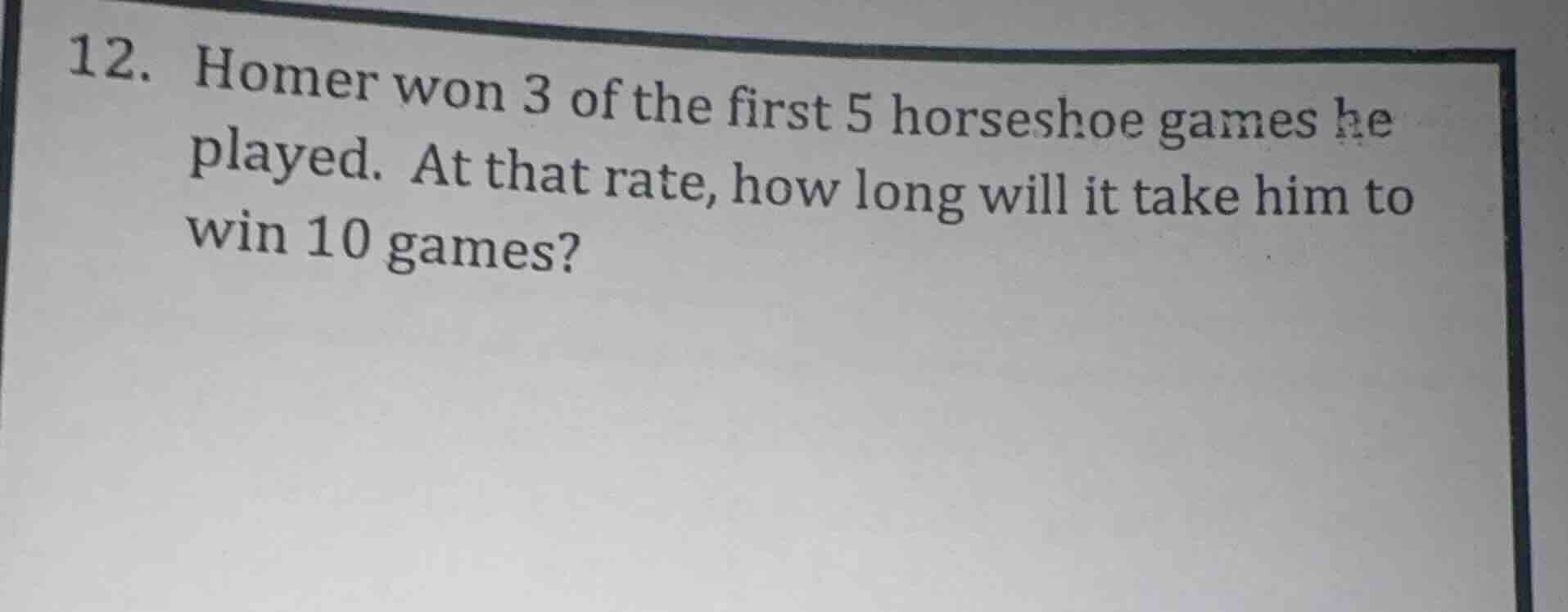
- homer won 3 of the first 5 horseshoe games he played. at that rate, how long will it take him to win 10 games?
Step1: Define the rate of winning
The rate of winning is the number of wins divided by the number of games played. So, the rate \( r = \frac{3}{5} \) (wins per game).
Step2: Set up a proportion to find the number of games needed to win 10 games
Let \( x \) be the number of games needed to win 10 games. We can set up the proportion: \( \frac{3}{5}=\frac{10}{x} \)
Step3: Cross - multiply to solve for \( x \)
Cross - multiplying gives us \( 3x = 10\times5 \), which simplifies to \( 3x=50 \). Then, we solve for \( x \) by dividing both sides of the equation by 3: \( x=\frac{50}{3}\approx16.67 \). But since we are talking about the number of games (and we assume we can't play a fraction of a game in the context of "how long it will take" in terms of number of games), we can also think in terms of the rate of games per win. The number of games per win is \( \frac{5}{3} \) games per win. To get 10 wins, we multiply the number of games per win by the number of wins: \( \frac{5}{3}\times10=\frac{50}{3}\approx16.67 \). If we consider that we need to play whole games, we would need to play 17 games to win 10 (since in 16 games, the number of wins would be \( 16\times\frac{3}{5} = 9.6\) which is less than 10, and in 17 games, \( 17\times\frac{3}{5}=10.2\) which is more than 10). But if we just go by the proportion without considering whole games, the value is \( \frac{50}{3}\) or approximately 16.67. However, the problem says "at that rate", and the rate is a ratio, so we can solve the proportion as a linear equation.
From \( \frac{3}{5}=\frac{10}{x} \), cross - multiply: \( 3x = 50 \), so \( x=\frac{50}{3}\approx16.67 \). But if we assume that the "rate" is in terms of games per win, the number of games required to get 10 wins is \( \frac{5}{3}\times10=\frac{50}{3}\approx16.67 \).

Snap & solve any problem in the app
Get step-by-step solutions on Sovi AI
Photo-based solutions with guided steps
Explore more problems and detailed explanations
The number of games (or the "time" in terms of number of games) it will take him to win 10 games is \( \frac{50}{3}\) (or approximately 16.67) games. If we consider whole games, it will take him 17 games (since 16 games would give him 9.6 wins and 17 games would give him 10.2 wins). But based on the proportion without considering whole - game approximation, the answer is \( \frac{50}{3}\approx16.67 \) games. If we follow the proportion strictly, \( x = \frac{50}{3}\) or approximately 16.7 games.