QUESTION IMAGE
Question
12.7 quiz analyze the declaration
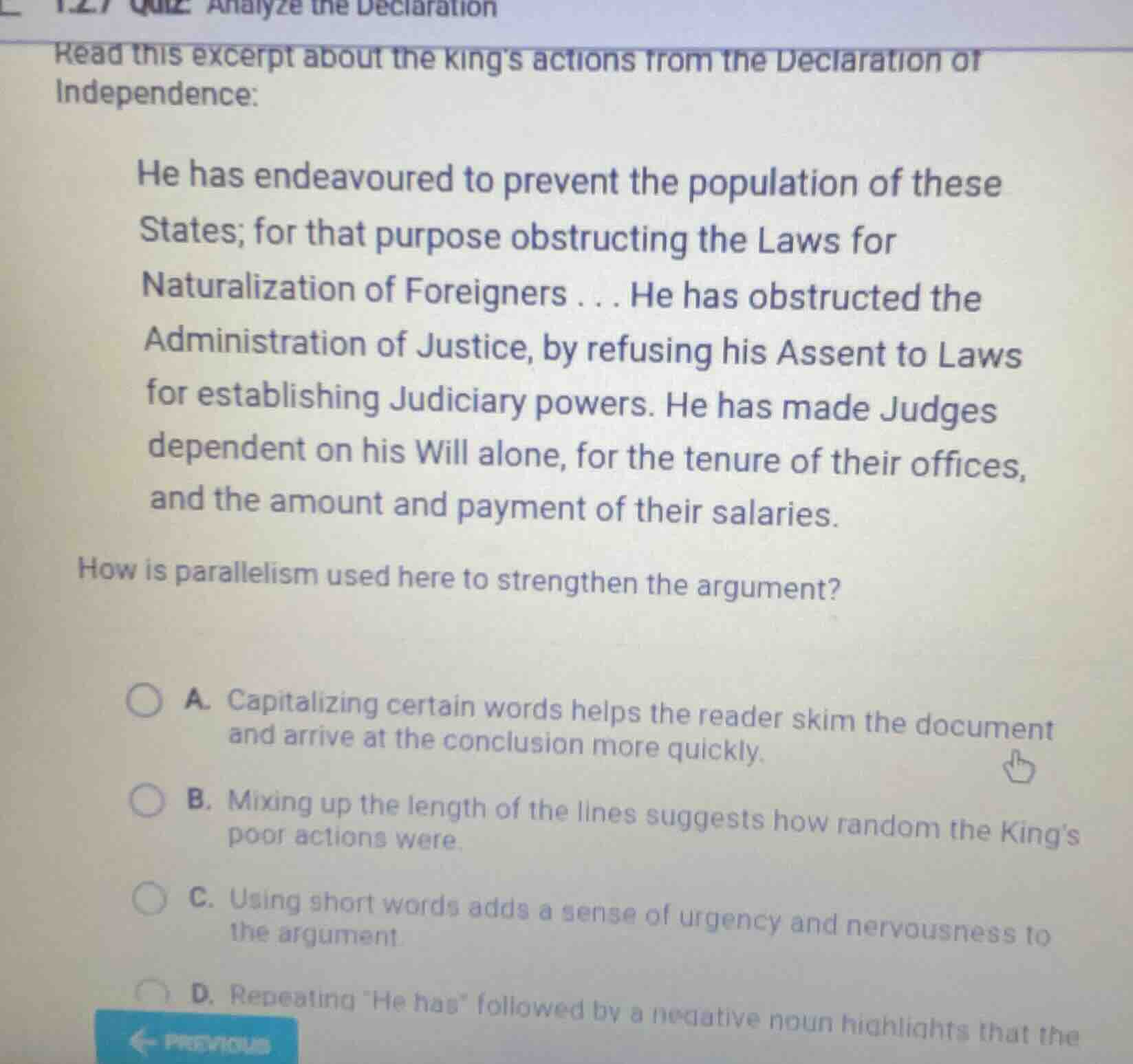
read this excerpt about the king’s actions from the declaration of independence:
he has endeavoured to prevent the population of these states; for that purpose obstructing the laws for naturalization of foreigners... he has obstructed the administration of justice, by refusing his assent to laws for establishing judiciary powers. he has made judges dependent on his will alone, for the tenure of their offices, and the amount and payment of their salaries.
how is parallelism used here to strengthen the argument?
a. capitalizing certain words helps the reader skim the document and arrive at the conclusion more quickly.
b. mixing up the length of the lines suggests how random the king’s poor actions were.
c. using short words adds a sense of urgency and nervousness to the argument.
d. repeating “he has” followed by a negative noun highlights that the
Parallelism here relies on the repeated grammatical structure of "He has + [action]". Option D correctly identifies that this repetition of "He has" paired with descriptions of the king's harmful, negative actions creates a rhythmic, cumulative effect. It emphasizes the sheer number of the king's offenses, making the argument against him more structured, forceful, and memorable for the reader. The other options are incorrect: A refers to capitalization, not parallelism; B contradicts parallelism's consistent structure; C focuses on word length, not the repeated phrase structure.

Snap & solve any problem in the app
Get step-by-step solutions on Sovi AI
Photo-based solutions with guided steps
Explore more problems and detailed explanations
D. Repeating "He has" followed by a negative noun highlights that the (complete intended meaning: king has committed a pattern of unjust, harmful acts, strengthening the argument for independence)