QUESTION IMAGE
Question
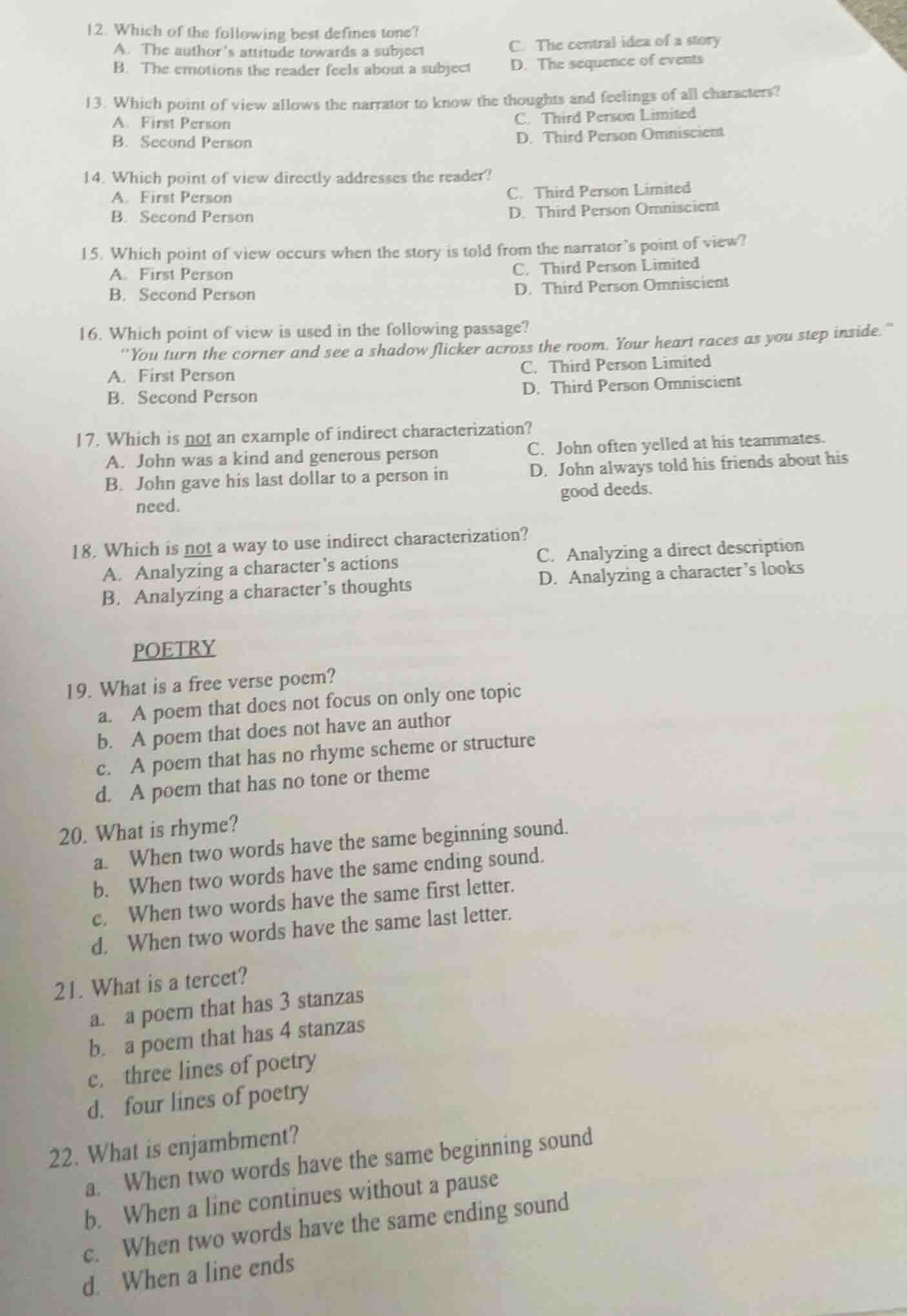
- which of the following best defines tone?
a. the author’s attitude towards a subject
c. the central idea of a story
b. the emotions the reader feels about a subject
d. the sequence of events
- which point of view allows the narrator to know the thoughts and feelings of all characters?
a. first person
c. third person limited
b. second person
d. third person omniscient
- which point of view directly addresses the reader?
a. first person
c. third person limited
b. second person
d. third person omniscient
- which point of view occurs when the story is told from the narrator’s point of view?
a. first person
c. third person limited
b. second person
d. third person omniscient
- which point of view is used in the following passage?
“you turn the corner and see a shadow flicker across the room. your heart races as you step inside.”
a. first person
c. third person limited
b. second person
d. third person omniscient
- which is not an example of indirect characterization?
a. john was a kind and generous person
c. john often yelled at his teammates.
b. john gave his last dollar to a person in
d. john always told his friends about his
eed. good deeds.
- which is not a way to use indirect characterization?
a. analyzing a character’s actions
c. analyzing a direct description
b. analyzing a character’s thoughts
d. analyzing a character’s looks
poetry
- what is a free verse poem?
a. a poem that does not focus on only one topic
b. a poem that does not have an author
c. a poem that has no rhyme scheme or structured. a poem that has no tone or theme
- what is rhyme?
a. when two words have the same beginning sound.
b. when two words have the same ending sound.
c. when two words have the same first letter.
d. when two words have the same last letter.
- what is a tercet?
a. a poem that has 3 stanzas
b. a poem that has 4 stanzas
c. three lines of poetry
d. four lines of poetry
- what is enjambment?
a. when two words have the same beginning sound
b. when a line continues without a pause
c. when two words have the same ending sound
d. when a line ends
- Q12: Tone refers to the author's attitude toward their subject, distinct from reader emotion (mood), central idea (theme), or plot sequence.
- Q13: Third Person Omniscient narrators have full access to all characters' inner thoughts and feelings, unlike limited or first/second person.
- Q14: Second Person directly addresses the reader using "you", making the reader part of the narrative.
- Q15: First Person uses a narrator sharing their own personal perspective of the story.
- Q16: The passage uses "you", which is the defining feature of Second Person point of view.
- Q17: Indirect characterization shows traits through actions/words; direct characterization states traits explicitly (e.g., "John was kind").
- Q18: Indirect characterization analyzes implicit cues (actions, thoughts, looks); direct descriptions are explicit, not indirect.
- Q19: Free verse poetry lacks a fixed rhyme scheme or formal structural rules like meter.
- Q20: Rhyme is defined by words sharing matching ending sounds.
- Q21: A tercet is a single unit of three lines of poetry, not a poem with 3 stanzas.
- Q22: Enjambment is when a line of poetry continues to the next line without a grammatical pause (like a period or comma).

Snap & solve any problem in the app
Get step-by-step solutions on Sovi AI
Photo-based solutions with guided steps
Explore more problems and detailed explanations
- A. The author's attitude towards a subject
- D. Third Person Omniscient
- B. Second Person
- A. First Person
- B. Second Person
- A. John was a kind and generous person
- C. Analyzing a direct description
- c. A poem that has no rhyme scheme or structure
- b. When two words have the same ending sound.
- c. three lines of poetry
- b. When a line continues without a pause