QUESTION IMAGE
Question
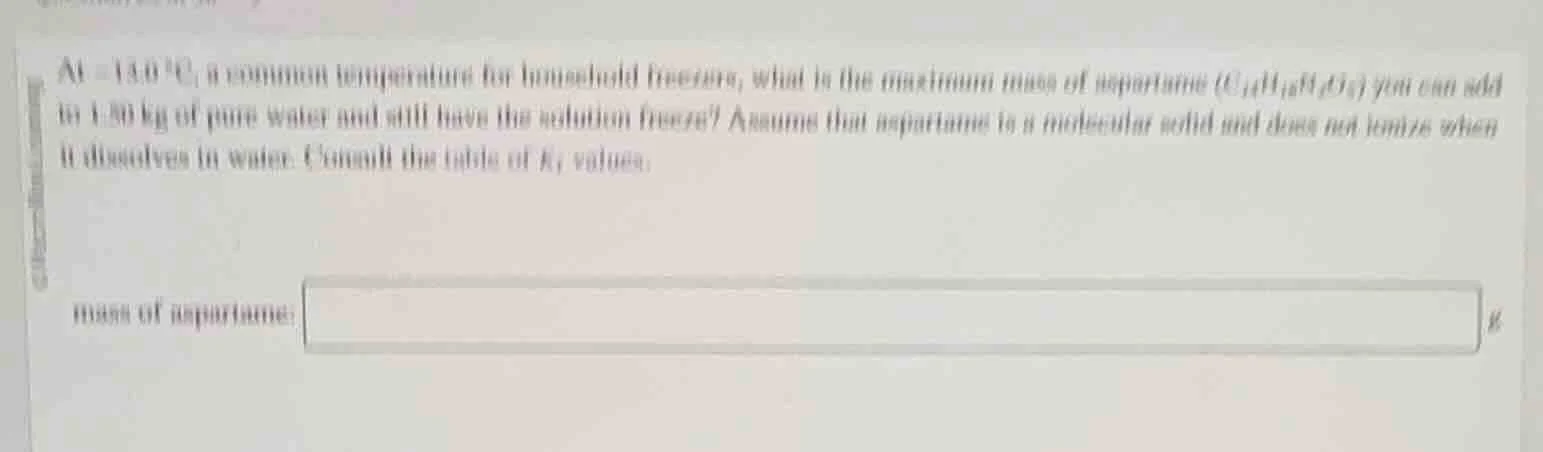
at -13.0 °c, a common temperature for household freezers, what is the maximum mass of aspartame (c₁₄h₁₈n₂o₅) you can add to 1.50 kg of pure water and still have the solution freeze? assume that aspartame is a molecular solid and does not ionize when it dissolves in water. consult the table of $k_f$ values:
mass of aspartame: ______ g
Step1: Define freezing point depression
The freezing point of pure water is $0^\circ\text{C}$, so the freezing point depression $\Delta T_f$ is:
$\Delta T_f = 0^\circ\text{C} - (-13.0^\circ\text{C}) = 13.0^\circ\text{C}$
Step2: Recall freezing point formula
For non-ionizing solutes, $\Delta T_f = K_f \times m$, where $K_f$ for water is $1.86^\circ\text{C}\cdot\text{kg/mol}$, and $m$ is molality. Rearrange to solve for $m$:
$m = \frac{\Delta T_f}{K_f} = \frac{13.0^\circ\text{C}}{1.86^\circ\text{C}\cdot\text{kg/mol}} \approx 6.9893\ \text{mol/kg}$
Step3: Calculate moles of aspartame
Molality $m = \frac{\text{moles of solute}}{\text{mass of solvent (kg)}}$. Rearrange to find moles:
$\text{Moles of aspartame} = m \times \text{mass of water} = 6.9893\ \text{mol/kg} \times 1.50\ \text{kg} \approx 10.484\ \text{mol}$
Step4: Find molar mass of aspartame
Aspartame formula: $\text{C}_{14}\text{H}_{18}\text{N}_2\text{O}_5$. Molar mass:
$M = (14\times12.01) + (18\times1.008) + (2\times14.01) + (5\times16.00) = 168.14 + 18.144 + 28.02 + 80.00 = 294.304\ \text{g/mol}$
Step5: Calculate mass of aspartame
$\text{Mass} = \text{moles} \times M = 10.484\ \text{mol} \times 294.304\ \text{g/mol} \approx 3085\ \text{g}$

Snap & solve any problem in the app
Get step-by-step solutions on Sovi AI
Photo-based solutions with guided steps
Explore more problems and detailed explanations
3090 g (rounded to 3 significant figures)