QUESTION IMAGE
Question
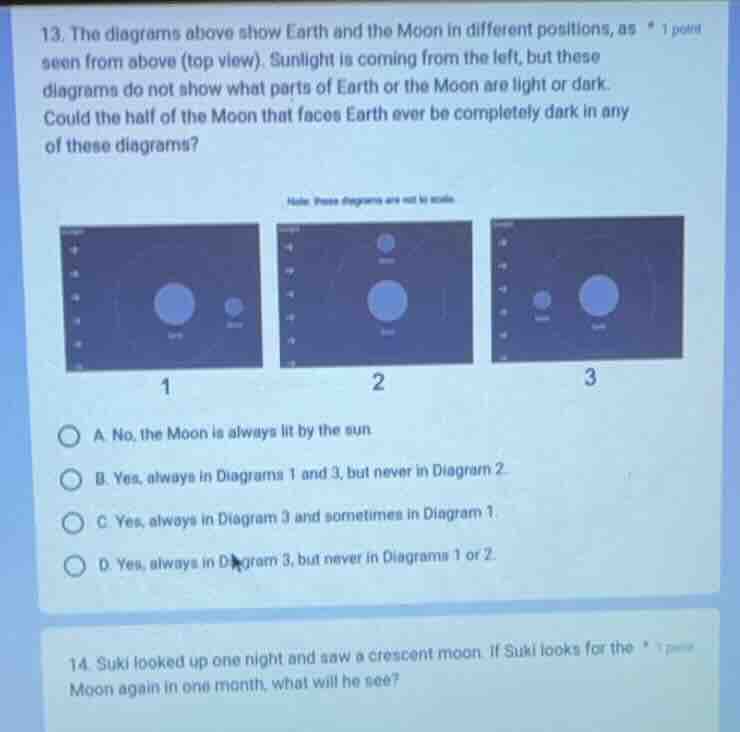
- the diagrams above show earth and the moon in different positions, as seen from above (top view). sunlight is coming from the left, but these diagrams do not show what parts of earth or the moon are light or dark. could the half of the moon that faces earth ever be completely dark in any of these diagrams? note: these diagrams are not to scale. a. no, the moon is always lit by the sun. b. yes, always in diagrams 1 and 3, but never in diagram 2. c. yes, always in diagram 3 and sometimes in diagram 1. d. yes, always in diagram 3, but never in diagrams 1 or 2. 14. suki looked up one night and saw a crescent moon. if suki looks for the moon again in one month, what will he see?
For Question 13:
The side of the Moon facing Earth is completely dark only when the Moon is positioned between the Sun and Earth (a new moon configuration). In Diagram 3, the Moon is directly between Earth and the incoming sunlight (from the left), so its Earth-facing side is always fully dark. In Diagram 1, the Moon is to Earth's right: sunlight hits the Moon's right side, so its Earth-facing side has some illumination, never full darkness. In Diagram 2, the Moon is above Earth, so sunlight hits its left side, leaving its Earth-facing side partially lit, never fully dark.
The Moon's lunar cycle (from one phase to the same phase again) takes approximately 29.5 days, which is roughly one month. This means after one month, the Moon will return to the same phase it was in when Suki first observed it.

Snap & solve any problem in the app
Get step-by-step solutions on Sovi AI
Photo-based solutions with guided steps
Explore more problems and detailed explanations
D. Yes, always in Diagram 3, but never in Diagrams 1 or 2.
---