QUESTION IMAGE
Question
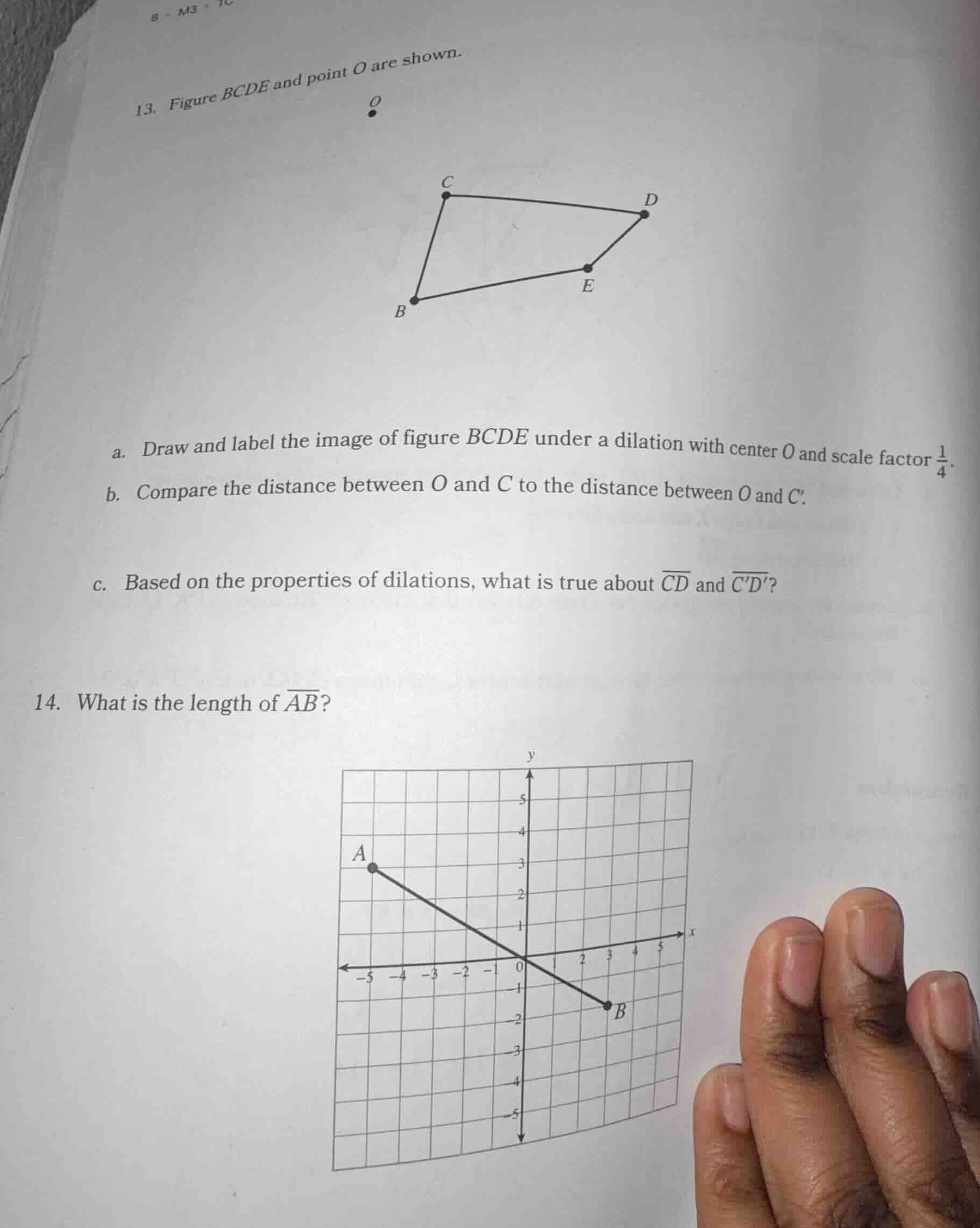
- figure bcde and point o are shown.
a. draw and label the image of figure bcde under a dilation with center o and scale factor \\(\frac{1}{4}\\).
b. compare the distance between o and c to the distance between o and c.
c. based on the properties of dilations, what is true about \\(\overline{cd}\\) and \\(\overline{cd}\\)?
- what is the length of \\(\overline{ab}\\)?
For Question 13:
a. To draw the dilated figure \(BCDE'\):
- Draw lines from center \(O\) through each vertex \(B, C, D, E\).
- On each line, mark a new point \(B', C', D', E'\) such that the distance from \(O\) to the new point is \(\frac{1}{4}\) the distance from \(O\) to the original vertex.
- Connect \(B', C', D', E'\) to form the dilated quadrilateral.
b. Dilations scale all distances from the center by the scale factor. The distance \(OC'\) is \(\frac{1}{4}\) the length of \(OC\), or \(OC = 4 \times OC'\).
c. Dilations preserve the direction (parallelism) of line segments and scale their lengths by the scale factor. So \(\overline{CD} \parallel \overline{C'D'}\), and the length of \(\overline{C'D'}\) is \(\frac{1}{4}\) the length of \(\overline{CD}\).
Step1: Identify coordinates of A, B
Point \(A = (-4, 3)\), Point \(B = (2, -2)\)
Step2: Apply distance formula
The distance formula is \(d = \sqrt{(x_2-x_1)^2 + (y_2-y_1)^2}\)
Substitute values:
\(d = \sqrt{(2 - (-4))^2 + (-2 - 3)^2}\)
Step3: Simplify the expression
\(d = \sqrt{(6)^2 + (-5)^2} = \sqrt{36 + 25} = \sqrt{61}\)

Snap & solve any problem in the app
Get step-by-step solutions on Sovi AI
Photo-based solutions with guided steps
Explore more problems and detailed explanations
a. (Drawn figure: Quadrilateral \(B'C'D'E'\) smaller than \(BCDE\), centered around \(O\), with each vertex on the line from \(O\) to the original vertex, \(\frac{1}{4}\) the distance from \(O\) to the original vertex)
b. The distance between \(O\) and \(C'\) is \(\frac{1}{4}\) the distance between \(O\) and \(C\).
c. \(\overline{CD}\) is parallel to \(\overline{C'D'}\), and \(C'D' = \frac{1}{4}CD\).
---