QUESTION IMAGE
Question
- -/1 points
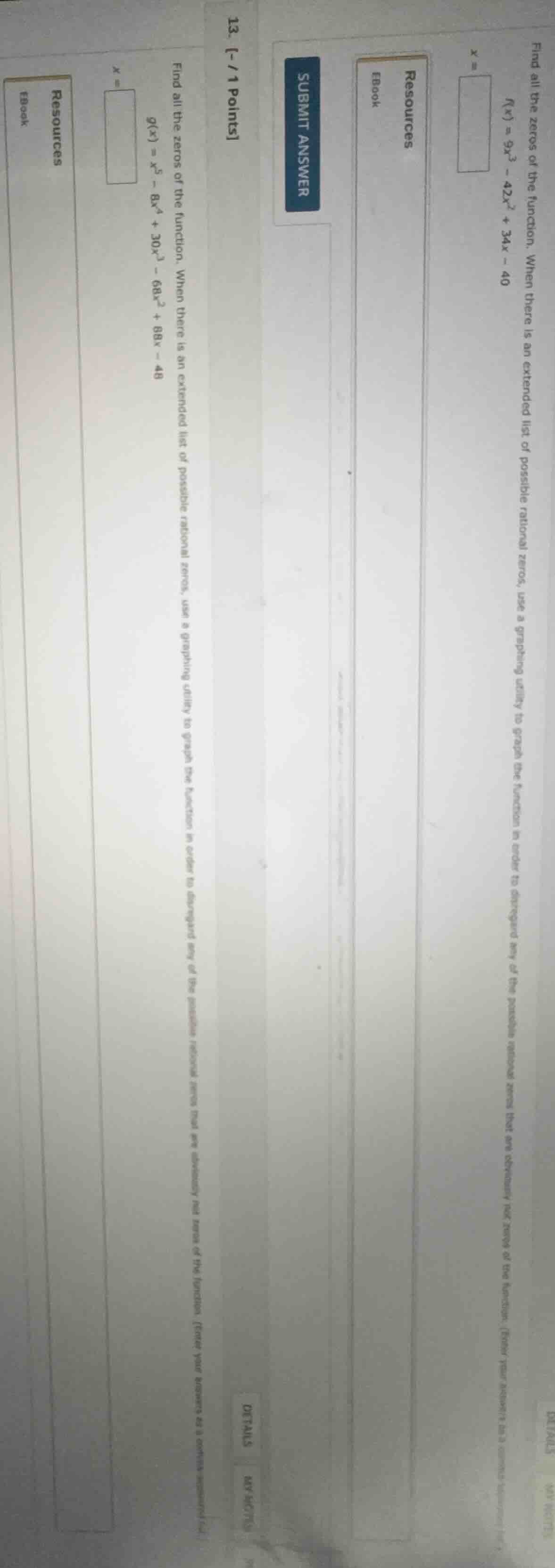
find all the zeros of the function. when there is an extended list of possible rational zeros, use a graphing utility to graph the function in order to disregard any of the possible rational zeros that are obviously not zeros of the function. (enter your answers as a comma-separated list)
$f(x) = 9x^{3} - 42x^{2} + 34x - 40$
$x = square$
find all the zeros of the function. when there is an extended list of possible rational zeros, use a graphing utility to graph the function in order to disregard any of the possible rational zeros that are obviously not zeros of the function. (enter your answers as a comma-separated list)
$g(x) = x^{5} - 8x^{4} + 30x^{3} - 68x^{2} + 88x - 48$
$x = square$
submit answer
resources
ebook
resources
ebook
First Function: $f(x) = 9x^3 - 42x^2 + 34x - 40$
Step1: List possible rational zeros
By Rational Root Theorem, possible zeros are $\pm1, \pm2, \pm4, \pm5, \pm8, \pm10, \pm20, \pm40, \pm\frac{1}{3}, \pm\frac{2}{3}, \pm\frac{4}{3}, \pm\frac{5}{3}, \pm\frac{8}{3}, \pm\frac{10}{3}, \pm\frac{20}{3}, \pm\frac{40}{3}, \pm\frac{1}{9}, \pm\frac{2}{9}, \pm\frac{4}{9}, \pm\frac{5}{9}, \pm\frac{8}{9}, \pm\frac{10}{9}, \pm\frac{20}{9}, \pm\frac{40}{9}$
Step2: Test $x=4$ via synthetic division
Since remainder is 0, $x=4$ is a zero.
Step3: Factor quadratic and find roots
The reduced polynomial is $9x^2 -6x +10$. Use quadratic formula $x=\frac{-b\pm\sqrt{b^2-4ac}}{2a}$:
$$x=\frac{6\pm\sqrt{(-6)^2-4(9)(10)}}{2(9)}=\frac{6\pm\sqrt{36-360}}{18}=\frac{6\pm\sqrt{-324}}{18}=\frac{6\pm18i}{18}=\frac{1}{3}\pm i$$
Step1: List possible rational zeros
By Rational Root Theorem, possible zeros are $\pm1, \pm2, \pm3, \pm4, \pm6, \pm8, \pm12, \pm16, \pm24, \pm48$
Step2: Test $x=2$ via synthetic division
Remainder is 0, so $x=2$ is a zero.
Step3: Test $x=2$ again on reduced polynomial
Remainder is 0, so $x=2$ is a repeated zero.
Step4: Test $x=3$ on new reduced polynomial
Remainder is not 0. Test $x=2$ again:
Remainder is 0, so $x=2$ is a triple zero.
Step5: Factor quadratic and find roots
Reduced polynomial is $x^2-2x+6$. Use quadratic formula:
$$x=\frac{2\pm\sqrt{(-2)^2-4(1)(6)}}{2(1)}=\frac{2\pm\sqrt{4-24}}{2}=\frac{2\pm\sqrt{-20}}{2}=\frac{2\pm2i\sqrt{5}}{2}=1\pm i\sqrt{5}$$

Snap & solve any problem in the app
Get step-by-step solutions on Sovi AI
Photo-based solutions with guided steps
Explore more problems and detailed explanations
$x=4, \frac{1}{3}+i, \frac{1}{3}-i$
---