QUESTION IMAGE
Question
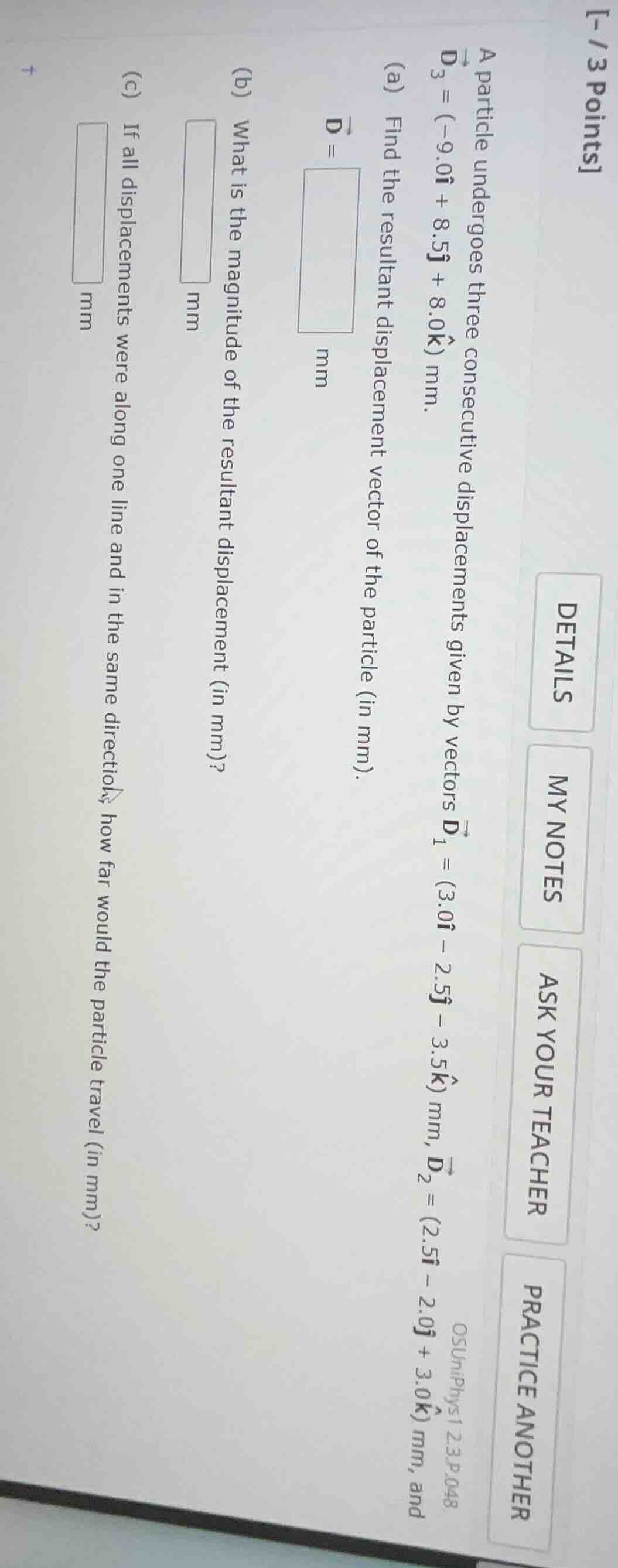
-13 points a particle undergoes three consecutive displacements given by vectors \\( \vec{d}_1 = (3.0\hat{i} - 2.5\hat{j} - 3.5\hat{k}) \\) mm, \\( \vec{d}_2 = (2.5\hat{i} - 2.0\hat{j} + 3.0\hat{k}) \\) mm, and \\( \vec{d}_3 = (-9.0\hat{i} + 8.5\hat{j} + 8.0\hat{k}) \\) mm. (a) find the resultant displacement vector of the particle (in mm). \\( \vec{d} = \\) \\( \square \\) mm (b) what is the magnitude of the resultant displacement (in mm)? \\( \square \\) mm (c) if all displacements were along one line and in the same direction, how far would the particle travel (in mm)? \\( \square \\) mm
Step1: Sum x-components
$D_x = 3.0 + 2.5 + (-9.0) = -3.5$
Step2: Sum y-components
$D_y = -2.5 + (-2.0) + 8.5 = 4.0$
Step3: Sum z-components
$D_z = -3.5 + 3.0 + 8.0 = 7.5$
Step4: Write resultant vector
$\vec{D} = -3.5\hat{\mathbf{i}} + 4.0\hat{\mathbf{j}} + 7.5\hat{\mathbf{k}}$
Step5: Calculate magnitude of $\vec{D}$
$|\vec{D}| = \sqrt{(-3.5)^2 + 4.0^2 + 7.5^2} = \sqrt{12.25 + 16 + 56.25} = \sqrt{84.5} \approx 9.19$
Step6: Sum magnitudes of all vectors
First, $|\vec{D_1}| = \sqrt{3.0^2 + (-2.5)^2 + (-3.5)^2} = \sqrt{9 + 6.25 + 12.25} = \sqrt{27.5} \approx 5.24$
$|\vec{D_2}| = \sqrt{2.5^2 + (-2.0)^2 + 3.0^2} = \sqrt{6.25 + 4 + 9} = \sqrt{19.25} \approx 4.39$
$|\vec{D_3}| = \sqrt{(-9.0)^2 + 8.5^2 + 8.0^2} = \sqrt{81 + 72.25 + 64} = \sqrt{217.25} \approx 14.74$
Total distance = $5.24 + 4.39 + 14.74 = 24.37$

Snap & solve any problem in the app
Get step-by-step solutions on Sovi AI
Photo-based solutions with guided steps
Explore more problems and detailed explanations
(a) $\vec{D} = -3.5\hat{\mathbf{i}} + 4.0\hat{\mathbf{j}} + 7.5\hat{\mathbf{k}}$ mm
(b) $9.19$ mm
(c) $24.37$ mm