QUESTION IMAGE
Question
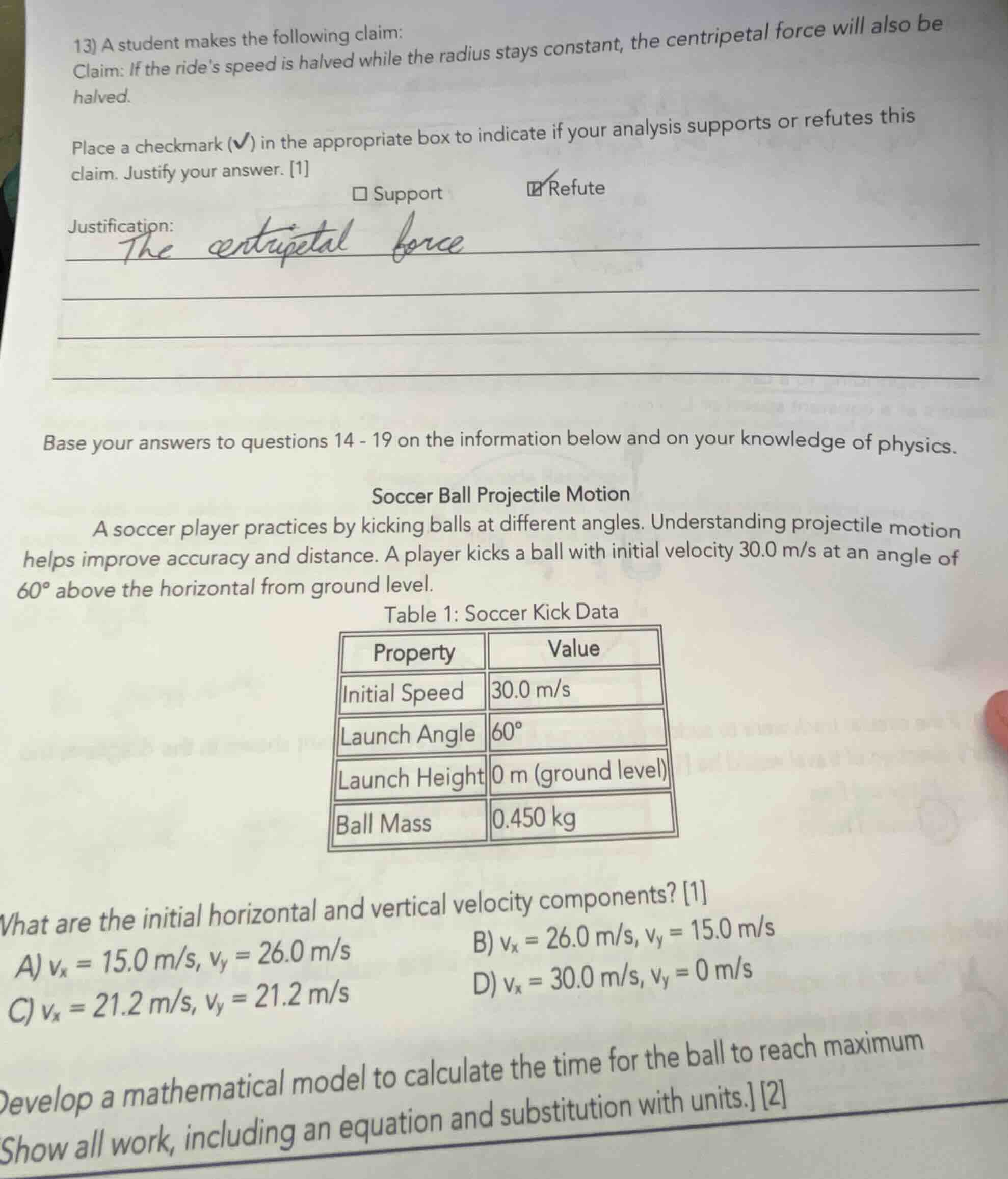
- a student makes the following claim:
claim: if the rides speed is halved while the radius stays constant, the centripetal force will also be halved.
place a checkmark (✓) in the appropriate box to indicate if your analysis supports or refutes this claim. justify your answer. 1
□ support
☑ refute
justification:
the centripetal force
base your answers to questions 14 - 19 on the information below and on your knowledge of physics.
soccer ball projectile motion
a soccer player practices by kicking balls at different angles. understanding projectile motion helps improve accuracy and distance. a player kicks a ball with initial velocity 30.0 m/s at an angle of 60° above the horizontal from ground level.
table 1: soccer kick data
| property | value |
|---|---|
| launch angle | 60° |
| launch height | 0 m (ground level) |
| ball mass | 0.450 kg |
what are the initial horizontal and vertical velocity components? 1
a) $v_x = 15.0$ m/s, $v_y = 26.0$ m/s
b) $v_x = 26.0$ m/s, $v_y = 15.0$ m/s
c) $v_x = 21.2$ m/s, $v_y = 21.2$ m/s
d) $v_x = 30.0$ m/s, $v_y = 0$ m/s
develop a mathematical model to calculate the time for the ball to reach maximum
show all work, including an equation and substitution with units.2
Question 13 Justification (Refute the Claim)
Step1: Recall Centripetal Force Formula
The formula for centripetal force is \( F_c = \frac{mv^2}{r} \), where \( m \) is mass, \( v \) is speed, and \( r \) is radius.
Step2: Analyze Effect of Halving Speed
If speed \( v \) is halved, new speed \( v' = \frac{v}{2} \). Substitute into the formula: \( F_c' = \frac{m(v')^2}{r} = \frac{m(\frac{v}{2})^2}{r} = \frac{mv^2}{4r} \).
Step3: Compare with Original Force
Original force \( F_c = \frac{mv^2}{r} \), so \( F_c' = \frac{F_c}{4} \). Thus, centripetal force is quartered, not halved.
Step1: Recall Velocity Component Formulas
For a projectile with initial velocity \( v_0 \) and angle \( \theta \), horizontal component \( v_x = v_0 \cos\theta \), vertical component \( v_y = v_0 \sin\theta \).
Step2: Substitute Values
Given \( v_0 = 30.0 \, \text{m/s} \), \( \theta = 60^\circ \).
\( \cos 60^\circ = 0.5 \), so \( v_x = 30.0 \times 0.5 = 15.0 \, \text{m/s} \).
\( \sin 60^\circ = \frac{\sqrt{3}}{2} \approx 0.866 \), so \( v_y = 30.0 \times 0.866 \approx 26.0 \, \text{m/s} \).
Step1: Recall Vertical Motion Formula
At maximum height, vertical velocity \( v_y = 0 \). The formula for vertical velocity is \( v_y = v_{y0} - gt \), where \( v_{y0} \) is initial vertical velocity, \( g = 9.8 \, \text{m/s}^2 \) (acceleration due to gravity), and \( t \) is time.
Step2: Solve for Time \( t \)
Rearrange the formula: \( 0 = v_{y0} - gt \Rightarrow t = \frac{v_{y0}}{g} \).
From earlier, \( v_{y0} = 30.0 \sin 60^\circ \approx 26.0 \, \text{m/s} \) (or use \( v_{y0} = 30.0 \times \frac{\sqrt{3}}{2} \approx 25.98 \, \text{m/s} \)).
Substitute \( v_{y0} \approx 25.98 \, \text{m/s} \) and \( g = 9.8 \, \text{m/s}^2 \): \( t = \frac{25.98}{9.8} \approx 2.65 \, \text{s} \).

Snap & solve any problem in the app
Get step-by-step solutions on Sovi AI
Photo-based solutions with guided steps
Explore more problems and detailed explanations
The centripetal force formula is \( F_c = \frac{mv^2}{r} \). If speed \( v \) is halved (\( v' = \frac{v}{2} \)) and \( r \), \( m \) are constant, \( F_c' = \frac{m(\frac{v}{2})^2}{r} = \frac{mv^2}{4r} = \frac{F_c}{4} \). So force is quartered, refuting the claim.