QUESTION IMAGE
Question
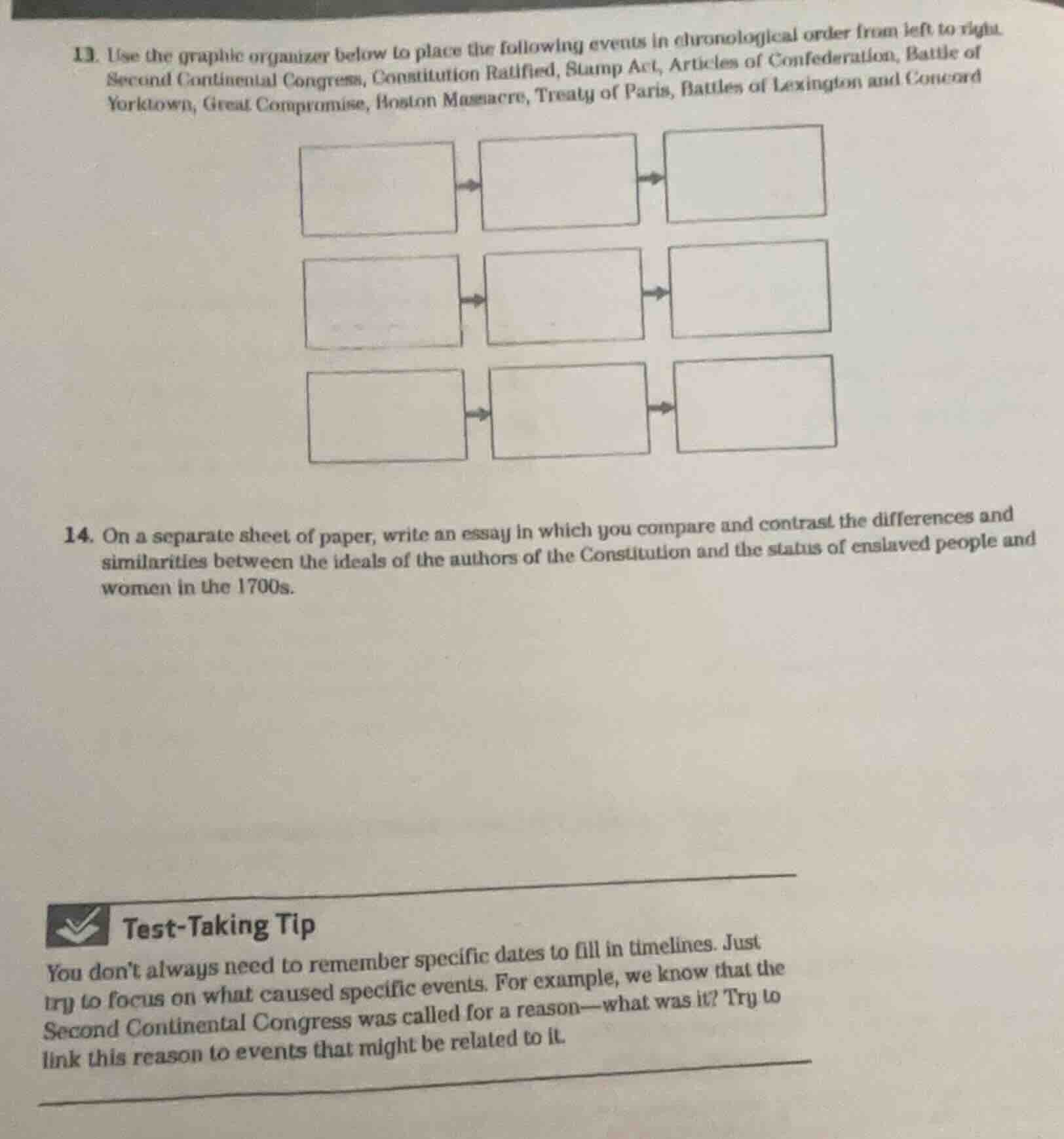
- use the graphic organizer below to place the following events in chronological order from left to right.second continental congress, constitution ratified, stamp act, articles of confederation, battle of yorktown, great compromise, boston massacre, treaty of paris, battles of lexington and concord14. on a separate sheet of paper, write an essay in which you compare and contrast the differences and similarities between the ideals of the authors of the constitution and the status of enslaved people and women in the 1700s.test-taking tipyou dont always need to remember specific dates to fill in timelines. justtry to focus on what caused specific events. for example, we know that thesecond continental congress was called for a reason—what was it? try tolink this reason to events that might be related to it.
For Question 13:
The events are ordered by their historical occurrence, based on the sequence of pre-Revolutionary, Revolutionary War, and post-war founding events of the United States.
For Question 14:
The essay would center on core Constitutional ideals like "life, liberty, and the pursuit of happiness" and "consent of the governed," then contrast these with the reality that enslaved people were legally property with no rights, and women had limited political, economic, and social rights (e.g., no voting, inability to own property in most cases). A similarity is that marginalized groups later used these very Constitutional ideals to advocate for their own rights.

Snap & solve any problem in the app
Get step-by-step solutions on Sovi AI
Photo-based solutions with guided steps
Explore more problems and detailed explanations
Question 13 (Chronological Order, left to right, top to bottom):
- Stamp Act
- Boston Massacre
- Battles of Lexington and Concord
- Second Continental Congress
- Articles of Confederation
- Battle of Yorktown
- Treaty of Paris
- Great Compromise
- Constitution Ratified
Question 14 (Essay Outline/Key Points):
- Introduction: State the core Constitutional ideals (e.g., self-governance, equality as written) and the gap between these ideals and the status of enslaved people and women in the 1700s.
- Similarities: The foundational ideals of liberty and self-rule would later be adopted by abolitionists and women's rights activists (e.g., using the Declaration of Independence/Constitution as a framework for their demands).
- Differences:
- Enslaved people: Classified as property via the Three-Fifths Compromise, denied all legal rights, subjected to chattel slavery, excluded from the "citizen" category the Constitution was designed to protect.
- Women: Could not vote, hold public office, own property in most states, were legally subordinate to their husbands, excluded from formal political participation despite being free citizens.
- Conclusion: Summarize that the Constitution's ideals were aspirational but not inclusive in practice, laying the groundwork for future social justice movements.