QUESTION IMAGE
Question
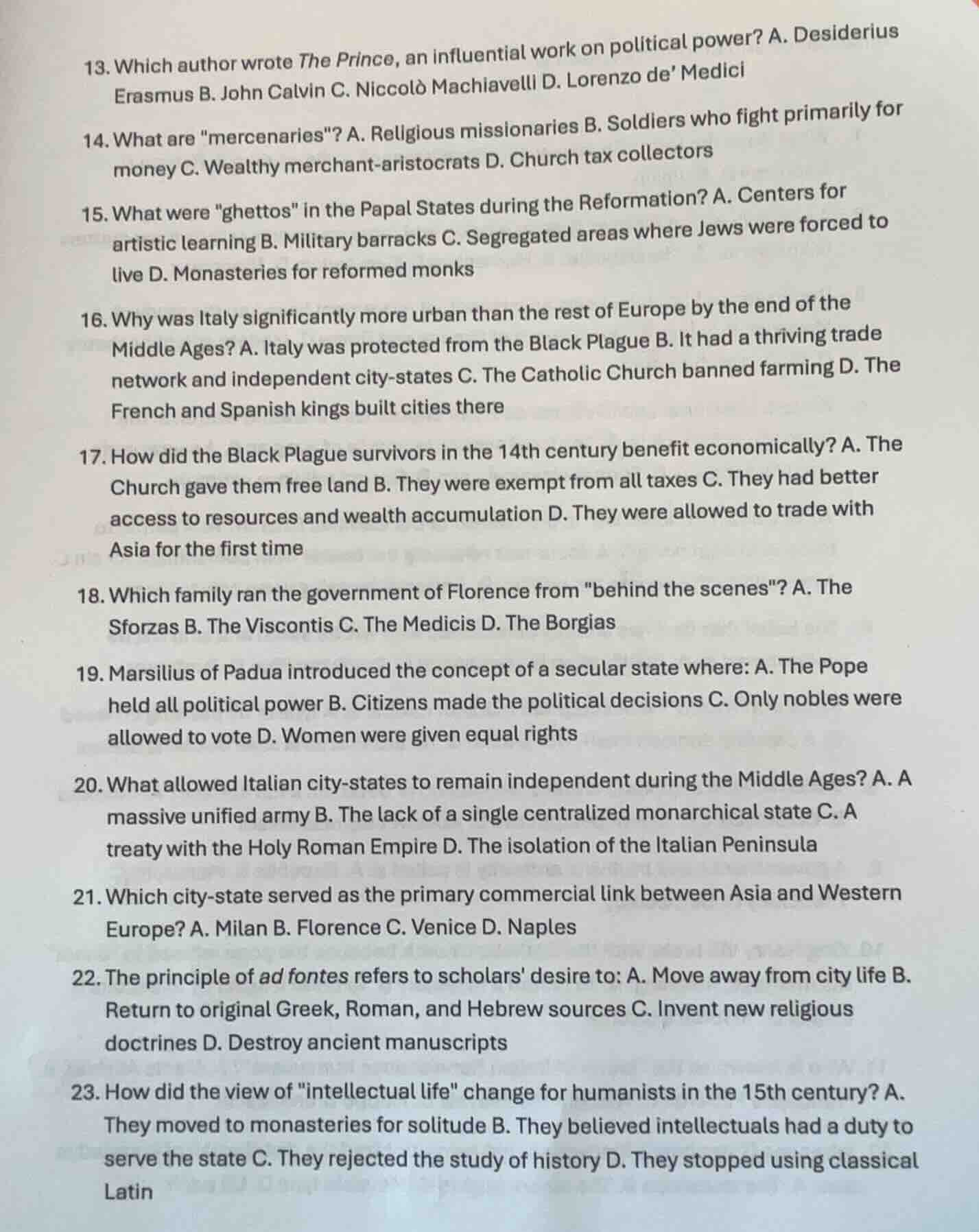
- which author wrote the prince, an influential work on political power? a. desiderius erasmus b. john calvin c. niccolò machiavelli d. lorenzo de’ medici
- what are \mercenaries\? a. religious missionaries b. soldiers who fight primarily for money c. wealthy merchant - aristocrats d. church tax collectors
- what were \ghettos\ in the papal states during the reformation? a. centers for artistic learning b. military barracks c. segregated areas where jews were forced to live d. monasteries for reformed monks
- why was italy significantly more urban than the rest of europe by the end of the middle ages? a. italy was protected from the black plague b. it had a thriving trade network and independent city - states c. the catholic church banned farming d. the french and spanish kings built cities there
- how did the black plague survivors in the 14th century benefit economically? a. the church gave them free land b. they were exempt from all taxes c. they had better access to resources and wealth accumulation d. they were allowed to trade with asia for the first time
- which family ran the government of florence from \behind the scenes\? a. the sforzas b. the viscontis c. the medicis d. the borgias
- marsilius of padua introduced the concept of a secular state where: a. the pope held all political power b. citizens made the political decisions c. only nobles were allowed to vote d. women were given equal rights
- what allowed italian city - states to remain independent during the middle ages? a. a massive unified army b. the lack of a single centralized monarchical state c. a treaty with the holy roman empire d. the isolation of the italian peninsula
- which city - state served as the primary commercial link between asia and western europe? a. milan b. florence c. venice d. naples
- the principle of ad fontes refers to scholars’ desire to: a. move away from city life b. return to original greek, roman, and hebrew sources c. invent new religious doctrines d. destroy ancient manuscripts
- how did the view of \intellectual life\ change for humanists in the 15th century? a. they moved to monasteries for solitude b. they believed intellectuals had a duty to serve the state c. they rejected the study of history d. they stopped using classical latin
Brief Explanations
- The Prince is a foundational work of political theory written by Niccolò Machiavelli.
- Mercenaries are defined as soldiers hired for pay, not out of loyalty.
- In the Papal States during the Reformation, ghettos were segregated residential areas enforced for Jewish communities.
- Italy's urbanization stemmed from its Mediterranean trade routes and independent, trade-focused city-states.
- The Black Plague killed a large portion of Europe's population, leaving survivors with more access to land, labor opportunities, and resources to accumulate wealth.
- The Medici family was the de facto ruling power of Florence, exerting control through wealth and influence rather than formal office.
- Marsilius of Padua's secular state theory argued for political authority to rest with citizens, not religious figures like the Pope.
- Italy lacked a single strong central monarchy, allowing city-states to maintain self-rule during the Middle Ages.
- Venice's maritime power and trade networks made it the key commercial hub connecting Asia and Western Europe.
- Ad fontes was a Renaissance humanist principle emphasizing return to original classical and religious source texts.
- 15th-century humanists believed intellectuals had a responsibility to engage with and serve their city-states.

Snap & solve any problem in the app
Get step-by-step solutions on Sovi AI
Photo-based solutions with guided steps
Explore more problems and detailed explanations
- C. Niccolò Machiavelli
- B. Soldiers who fight primarily for money
- C. Segregated areas where Jews were forced to live
- B. It had a thriving trade network and independent city-states
- C. They had better access to resources and wealth accumulation
- C. The Medicis
- B. Citizens made the political decisions
- B. The lack of a single centralized monarchical state
- C. Venice
- B. Return to original Greek, Roman, and Hebrew sources
- B. They believed intellectuals had a duty to serve the state