QUESTION IMAGE
Question
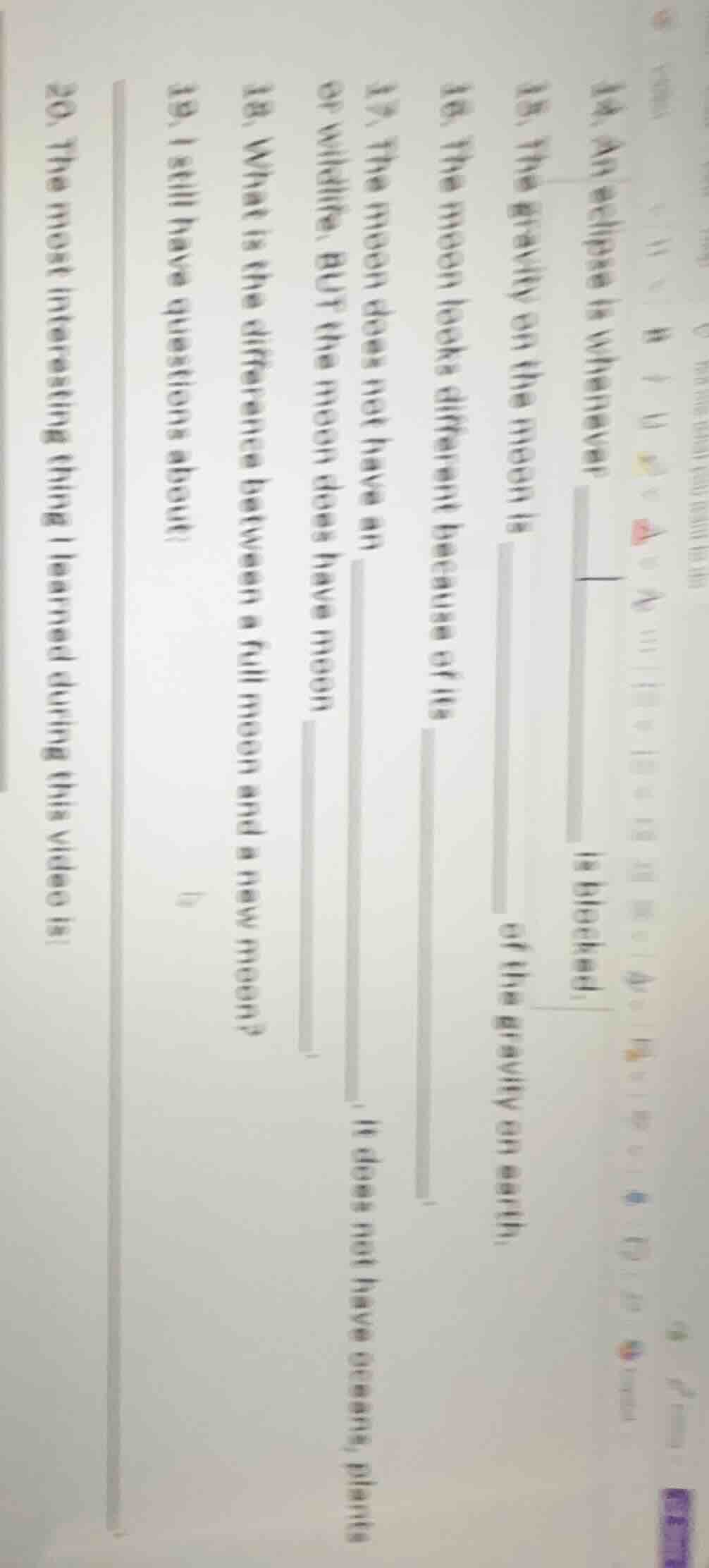
- an eclipse is whenever ____ is blocked. 15. the gravity on the moon is __ of the gravity on earth. 16. the moon looks different because of its __. 17. the moon does not have an __. it does not have oceans, plants or wildlife, but the moon does have moon __. 18. what is the difference between a full moon and a new moon? 19. i still have questions about: ____ 20. the most interesting thing i learned during this video is:
Question 14:
An eclipse (solar or lunar) occurs when the light from the sun (for solar) or the sun - moon - earth alignment (for lunar) causes one celestial body to be blocked. In a solar eclipse, the moon blocks the sun's light as seen from Earth. In a lunar eclipse, the Earth blocks the sun's light from reaching the moon. So the blank should be filled with "the sun (in solar eclipse) or the Earth (in lunar eclipse) light" (more precisely, for solar eclipse: "the sun's light is blocked by the moon"; for lunar eclipse: "the moon's light (reflected sun - light) is blocked by the Earth"). But a general answer for the fill - in - the - blank (since the question says "An eclipse is whenever ____ is blocked"): the light of the sun (for solar) or the light of the moon (for lunar, as the moon's light is reflected sunlight). A concise answer is "the sun's light (or the moon's light depending on eclipse type)". But the most common fill here is related to the sun - moon - earth alignment. So the answer is that an eclipse is whenever the sun (in solar) or the moon (in lunar) light is blocked. But a more standard fill is "the sun (for solar eclipse, moon blocks sun) or Earth (for lunar eclipse, Earth blocks moon's sun - light)". But to fit the blank, the answer is "the sun's light (in solar eclipse) or the moon's light (in lunar eclipse)" is blocked.
The gravity on the moon is about 1/6 of the gravity on Earth. This is a known scientific fact. The formula to express it is $g_{moon}=\frac{1}{6}g_{earth}$, where $g_{moon}$ is the gravitational acceleration on the moon and $g_{earth}$ is that on Earth.
Step 1: Recall the gravitational ratio
The gravitational acceleration on the moon is approximately one - sixth of that on Earth.
Step 2: Fill in the blank
So the gravity on the moon is $\frac{1}{6}$ of the gravity on earth.

Snap & solve any problem in the app
Get step-by-step solutions on Sovi AI
Photo-based solutions with guided steps
Explore more problems and detailed explanations
the sun's light (or the moon's light, depending on the type of eclipse)