QUESTION IMAGE
Question
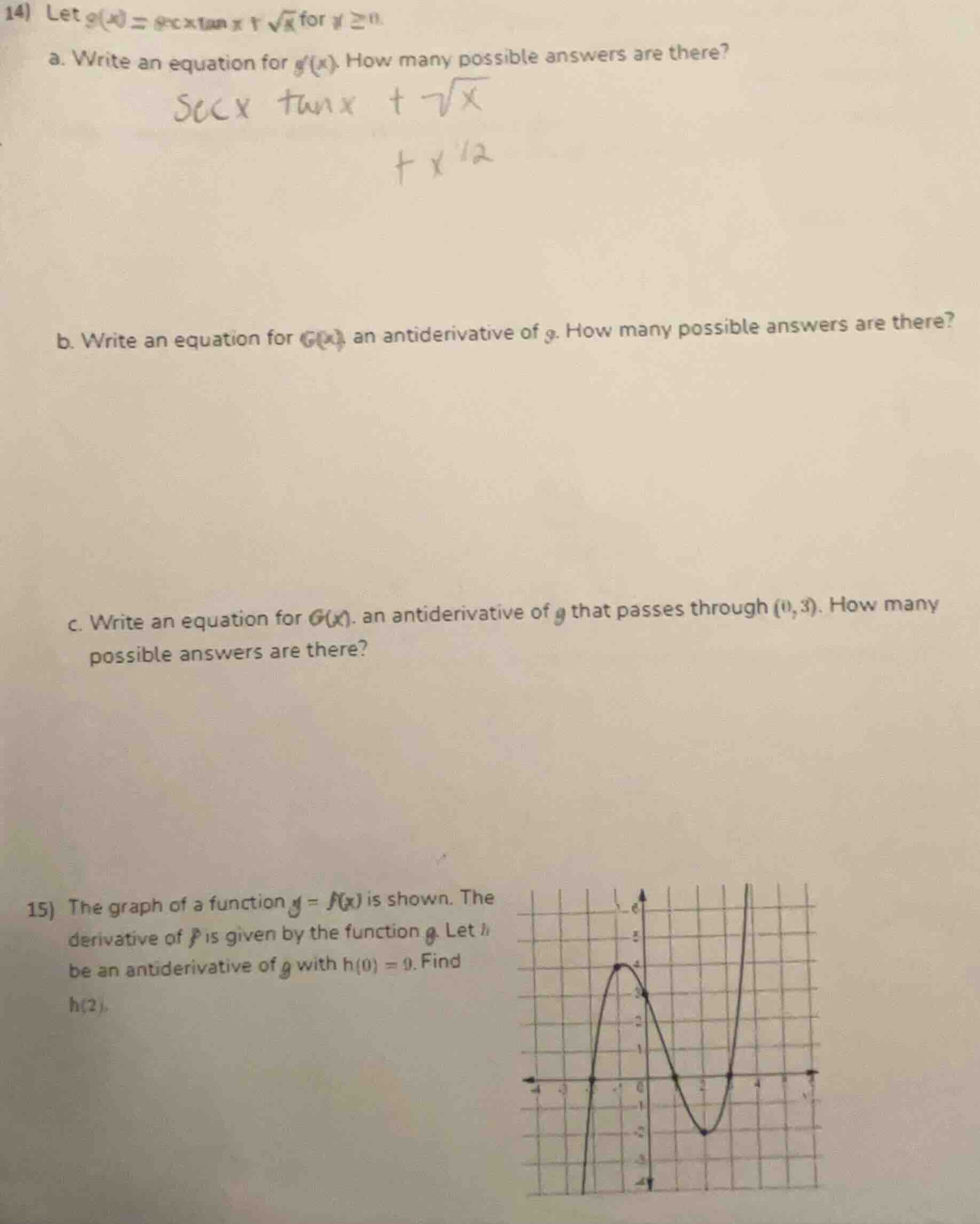
- let ( g(x) = sec x \tan x + sqrt{x} ) for ( x geq 0 ).
a. write an equation for ( g(x) ). how many possible answers are there?
b. write an equation for ( g(x) ), an antiderivative of ( g ). how many possible answers are there?
c. write an equation for ( g(x) ), an antiderivative of ( g ) that passes through ( (0, 3) ). how many possible answers are there?
- the graph of a function ( y = f(x) ) is shown. the derivative of ( f ) is given by the function ( g ). let ( h ) be an antiderivative of ( g ) with ( h(0) = 9 ). find ( h(2) ).
Part 14a
Step1: Identify the function \( g(x) \)
The function is given as \( g(x)=\sec x\tan x+\sqrt{x} \) (assuming the original typo \( \sec x\tan x + \sqrt{x} \) for \( x\geq0 \)). Since the function is defined explicitly, there's only 1 possible equation for \( g(x) \) as it's given.
Step1: Recall the antiderivative rule
The antiderivative of \( \sec x\tan x \) is \( \sec x \) (since \( \frac{d}{dx}(\sec x)=\sec x\tan x \)), and the antiderivative of \( \sqrt{x}=x^{\frac{1}{2}} \) is \( \frac{x^{\frac{1}{2}+1}}{\frac{1}{2}+1}=\frac{2}{3}x^{\frac{3}{2}} \) (using power rule \( \int x^n dx=\frac{x^{n + 1}}{n+1}+C, n
eq - 1 \)).
Step2: Form the antiderivative
The general antiderivative \( G(x) \) of \( g(x) \) is \( G(x)=\sec x+\frac{2}{3}x^{\frac{3}{2}}+C \), where \( C \) is an arbitrary constant. Since \( C \) can be any real number, there are infinitely many possible antiderivatives (one for each value of \( C \)).
Step1: Use the point \( (0,3) \) to find \( C \)
We know \( G(x)=\sec x+\frac{2}{3}x^{\frac{3}{2}}+C \). Substitute \( x = 0 \) and \( G(0)=3 \).
First, \( \sec(0)=1 \) and \( \frac{2}{3}(0)^{\frac{3}{2}} = 0 \). So \( 3=1 + 0+C \).
Step2: Solve for \( C \)
From \( 3=1 + C \), we get \( C=3 - 1=2 \).
Step3: Determine the number of solutions
Substituting \( C = 2 \) into the antiderivative formula, we get \( G(x)=\sec x+\frac{2}{3}x^{\frac{3}{2}}+2 \). Since \( C \) is uniquely determined by the point \( (0,3) \), there is only 1 possible antiderivative that passes through \( (0,3) \).

Snap & solve any problem in the app
Get step-by-step solutions on Sovi AI
Photo-based solutions with guided steps
Explore more problems and detailed explanations
The equation for \( g(x) \) is \( g(x)=\sec x\tan x+\sqrt{x} \) (or \( g(x)=\sec x\tan x + x^{\frac{1}{2}} \)). The number of possible answers is \( 1 \).