QUESTION IMAGE
Question
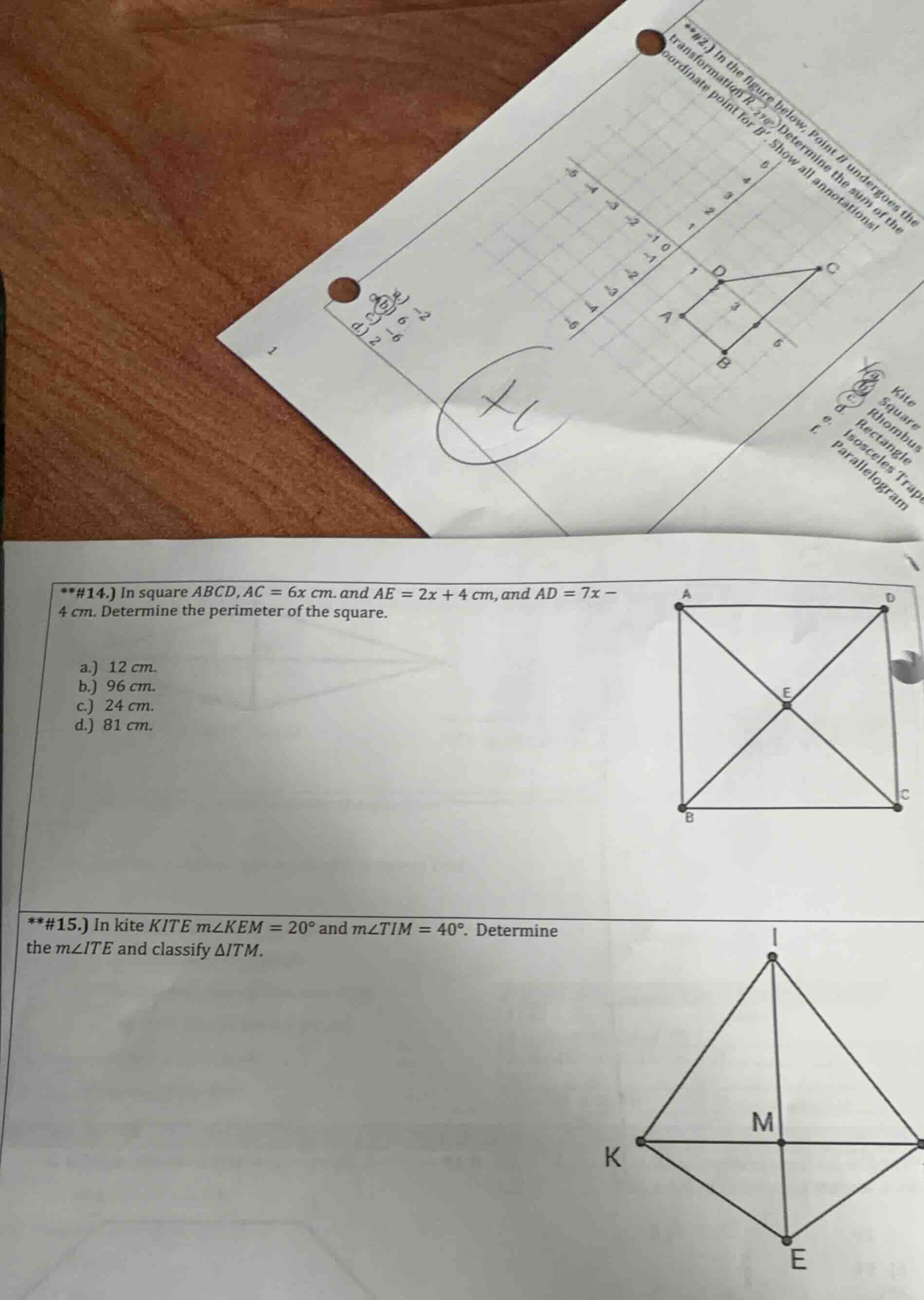
**#14.) in square abcd, ac = 6x cm. and ae = 2x + 4 cm, and ad = 7x - 4 cm. determine the perimeter of the square.
a.) 12 cm.
b.) 96 cm.
c.) 24 cm.
d.) 81 cm.
**#15.) in kite kite m∠kem = 20° and m∠tim = 40°. determine the m∠ite and classify δitm.
Problem #14 Solution:
Step1: Recall square diagonals property
In a square, the diagonals bisect each other, so \( AC = 2 \times AE \).
Given \( AC = 6x \) and \( AE = 2x + 4 \), we set up the equation:
\( 6x = 2(2x + 4) \)
Step2: Solve for \( x \)
Expand the right - hand side: \( 6x = 4x + 8 \)
Subtract \( 4x \) from both sides: \( 6x - 4x = 4x + 8 - 4x \)
\( 2x = 8 \)
Divide both sides by 2: \( x=\frac{8}{2}=4 \)
Step3: Find the side length of the square
The side length of the square \( AD = 7x - 4 \). Substitute \( x = 4 \):
\( AD=7\times4 - 4=28 - 4 = 24 \) cm
Step4: Calculate the perimeter of the square
The perimeter of a square \( P = 4\times\text{side length} \).
So \( P = 4\times24 = 96 \) cm
Step1: Analyze the kite properties
In a kite, the diagonals are perpendicular, so \( \angle KME = 90^{\circ} \). Also, the diagonal \( IE \) bisects \( \angle KIT \) and \( \angle KET \), and the diagonal \( KM \) bisects \( \angle K \) and \( \angle T \).
We know that in \( \triangle KEM \), \( \angle KEM = 20^{\circ} \) and \( \angle KME = 90^{\circ} \), so we can find \( \angle EKM=180^{\circ}-\angle KEM - \angle KME=180 - 20 - 90 = 70^{\circ} \). But we are more interested in \( \triangle ITM \).
In \( \triangle ITM \), we know that \( \angle TIM = 40^{\circ} \) and since the diagonals of a kite are perpendicular, \( \angle IM T=90^{\circ} \).
Step2: Find \( m\angle ITE \) (which is \( m\angle ITM \) in \( \triangle ITM \))
Using the angle - sum property of a triangle (\( \angle TIM+\angle IM T+\angle ITM = 180^{\circ} \))
Substitute \( \angle TIM = 40^{\circ} \) and \( \angle IM T = 90^{\circ} \)
\( 40^{\circ}+90^{\circ}+\angle ITM = 180^{\circ} \)
\( \angle ITM=180^{\circ}-40^{\circ}-90^{\circ}=50^{\circ} \)
Step3: Classify \( \triangle ITM \)
In \( \triangle ITM \), \( \angle IM T = 90^{\circ} \) (right angle), \( \angle TIM = 40^{\circ} \), \( \angle ITM = 50^{\circ} \). Since one angle is \( 90^{\circ} \), \( \triangle ITM \) is a right - angled triangle. Also, since all angles are different (\( 40^{\circ}
eq50^{\circ}
eq90^{\circ} \)), it is a right - angled scalene triangle.

Snap & solve any problem in the app
Get step-by-step solutions on Sovi AI
Photo-based solutions with guided steps
Explore more problems and detailed explanations
b.) 96 cm.