QUESTION IMAGE
Question
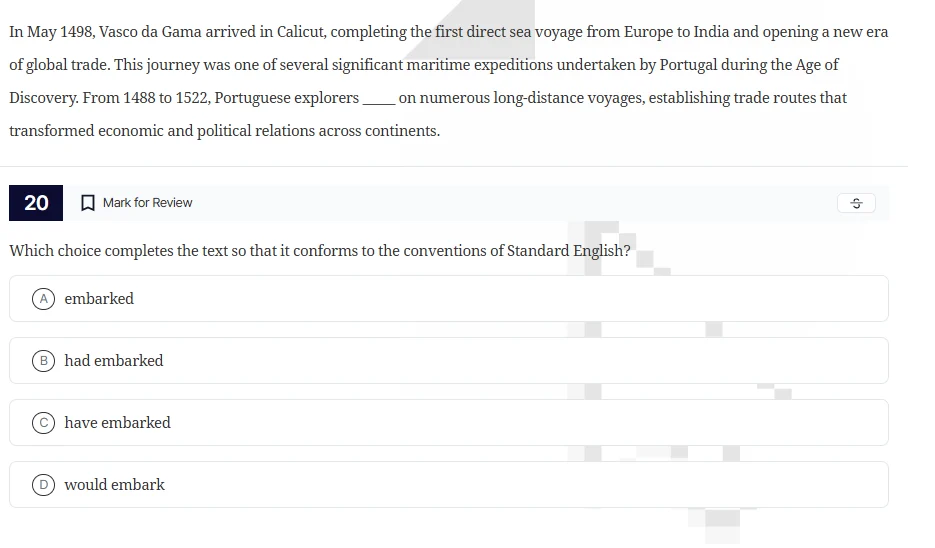
in may 1498, vasco da gama arrived in calicut, completing the first direct sea voyage from europe to india and opening a new era of global trade. this journey was one of several significant maritime expeditions undertaken by portugal during the age of discovery. from 1488 to 1522, portuguese explorers ___ on numerous long - distance voyages, establishing trade routes that transformed economic and political relations across continents.
20 mark for review
which choice completes the text so that it conforms to the conventions of standard english?
a embarked
b had embarked
c have embarked
d would embark
To determine the correct verb tense, we analyze the context. The time period is from 1488 to 1522, which is a past time frame. The action of Portuguese explorers undertaking voyages happened in the past and is a completed action in that past period.
- Option A: "embarked" is simple past tense, which is appropriate for actions that occurred in a specific past time frame (1488 - 1522).
- Option B: "had embarked" is past perfect, which is used to show an action completed before another past action. Here, there's no other past action to reference, so it's not needed.
- Option C: "have embarked" is present perfect, which connects past actions to the present. But the time frame (1488 - 1522) is entirely in the past, so present perfect is incorrect.
- Option D: "would embark" is conditional or past future, which doesn't fit the context of a past action that actually occurred.
So, the simple past tense "embarked" is the best choice.

Snap & solve any problem in the app
Get step-by-step solutions on Sovi AI
Photo-based solutions with guided steps
Explore more problems and detailed explanations
A. embarked