QUESTION IMAGE
Question
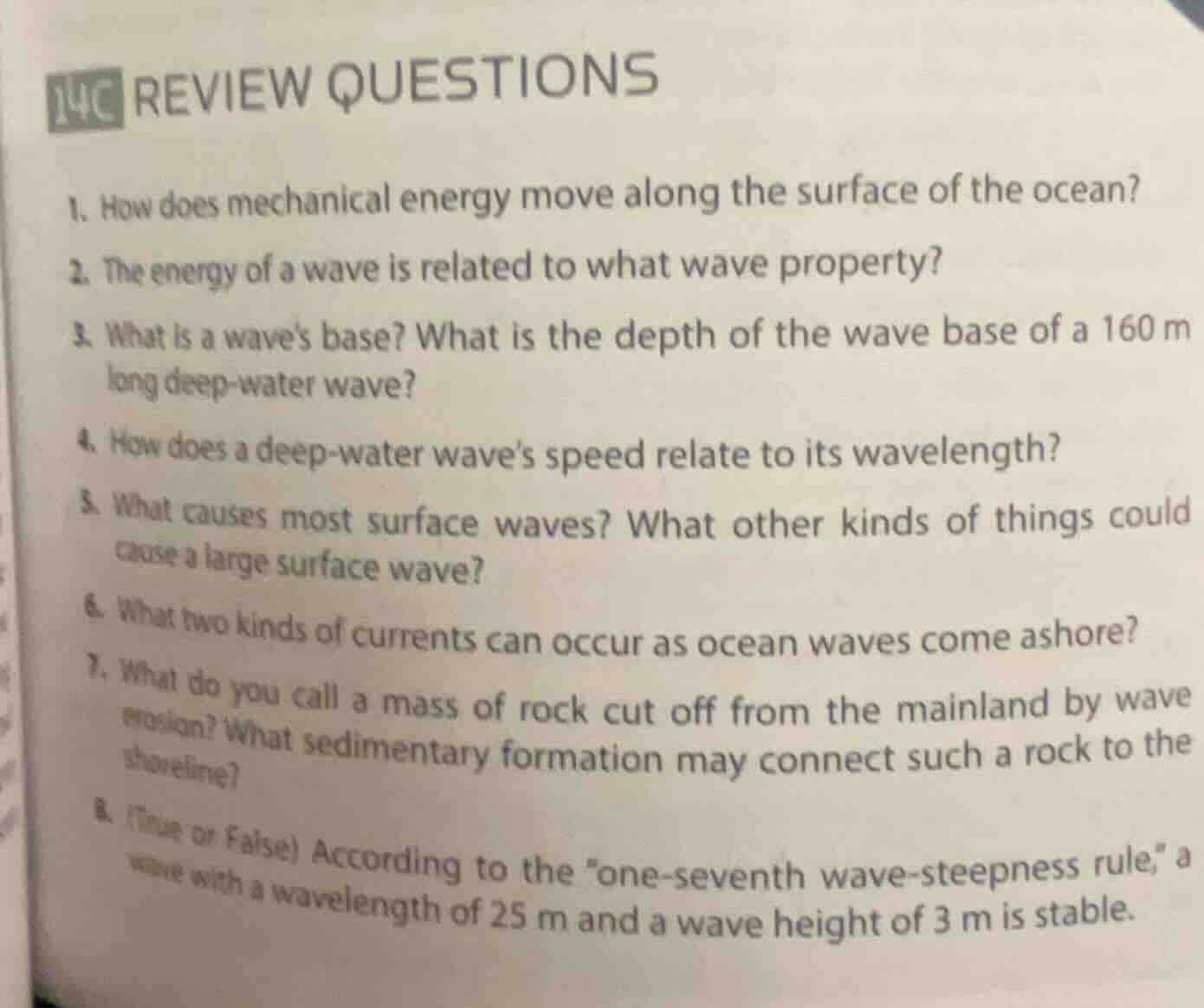
14c review questions
- how does mechanical energy move along the surface of the ocean?
- the energy of a wave is related to what wave property?
- what is a waves base? what is the depth of the wave base of a 160 m long deep - water wave?
- how does a deep - water waves speed relate to its wavelength?
- what causes most surface waves? what other kinds of things could cause a large surface wave?
- what two kinds of currents can occur as ocean waves come ashore?
- what do you call a mass of rock cut off from the mainland by wave erosion? what sedimentary formation may connect such a rock to the shoreline?
- (true or false) according to the \one - seventh wave - steepness rule,\ a wave with a wavelength of 25 m and a wave height of 3 m is stable.
Question 1
Mechanical energy moves along the ocean surface via surface waves. Wind transfers energy to water, creating waves where energy travels with the wave motion (water particles move in circular orbits, transferring energy forward).
The energy of a wave is related to its amplitude (or height) and also to its frequency/wavelength. For ocean waves, energy is proportional to the square of the wave height (amplitude) and also related to the wave's period/frequency. Larger amplitude (taller waves) or higher frequency means more energy.
Step 1: Define wave base
A wave's base (wave base) is the depth below the ocean surface at which the circular orbital motion of water particles caused by the wave becomes negligible (usually considered to be at a depth of half the wavelength, $\frac{\lambda}{2}$, where $\lambda$ is the wavelength).
Step 2: Calculate wave base depth for 160 m wavelength
Given $\lambda = 160\space m$, the wave base depth $d=\frac{\lambda}{2}$. Substitute $\lambda = 160\space m$ into the formula: $d=\frac{160}{2}=80\space m$.

Snap & solve any problem in the app
Get step-by-step solutions on Sovi AI
Photo-based solutions with guided steps
Explore more problems and detailed explanations
Mechanical energy moves along the ocean surface via surface waves (e.g., wind - generated waves), where energy is transferred as water particles move in circular orbits, propagating the wave.