QUESTION IMAGE
Question
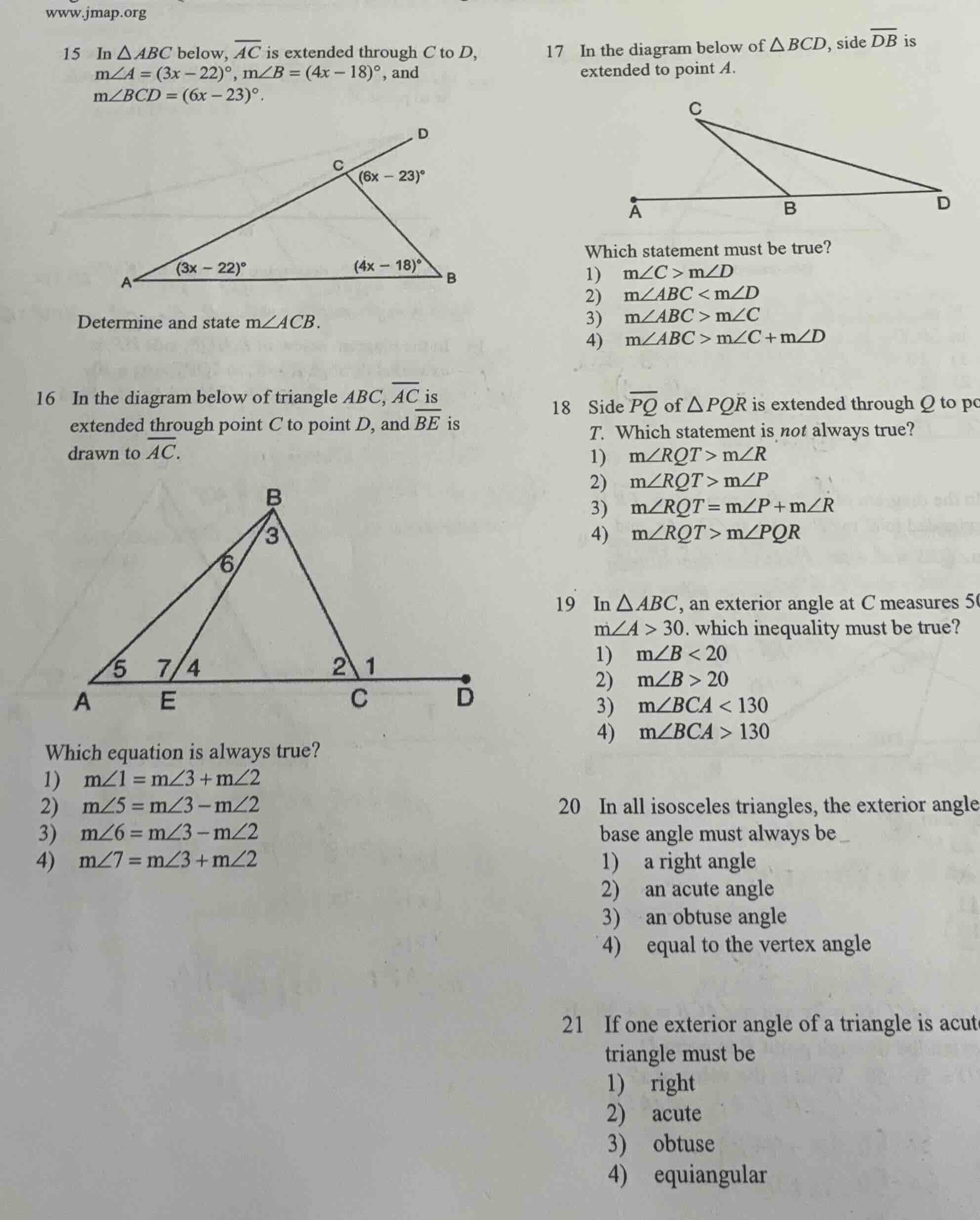
15 in $\triangle abc$ below, $\overline{ac}$ is extended through $c$ to $d$, $m\angle a = (3x - 22)\degree$, $m\angle b = (4x - 18)\degree$, and $m\angle bcd = (6x - 23)\degree$.
determine and state $m\angle acb$.
16 in the diagram below of triangle $abc$, $\overline{ac}$ is extended through point $c$ to point $d$, and $be$ is drawn to $ac$.
which equation is always true?
- $m\angle 1 = m\angle 3 + m\angle 2$
- $m\angle 5 = m\angle 3 - m\angle 2$
- $m\angle 6 = m\angle 3 - m\angle 2$
- $m\angle 7 = m\angle 3 + m\angle 2$
17 in the diagram below of $\triangle bcd$, side $\overline{db}$ is extended to point $a$.
which statement must be true?
- $m\angle c > m\angle d$
- $m\angle abc < m\angle d$
- $m\angle abc > m\angle c$
- $m\angle abc > m\angle c + m\angle d$
18 side $\overline{pq}$ of $\triangle pqr$ is extended through $q$ to $t$. which statement is not always true?
- $m\angle rqt > m\angle r$
- $m\angle rqt > m\angle p$
- $m\angle rqt = m\angle p + m\angle r$
- $m\angle rqt > m\angle pqr$
19 in $\triangle abc$, an exterior angle at $c$ measures $50$, $m\angle a > 30$. which inequality must be true?
- $m\angle b < 20$
- $m\angle b > 20$
- $m\angle bca < 130$
- $m\angle bca > 130$
20 in all isosceles triangles, the exterior angle base angle must always be
- a right angle
- an acute angle
- an obtuse angle
- equal to the vertex angle
21 if one exterior angle of a triangle is acute triangle must be
- right
- acute
- obtuse
- equiangular
Problem 15
Step1: Use exterior angle theorem
The exterior angle of a triangle equals the sum of the two remote interior angles, so:
$$(6x - 23) = (3x - 22) + (4x - 18)$$
Step2: Simplify and solve for $x$
$$6x - 23 = 7x - 40$$
$$-23 + 40 = 7x - 6x$$
$$x = 17$$
Step3: Find $\text{m}\angle BCD$
Substitute $x=17$ into the exterior angle expression:
$$\text{m}\angle BCD = 6(17) - 23 = 102 - 23 = 79^\circ$$
Step4: Calculate $\text{m}\angle ACB$
$\angle ACB$ and $\angle BCD$ are supplementary (linear pair):
$$\text{m}\angle ACB = 180^\circ - 79^\circ = 101^\circ$$
Use the exterior angle theorem for triangles. $\angle 1$ is an exterior angle of $\triangle ABC$, so $\text{m}\angle 1 = \text{m}\angle 3 + \text{m}\angle 2$ is false. $\angle 5$ cannot be expressed as $\text{m}\angle 3 - \text{m}\angle 2$. $\angle 6$ is an exterior angle of $\triangle BEC$, so $\text{m}\angle 6 = \text{m}\angle 3 + \text{m}\angle 2$ is false. $\angle 7$ is an exterior angle of $\triangle BEC$, so $\text{m}\angle 7 = \text{m}\angle 3 + \text{m}\angle 2$ is always true.
$\angle ABC$ is an exterior angle of $\triangle BCD$, so by the exterior angle theorem, $\text{m}\angle ABC = \text{m}\angle C + \text{m}\angle D$. This means $\text{m}\angle ABC > \text{m}\angle D$, $\text{m}\angle ABC > \text{m}\angle C$, and $\text{m}\angle ABC$ cannot be greater than $\text{m}\angle C + \text{m}\angle D$. Only $\text{m}\angle C > \text{m}\angle D$ is not guaranteed, but the theorem confirms $\text{m}\angle ABC > \text{m}\angle D$ is false, and $\text{m}\angle ABC > \text{m}\angle C$ is true.

Snap & solve any problem in the app
Get step-by-step solutions on Sovi AI
Photo-based solutions with guided steps
Explore more problems and detailed explanations
$\boldsymbol{101^\circ}$
---