QUESTION IMAGE
Question
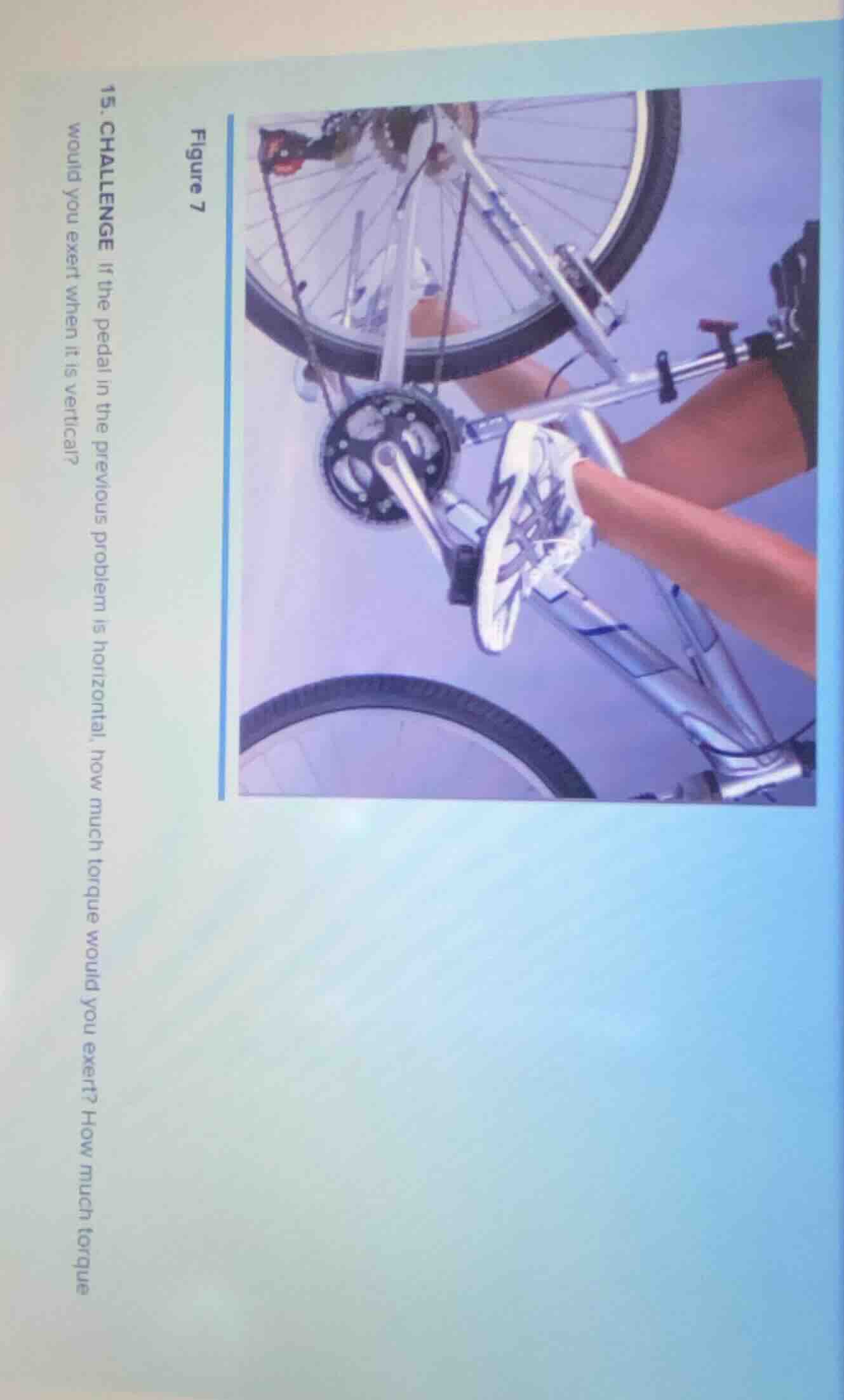
- challenge if the pedal in the previous problem is horizontal, how much torque would you exert? how much torque would you exert when it is vertical? figure 7
To solve this torque problem, we need to recall the formula for torque (\(\tau\)): \(\tau = rF\sin\theta\), where \(r\) is the distance from the pivot (the length of the pedal arm), \(F\) is the force applied (usually the weight of the foot or a given force), and \(\theta\) is the angle between the position vector \(r\) and the force vector \(F\).
Step 1: Analyze the horizontal pedal case
When the pedal is horizontal, the force applied (let's assume it's the weight \(F = mg\) or a given force) is perpendicular to the pedal arm (position vector \(r\)). So the angle \(\theta\) between \(r\) and \(F\) is \(90^\circ\), and \(\sin(90^\circ) = 1\).
If we let the length of the pedal arm be \(r\) and the force be \(F\), then the torque \(\tau_{\text{horizontal}} = rF\sin(90^\circ) = rF\).
Step 2: Analyze the vertical pedal case
When the pedal is vertical, the force applied (still \(F\)) is parallel to the pedal arm (position vector \(r\)). So the angle \(\theta\) between \(r\) and \(F\) is \(0^\circ\) (or \(180^\circ\), but \(\sin(0^\circ) = \sin(180^\circ) = 0\)).
Using the torque formula, \(\tau_{\text{vertical}} = rF\sin(0^\circ) = 0\).

Snap & solve any problem in the app
Get step-by-step solutions on Sovi AI
Photo-based solutions with guided steps
Explore more problems and detailed explanations
- Torque when pedal is horizontal: \(\boldsymbol{rF}\) (where \(r\) is pedal arm length, \(F\) is applied force).
- Torque when pedal is vertical: \(\boldsymbol{0}\) (since \(\sin(0^\circ) = 0\)).