QUESTION IMAGE
Question
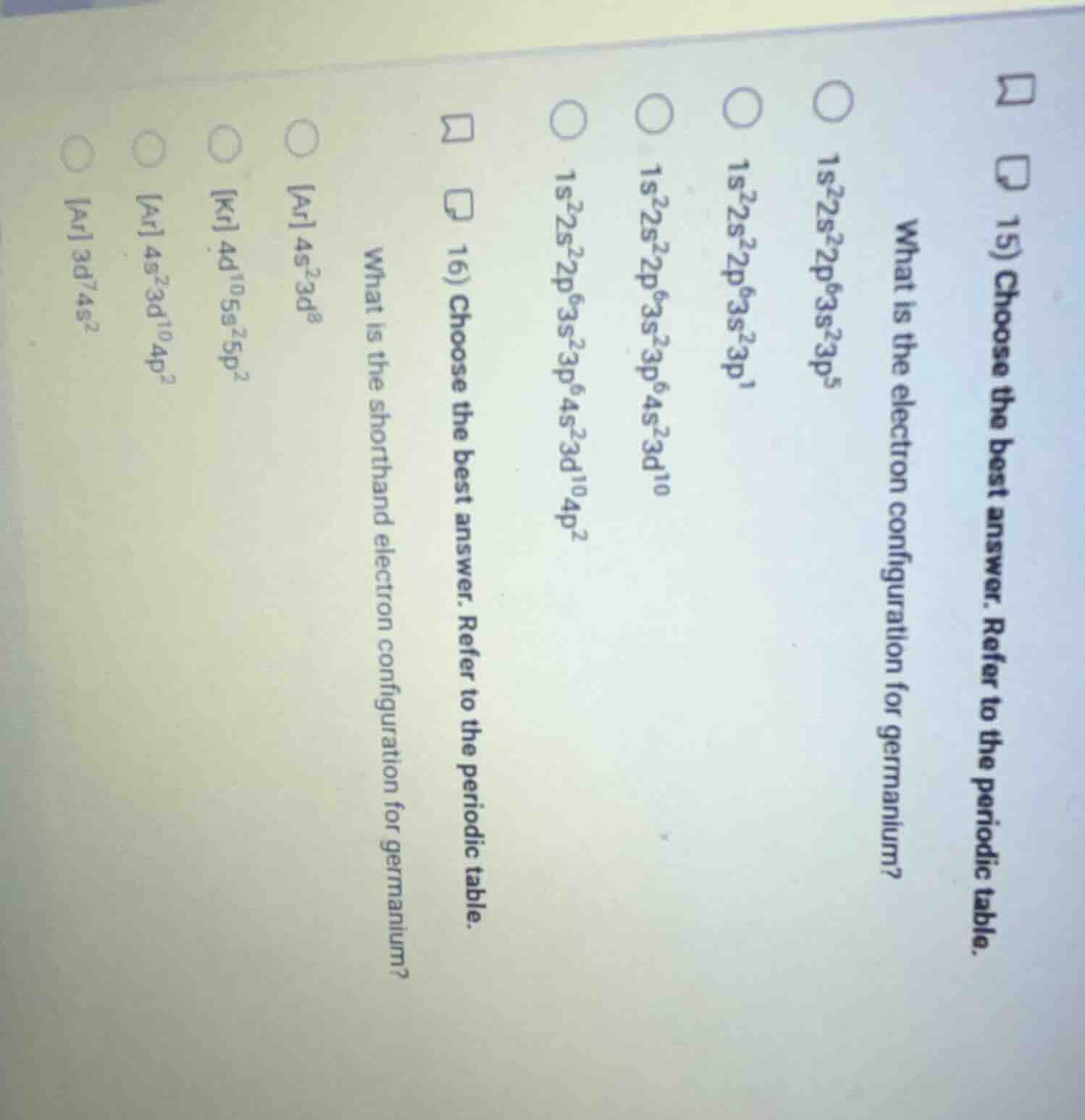
- choose the best answer. refer to the periodic table. what is the electron configuration for germanium? \\(1s^22s^22p^63s^23p^5\\) \\(1s^22s^22p^63s^23p^1\\) \\(1s^22s^22p^63s^23p^64s^23d^{10}\\) \\(1s^22s^22p^63s^23p^64s^23d^{10}4p^2\\) 16) choose the best answer. refer to the periodic table. what is the shorthand electron configuration for germanium? \\(ar 4s^23d^8\\) \\(kr 4d^{10}5s^25p^2\\) \\(ar 4s^23d^{10}4p^2\\) \\(ar 3d^74s^2\\)
Step1: Find germanium's atomic number
Germanium (Ge) has an atomic number of 32, meaning it has 32 electrons.
Step2: Build full electron configuration
Fill orbitals in Aufbau order: $1s^22s^22p^63s^23p^64s^23d^{10}4p^2$ (sum of exponents: $2+2+6+2+6+2+10+2=32$)
Step3: Identify noble gas core
The noble gas before Ge is Argon (Ar, atomic number 18), with configuration $1s^22s^22p^63s^23p^6$. Replace this with [Ar] for shorthand.
Step4: Match to options
Full configuration: $1s^22s^22p^63s^23p^64s^23d^{10}4p^2$
Shorthand configuration: $[Ar] 4s^23d^{10}4p^2$

Snap & solve any problem in the app
Get step-by-step solutions on Sovi AI
Photo-based solutions with guided steps
Explore more problems and detailed explanations
Question 15:
$\boldsymbol{1s^22s^22p^63s^23p^64s^23d^{10}4p^2}$
Question 16:
$\boldsymbol{[Ar] 4s^23d^{10}4p^2}$