QUESTION IMAGE
Question
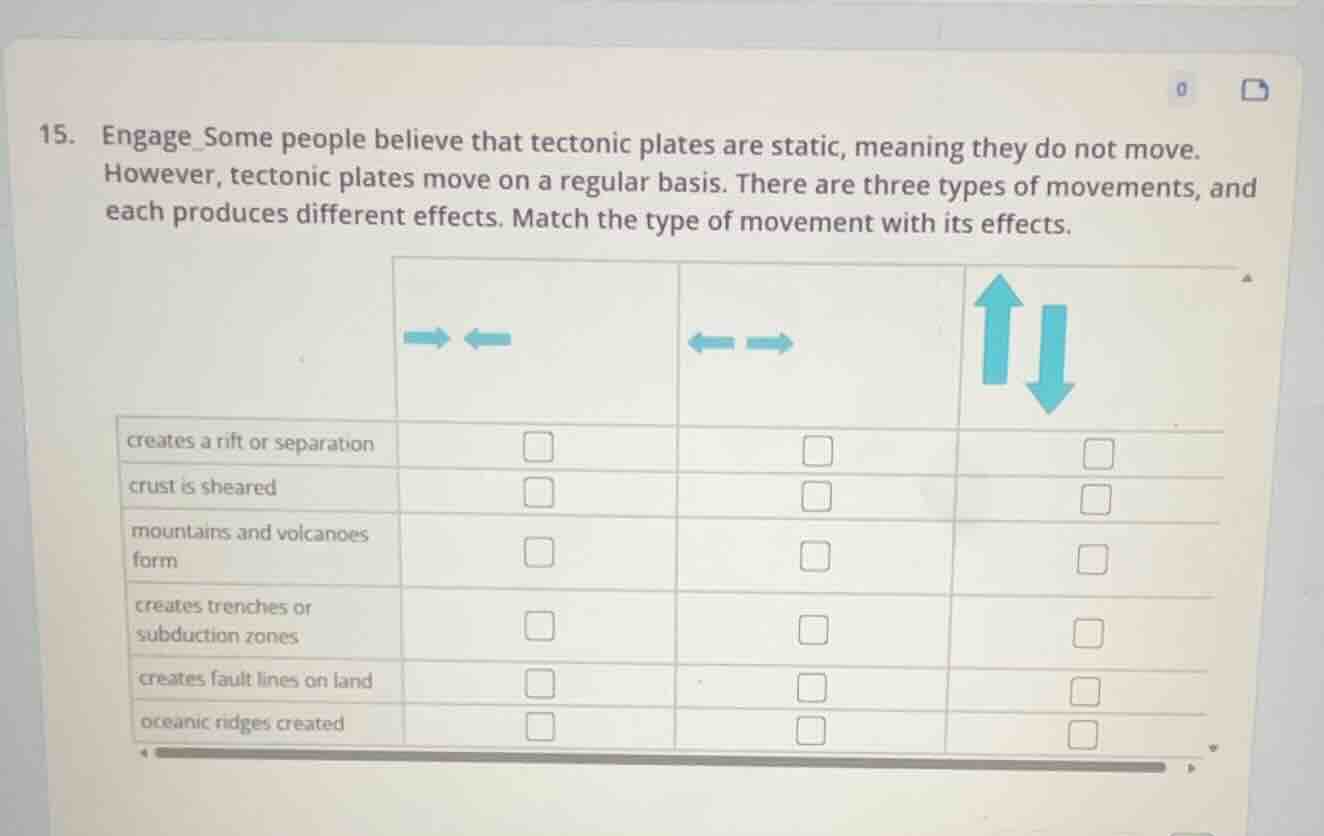
- engage some people believe that tectonic plates are static, meaning they do not move. however, tectonic plates move on a regular basis. there are three types of movements, and each produces different effects. match the type of movement with its effects. creates a rift or separation crust is sheared mountains and volcanoes form creates trenches or subduction zones creates fault lines on land oceanic ridges created
To solve this, we first identify the three types of tectonic plate movements from the arrows: Convergent (→←), Divergent (←→), and Transform (↑↓). Then we match each movement to its effects using tectonic plate theory:
1. Divergent Boundaries (←→: plates move apart)
- Creates a rift or separation: ✓ (Plates moving apart form rifts, e.g., mid - ocean ridges or continental rifts).
- Oceanic ridges created: ✓ (Divergent movement at ocean floors forms mid - ocean ridges).
2. Transform Boundaries (↑↓: plates slide past each other)
- Crust is sheared: ✓ (Shearing occurs as plates slide, causing shear stress).
- Creates fault lines on land: ✓ (Transform boundaries on land form fault lines like the San Andreas Fault).
3. Convergent Boundaries (→←: plates move toward each other)
- Mountains and volcanoes form: ✓ (Convergent movement (e.g., continental - continental or oceanic - continental) can create mountains and volcanic activity).
- Creates trenches or subduction zones: ✓ (Oceanic - continental or oceanic - oceanic convergence forms trenches/subduction zones).
Final Matches (Column 1: Convergent; Column 2: Divergent; Column 3: Transform)
| Effect | Convergent (→←) | Divergent (←→) | Transform (↑↓) |
|---|---|---|---|
| crust is sheared | ✔️ | ||
| mountains and volcanoes form | ✔️ | ||
| creates trenches or subduction zones | ✔️ | ||
| creates fault lines on land | ✔️ | ||
| oceanic ridges created | ✔️ |
(Note: In the table, mark the appropriate column with a checkmark for each effect based on the boundary type.)

Snap & solve any problem in the app
Get step-by-step solutions on Sovi AI
Photo-based solutions with guided steps
Explore more problems and detailed explanations
To solve this, we first identify the three types of tectonic plate movements from the arrows: Convergent (→←), Divergent (←→), and Transform (↑↓). Then we match each movement to its effects using tectonic plate theory:
1. Divergent Boundaries (←→: plates move apart)
- Creates a rift or separation: ✓ (Plates moving apart form rifts, e.g., mid - ocean ridges or continental rifts).
- Oceanic ridges created: ✓ (Divergent movement at ocean floors forms mid - ocean ridges).
2. Transform Boundaries (↑↓: plates slide past each other)
- Crust is sheared: ✓ (Shearing occurs as plates slide, causing shear stress).
- Creates fault lines on land: ✓ (Transform boundaries on land form fault lines like the San Andreas Fault).
3. Convergent Boundaries (→←: plates move toward each other)
- Mountains and volcanoes form: ✓ (Convergent movement (e.g., continental - continental or oceanic - continental) can create mountains and volcanic activity).
- Creates trenches or subduction zones: ✓ (Oceanic - continental or oceanic - oceanic convergence forms trenches/subduction zones).
Final Matches (Column 1: Convergent; Column 2: Divergent; Column 3: Transform)
| Effect | Convergent (→←) | Divergent (←→) | Transform (↑↓) |
|---|---|---|---|
| crust is sheared | ✔️ | ||
| mountains and volcanoes form | ✔️ | ||
| creates trenches or subduction zones | ✔️ | ||
| creates fault lines on land | ✔️ | ||
| oceanic ridges created | ✔️ |
(Note: In the table, mark the appropriate column with a checkmark for each effect based on the boundary type.)