QUESTION IMAGE
Question
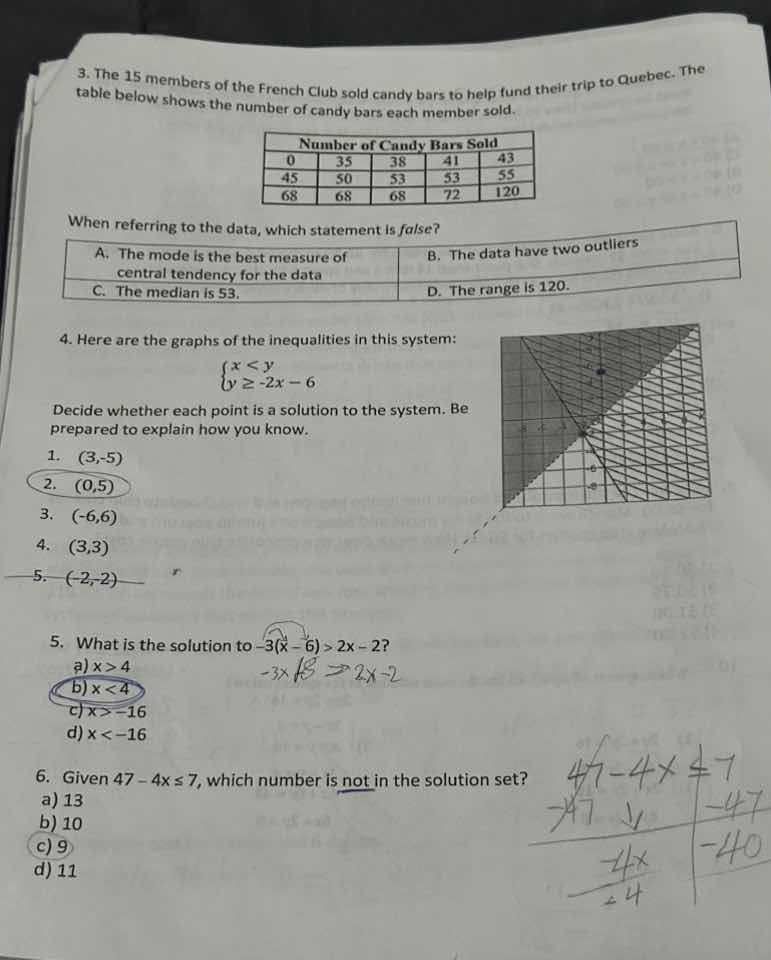
- the 15 members of the french club sold candy bars to help fund their trip to quebec. the table below shows the number of candy bars each member sold.
when referring to the data, which statement is false?
a. the mode is the best measure of central tendency for the data
b. the data have two outliers
c. the median is 53.
d. the range is 120.
- here are the graphs of the inequalities in this system:
\
decide whether each point is a solution to the system. be prepared to explain how you know.
- (3,-5)
- (0,5)
- (-6,6)
- (3,3)
- (-2,-2)
- what is the solution to -3(x - 6) > 2x - 2?
a) x > 4
b) x < 4
c) x > -16
d) x < -16
- given 47 - 4x \leq 7, which number is not in the solution set?
a) 13
b) 10
c) 9
d) 11
Question 3
Step1: Identify mode, outliers, median, range
- Mode: Most frequent value is 53 and 68 (bimodal).
- Outliers: Values far from the rest: 0, 120 (two outliers).
- Median: Order data: 0,35,38,41,43,45,50,53,53,55,68,68,68,72,120. 8th value = 53.
- Range: $120 - 0 = 120$.
- Mode is not best for skewed data with outliers; median is better.
A point is a solution if it lies in the overlapping shaded region of the inequalities $x < y$ and $y \geq -2x -6$.
- For (3,-5): $3 < -5$ is false → Not a solution.
- For (0,5): $0 < 5$ is true, $5 \geq -2(0)-6=-6$ is true → Solution.
- For (-6,6): $-6 < 6$ is true, $6 \geq -2(-6)-6=6$ is true → Solution.
- For (3,3): $3 < 3$ is false → Not a solution.
- For (-2,2): $-2 < 2$ is true, $2 \geq -2(-2)-6=-2$ is true → Solution.
Step1: Expand left side
$-3(x-6) = -3x + 18$
Step2: Rearrange inequality
$-3x + 18 > 2x - 2$
$-3x -2x > -2 -18$
Step3: Simplify to solve for x
$-5x > -20$
$x < \frac{-20}{-5}$
$x < 4$

Snap & solve any problem in the app
Get step-by-step solutions on Sovi AI
Photo-based solutions with guided steps
Explore more problems and detailed explanations
A. The mode is the best measure of central tendency for the data
---