QUESTION IMAGE
Question
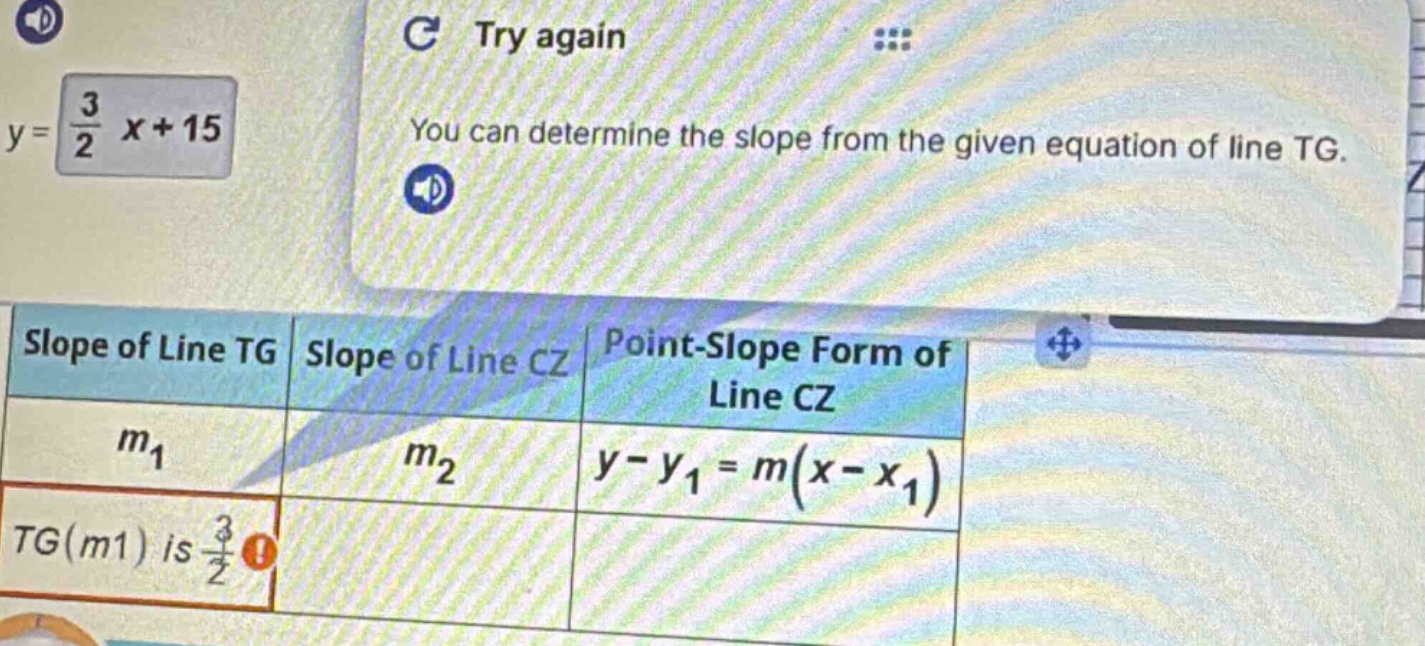
y = (3/2)x + 15; try again; you can determine the slope from the given equation of line tg; table with columns: slope of line tg (m₁), slope of line cz (m₂), point - slope form of line cz (y - y₁ = m(x - x₁)); row: tg(m1) is 3/2 (with an error icon)
To determine the slope of line \( TG \) from the equation \( y = \frac{3}{2}x + 15 \), we use the slope - intercept form of a line, which is \( y=mx + b \), where \( m \) is the slope and \( b \) is the y - intercept.
Step 1: Identify the form of the equation
The given equation of line \( TG \) is \( y=\frac{3}{2}x + 15 \), and it is in the slope - intercept form \( y = mx + b \).
Step 2: Extract the slope
In the slope - intercept form \( y=mx + b \), the coefficient of \( x \) is the slope. For the equation \( y=\frac{3}{2}x + 15 \), the coefficient of \( x \) is \( \frac{3}{2} \). So, the slope of line \( TG \) (\( m_1 \)) is \( \frac{3}{2} \).
If we assume that lines \( TG \) and \( CZ \) are parallel, then the slope of line \( CZ \) (\( m_2 \)) will be equal to the slope of line \( TG \). So \( m_2=\frac{3}{2} \).
If we want to write the point - slope form of line \( CZ \), we need a point \( (x_1,y_1) \) on line \( CZ \). Let's assume we have a point \( (x_1,y_1) \) on line \( CZ \). The point - slope form is \( y - y_1=m(x - x_1) \), and since \( m = \frac{3}{2} \) (if parallel), the point - slope form would be \( y - y_1=\frac{3}{2}(x - x_1) \).
For the slope of line \( TG \):
The slope of line \( TG \) is \( \boldsymbol{\frac{3}{2}} \)
If lines are parallel (for slope of \( CZ \)):
The slope of line \( CZ \) is \( \boldsymbol{\frac{3}{2}} \)
For point - slope form (assuming a point \( (x_1,y_1) \) on \( CZ \)):
The point - slope form of line \( CZ \) is \( \boldsymbol{y - y_1=\frac{3}{2}(x - x_1)} \) (where \( (x_1,y_1) \) is a point on line \( CZ \))

Snap & solve any problem in the app
Get step-by-step solutions on Sovi AI
Photo-based solutions with guided steps
Explore more problems and detailed explanations
To determine the slope of line \( TG \) from the equation \( y = \frac{3}{2}x + 15 \), we use the slope - intercept form of a line, which is \( y=mx + b \), where \( m \) is the slope and \( b \) is the y - intercept.
Step 1: Identify the form of the equation
The given equation of line \( TG \) is \( y=\frac{3}{2}x + 15 \), and it is in the slope - intercept form \( y = mx + b \).
Step 2: Extract the slope
In the slope - intercept form \( y=mx + b \), the coefficient of \( x \) is the slope. For the equation \( y=\frac{3}{2}x + 15 \), the coefficient of \( x \) is \( \frac{3}{2} \). So, the slope of line \( TG \) (\( m_1 \)) is \( \frac{3}{2} \).
If we assume that lines \( TG \) and \( CZ \) are parallel, then the slope of line \( CZ \) (\( m_2 \)) will be equal to the slope of line \( TG \). So \( m_2=\frac{3}{2} \).
If we want to write the point - slope form of line \( CZ \), we need a point \( (x_1,y_1) \) on line \( CZ \). Let's assume we have a point \( (x_1,y_1) \) on line \( CZ \). The point - slope form is \( y - y_1=m(x - x_1) \), and since \( m = \frac{3}{2} \) (if parallel), the point - slope form would be \( y - y_1=\frac{3}{2}(x - x_1) \).
For the slope of line \( TG \):
The slope of line \( TG \) is \( \boldsymbol{\frac{3}{2}} \)
If lines are parallel (for slope of \( CZ \)):
The slope of line \( CZ \) is \( \boldsymbol{\frac{3}{2}} \)
For point - slope form (assuming a point \( (x_1,y_1) \) on \( CZ \)):
The point - slope form of line \( CZ \) is \( \boldsymbol{y - y_1=\frac{3}{2}(x - x_1)} \) (where \( (x_1,y_1) \) is a point on line \( CZ \))