QUESTION IMAGE
Question
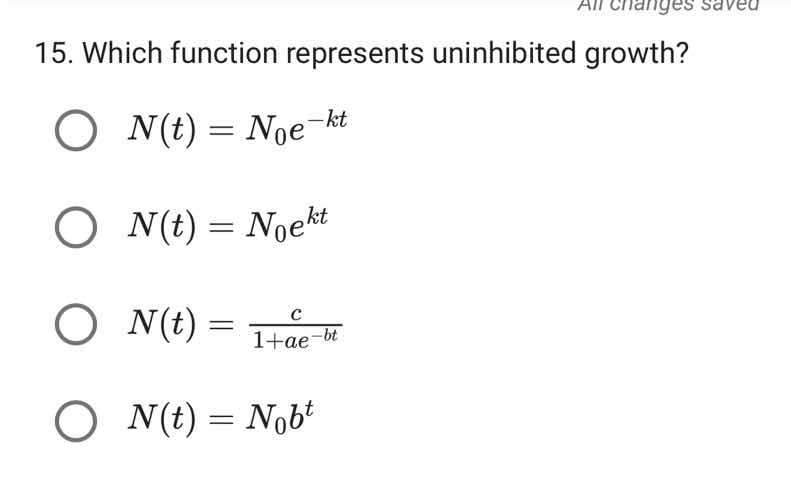
- which function represents uninhibited growth?
$n(t) = n_0 e^{-kt}$
$n(t) = n_0 e^{kt}$
$n(t) = \frac{c}{1 + ae^{-bt}}$
$n(t) = n_0 b^t$
Step1: Recall uninhibited growth definition
Uninhibited growth follows an exponential model where the quantity increases without bound over time, with a positive growth rate.
Step2: Analyze each option
- $N(t) = N_0e^{-kt}$: This has a negative exponent, representing exponential decay, not growth.
- $N(t) = N_0e^{kt}$: This is the standard continuous exponential growth model, where $k>0$ leads to unbounded growth over time, matching uninhibited growth.
- $N(t) = \frac{c}{1+ae^{-bt}}$: This is a logistic growth model, which has a carrying capacity (limited growth), not uninhibited.
- $N(t) = N_0b^t$: While this is an exponential model, it is a general form; the specific continuous model for uninhibited growth is the $e^{kt}$ form, and this option does not explicitly guarantee $b>1$ (though it can represent growth, the $e^{kt}$ form is the standard representation for uninhibited continuous growth asked here).

Snap & solve any problem in the app
Get step-by-step solutions on Sovi AI
Photo-based solutions with guided steps
Explore more problems and detailed explanations
B. $N(t) = N_0e^{kt}$