QUESTION IMAGE
Question
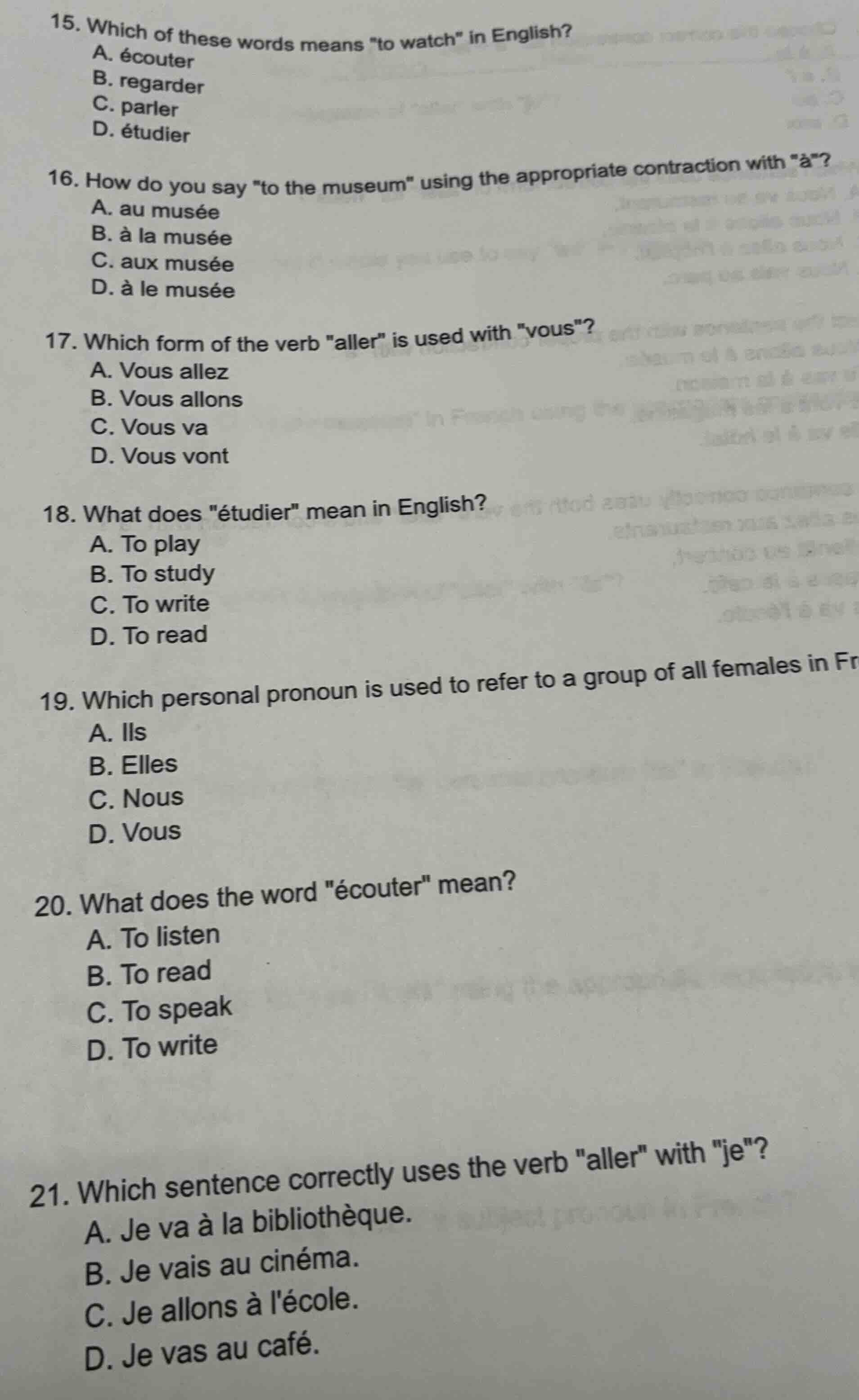
- which of these words means \to watch\ in english?
a. écouter
b. regarder
c. parler
d. étudier
- how do you say \to the museum\ using the appropriate contraction with \à\?
a. au musée
b. à la musée
c. aux musée
d. à le musée
- which form of the verb \aller\ is used with \vous\?
a. vous allez
b. vous allons
c. vous va
d. vous vont
- what does \étudier\ mean in english?
a. to play
b. to study
c. to write
d. to read
- which personal pronoun is used to refer to a group of all females in fr
a. ils
b. elles
c. nous
d. vous
- what does the word \écouter\ mean?
a. to listen
b. to read
c. to speak
d. to write
- which sentence correctly uses the verb \aller\ with \je\?
a. je va à la bibliothèque.
b. je vais au cinéma.
c. je allons à lécole.
d. je vas au café.
Question 15
We need to find the French word that means "to watch". Let's analyze each option:
- Option A: "écouter" means "to listen".
- Option B: "regarder" means "to watch" or "to look at".
- Option C: "parler" means "to speak".
- Option D: "étudier" means "to study".
So the correct option is B.
We need to say "to the museum" with the appropriate contraction with "à". In French, "à" + "le" contracts to "au", "à" + "la" stays as "à la", "à" + "les" contracts to "aux". "Musée" is a masculine singular noun, so we use "au" (à + le).
- Option A: "au musée" is correct (à + le musée = au musée).
- Option B: "à la musée" is wrong because "musée" is masculine, not feminine.
- Option C: "aux musée" is wrong because "musée" is singular, "aux" is for plural.
- Option D: "à le musée" is incorrect; we need to use the contraction "au" instead of "à le".
So the correct option is A.
We need to find the correct form of the verb "aller" with "vous". The conjugation of "aller" is: je vais, tu vas, il/elle va, nous allons, vous allez, ils/elles vont.
- Option A: "Vous allez" is the correct conjugation for "vous" (you plural or formal you).
- Option B: "Vous allons" is incorrect; "allons" is the conjugation for "nous" (we).
- Option C: "Vous va" is incorrect; "va" is for "il/elle" (he/she).
- Option D: "Vous vont" is incorrect; "vont" is for "ils/elles" (they).
So the correct option is A.

Snap & solve any problem in the app
Get step-by-step solutions on Sovi AI
Photo-based solutions with guided steps
Explore more problems and detailed explanations
B. regarder