QUESTION IMAGE
Question
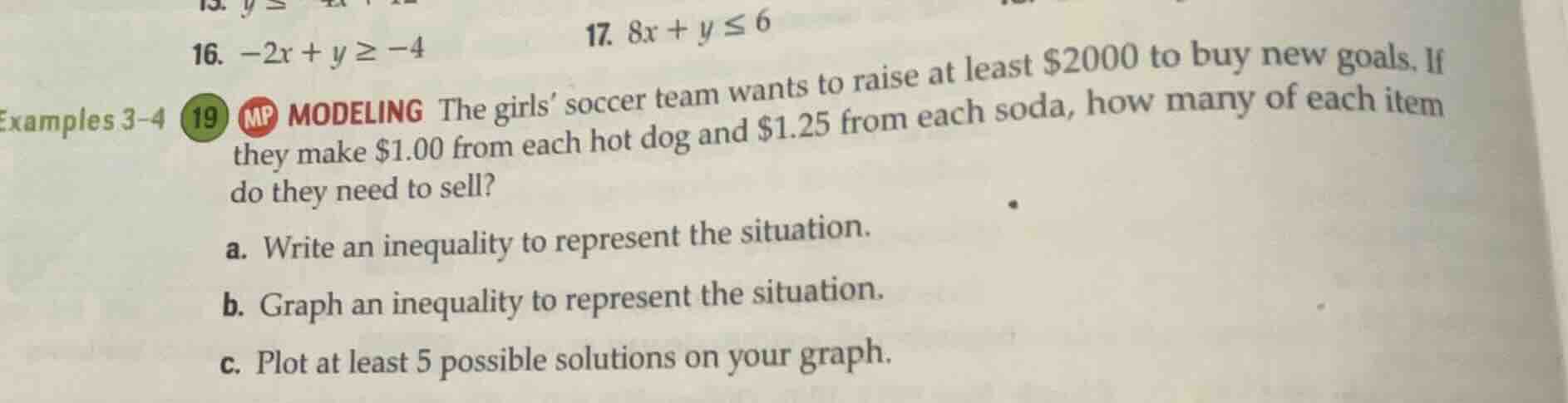
- $-2x + y geq -4$ 17. $8x + y leq 6$ examples 3 - 4 19 mp modeling the girls’ soccer team wants to raise at least $2000 to buy new goals. if they make $1.00 from each hot dog and $1.25 from each soda, how many of each item do they need to sell? a. write an inequality to represent the situation. b. graph an inequality to represent the situation. c. plot at least 5 possible solutions on your graph.
Part (a)
Step1: Define Variables
Let \( x \) be the number of hot dogs sold and \( y \) be the number of sodas sold.
Step2: Determine Earnings
Earnings from hot dogs: \( 1.00x \) dollars. Earnings from sodas: \( 1.25y \) dollars.
Step3: Form Inequality
Total earnings must be at least \( 2000 \) dollars, so \( 1.00x + 1.25y \geq 2000 \).
Step1: Rewrite in Slope - Intercept Form
Start with \( x + 1.25y \geq 2000 \). Solve for \( y \):
\( 1.25y\geq - x + 2000 \)
\( y\geq-\frac{1}{1.25}x+\frac{2000}{1.25} \)
Simplify: \( y\geq - 0.8x + 1600 \)
Step2: Graph the Boundary Line
The boundary line is \( y=-0.8x + 1600 \). Since the inequality is \( \geq \), the line is solid.
Step3: Shade the Region
Test a point not on the line, e.g., \( (0,0) \): \( 0+0\geq2000 \) is false. So shade the region above the line (where \( y\geq - 0.8x + 1600 \)).
We need to find points \( (x,y) \) such that \( x + 1.25y\geq2000 \), \( x\geq0 \), \( y\geq0 \) (since we can't sell a negative number of items).
Step1: Find Points
- When \( x = 0 \): \( 0+1.25y\geq2000\Rightarrow y\geq1600 \). So \( (0,1600) \) is a solution.
- When \( y = 0 \): \( x + 0\geq2000\Rightarrow x\geq2000 \). So \( (2000,0) \) is a solution.
- When \( x = 500 \): \( 500+1.25y\geq2000\Rightarrow1.25y\geq1500\Rightarrow y\geq1200 \). So \( (500,1200) \) (check: \( 500 + 1.25\times1200=500 + 1500 = 2000\geq2000 \))
- When \( x = 1000 \): \( 1000+1.25y\geq2000\Rightarrow1.25y\geq1000\Rightarrow y\geq800 \). So \( (1000,800) \) (check: \( 1000+1.25\times800 = 1000 + 1000=2000\geq2000 \))
- When \( x = 1500 \): \( 1500+1.25y\geq2000\Rightarrow1.25y\geq500\Rightarrow y\geq400 \). So \( (1500,400) \) (check: \( 1500 + 1.25\times400=1500 + 500=2000\geq2000 \))
- When \( x = 1000,y = 1000 \): \( 1000+1.25\times1000=1000 + 1250=2250\geq2000 \). So \( (1000,1000) \) is a solution.
Step2: Plot the Points
Plot \( (0,1600) \), \( (2000,0) \), \( (500,1200) \), \( (1000,800) \), \( (1500,400) \), \( (1000,1000) \) (or other valid points) on the shaded region from part (b).

Snap & solve any problem in the app
Get step-by-step solutions on Sovi AI
Photo-based solutions with guided steps
Explore more problems and detailed explanations
The inequality is \( \boldsymbol{x + 1.25y \geq 2000} \) (where \( x \) = number of hot dogs, \( y \) = number of sodas).