QUESTION IMAGE
Question
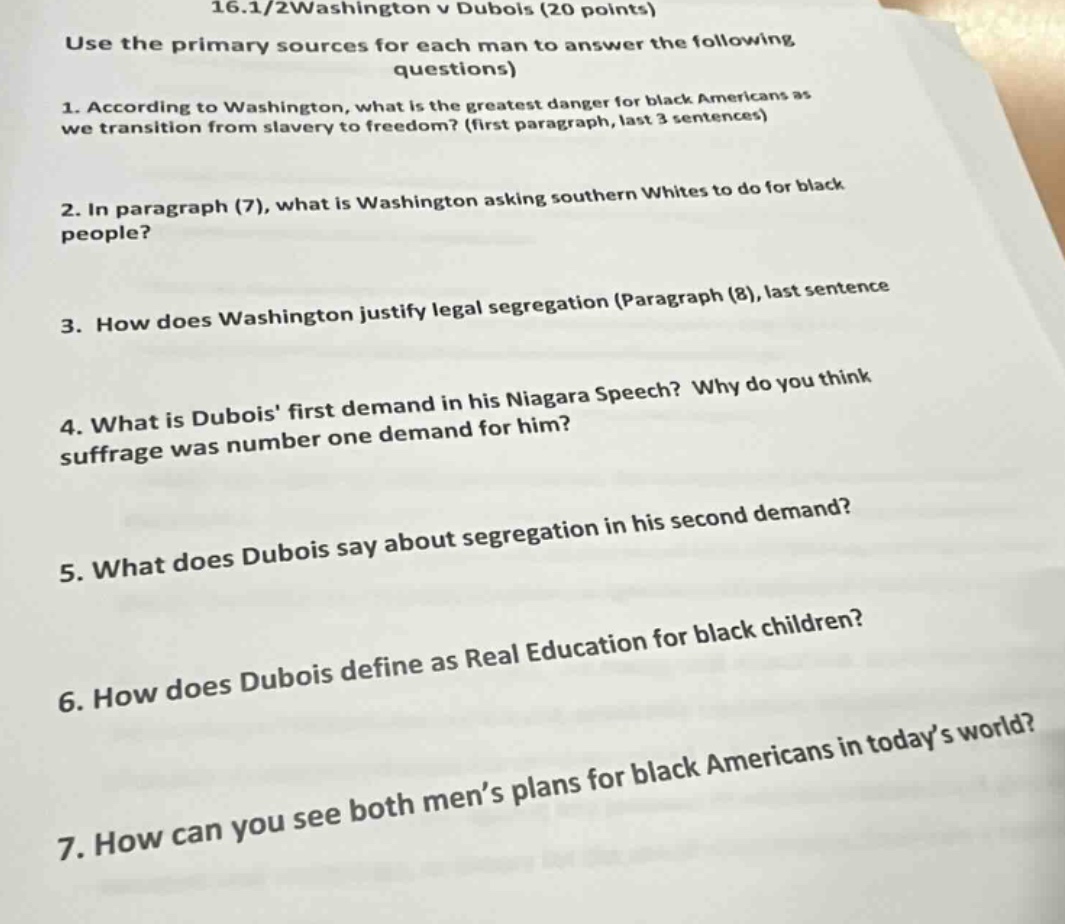
16.1/2washington v dubois (20 points)use the primary sources for each man to answer the following questions)1. according to washington, what is the greatest danger for black americans as we transition from slavery to freedom? (first paragraph, last 3 sentences)2. in paragraph (7), what is washington asking southern whites to do for black people?3. how does washington justify legal segregation (paragraph (8), last sentence4. what is dubois first demand in his niagara speech? why do you think suffrage was number one demand for him?5. what does dubois say about segregation in his second demand?6. how does dubois define as real education for black children?7. how can you see both men’s plans for black americans in today’s world?
To answer these questions, you'll need to analyze the primary sources (Washington's and Du Bois' writings) as follows:
1. Washington’s Greatest Danger for Black Americans
- Approach: Locate the first paragraph (last 3 sentences) of Washington’s text (e.g., his Atlanta Compromise speech).
- Typical Answer: Washington often argues that the “greatest danger” is Black Americans seeking social/political equality too aggressively (e.g., prioritizing “rights” over “economic self - reliance”), which he feared would provoke white hostility.
2. Washington’s Request to Southern Whites (Paragraph 7)
- Approach: Examine Paragraph 7 of Washington’s work.
- Typical Answer: Washington asks Southern Whites to provide economic opportunities (e.g., jobs, business partnerships) to Black Americans, framing it as a mutual benefit (e.g., “cast down your bucket where you are” to hire Black labor).
3. Washington’s Justification for Legal Segregation (Paragraph 8, Last Sentence)
- Approach: Find Paragraph 8’s last sentence.
- Typical Answer: Washington justifies segregation by arguing that “separate but equal” allows racial groups to “develop” independently, claiming social separation does not imply inequality (e.g., comparing it to natural racial “affinities”).
4. Du Bois’ First Demand (Niagara Speech) & Suffrage Reason
- Approach: Analyze the Niagara Movement speech.
- First Demand: Du Bois’ first demand is universal suffrage (voting rights) for Black Americans.
- Why Suffrage?: He saw suffrage as fundamental to political power—without it, Black Americans could not protect their rights, advance socially, or hold leaders accountable.
5. Du Bois on Segregation (Second Demand)
- Approach: Locate Du Bois’ second demand in the Niagara Speech.
- Typical Answer: Du Bois denounces segregation as “caste distinction,” arguing it is a tool of oppression that violates equality (e.g., he demands an end to legalized segregation in public life).
6. Du Bois’ “Real Education” for Black Children
- Approach: Find Du Bois’ definition of education (e.g., in The Souls of Black Folk or the Niagara Speech).
- Typical Answer: Du Bois advocates for “liberal education” (academic, intellectual, and moral development), not just vocational training. He emphasizes teaching Black children history, literature, science, and critical thinking to empower them as full citizens.
7. Applying Their Plans to Today
- Approach: Compare Washington’s “accommodationist” (economic self - help, gradual equality) and Du Bois’ “radical” (immediate civil rights, political power) approaches to modern issues (e.g., systemic racism, education, economic inequality).
- Typical Answer: Washington’s focus on economic self - reliance still resonates in promoting Black entrepreneurship. Du Bois’ emphasis on civil rights and education informs modern movements for racial justice (e.g., fighting voter suppression, advocating for equitable schools).
To provide precise answers, you must reference the exact primary source text (e.g., Washington’s speeches, Du Bois’ Niagara Speech or The Souls of Black Folk) for each question.

Snap & solve any problem in the app
Get step-by-step solutions on Sovi AI
Photo-based solutions with guided steps
Explore more problems and detailed explanations
To answer these questions, you'll need to analyze the primary sources (Washington's and Du Bois' writings) as follows:
1. Washington’s Greatest Danger for Black Americans
- Approach: Locate the first paragraph (last 3 sentences) of Washington’s text (e.g., his Atlanta Compromise speech).
- Typical Answer: Washington often argues that the “greatest danger” is Black Americans seeking social/political equality too aggressively (e.g., prioritizing “rights” over “economic self - reliance”), which he feared would provoke white hostility.
2. Washington’s Request to Southern Whites (Paragraph 7)
- Approach: Examine Paragraph 7 of Washington’s work.
- Typical Answer: Washington asks Southern Whites to provide economic opportunities (e.g., jobs, business partnerships) to Black Americans, framing it as a mutual benefit (e.g., “cast down your bucket where you are” to hire Black labor).
3. Washington’s Justification for Legal Segregation (Paragraph 8, Last Sentence)
- Approach: Find Paragraph 8’s last sentence.
- Typical Answer: Washington justifies segregation by arguing that “separate but equal” allows racial groups to “develop” independently, claiming social separation does not imply inequality (e.g., comparing it to natural racial “affinities”).
4. Du Bois’ First Demand (Niagara Speech) & Suffrage Reason
- Approach: Analyze the Niagara Movement speech.
- First Demand: Du Bois’ first demand is universal suffrage (voting rights) for Black Americans.
- Why Suffrage?: He saw suffrage as fundamental to political power—without it, Black Americans could not protect their rights, advance socially, or hold leaders accountable.
5. Du Bois on Segregation (Second Demand)
- Approach: Locate Du Bois’ second demand in the Niagara Speech.
- Typical Answer: Du Bois denounces segregation as “caste distinction,” arguing it is a tool of oppression that violates equality (e.g., he demands an end to legalized segregation in public life).
6. Du Bois’ “Real Education” for Black Children
- Approach: Find Du Bois’ definition of education (e.g., in The Souls of Black Folk or the Niagara Speech).
- Typical Answer: Du Bois advocates for “liberal education” (academic, intellectual, and moral development), not just vocational training. He emphasizes teaching Black children history, literature, science, and critical thinking to empower them as full citizens.
7. Applying Their Plans to Today
- Approach: Compare Washington’s “accommodationist” (economic self - help, gradual equality) and Du Bois’ “radical” (immediate civil rights, political power) approaches to modern issues (e.g., systemic racism, education, economic inequality).
- Typical Answer: Washington’s focus on economic self - reliance still resonates in promoting Black entrepreneurship. Du Bois’ emphasis on civil rights and education informs modern movements for racial justice (e.g., fighting voter suppression, advocating for equitable schools).
To provide precise answers, you must reference the exact primary source text (e.g., Washington’s speeches, Du Bois’ Niagara Speech or The Souls of Black Folk) for each question.