QUESTION IMAGE
Question
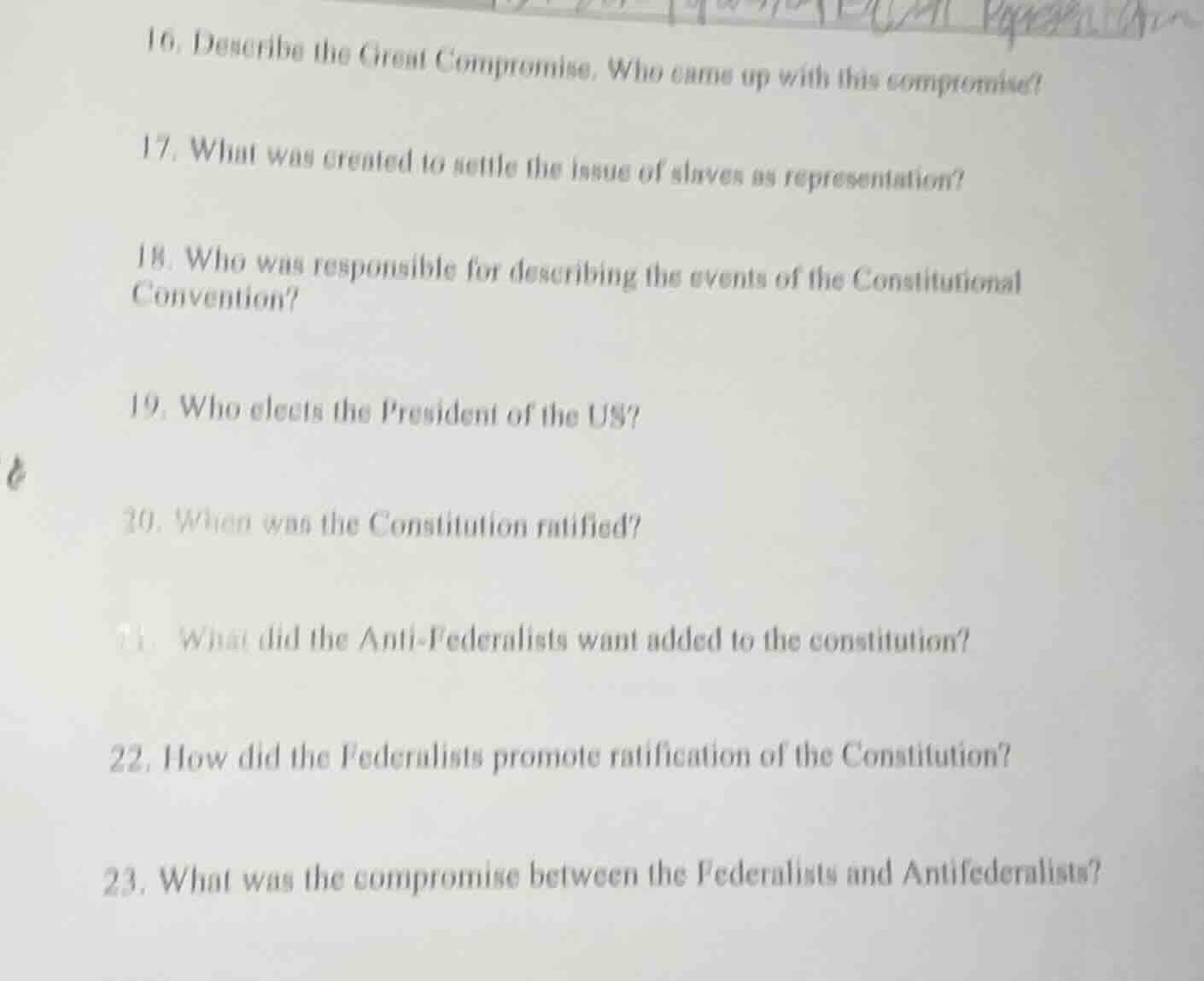
- describe the great compromise. who came up with this compromise?
- what was created to settle the issue of slaves as representation?
- who was responsible for describing the events of the constitutional convention?
- who elects the president of the us?
- when was the constitution ratified?
- what did the anti-federalists want added to the constitution?
- how did the federalists promote ratification of the constitution?
- what was the compromise between the federalists and antifederalists?
Brief Explanations
- Q16: The Great Compromise resolved disputes between large and small states over legislative representation, establishing a bicameral legislature. It was proposed by Roger Sherman.
- Q17: This agreement counted enslaved people for representation and taxation at a fraction of a free person.
- Q18: This figure kept detailed, secret notes of the convention's proceedings.
- Q19: This body is established by the U.S. Constitution to formally elect the president.
- Q20: This is the date when the required number of states approved the Constitution.
- Q21: Anti-Federalists sought protections for individual liberties not in the original Constitution.
- Q22: Federalists used written arguments to advocate for the Constitution's ratification.
- Q23: This compromise addressed the core demand of Anti-Federalists to secure ratification.

Snap & solve any problem in the app
Get step-by-step solutions on Sovi AI
Photo-based solutions with guided steps
Explore more problems and detailed explanations
- The Great Compromise established a bicameral U.S. Congress: the House of Representatives (with representation based on state population) and the Senate (with equal representation, two senators per state). It was proposed by Roger Sherman of Connecticut.
- The Three-Fifths Compromise
- James Madison
- The Electoral College
- June 21, 1788 (when New Hampshire became the 9th state to ratify it, meeting the requirement for adoption)
- A bill of rights (to protect individual liberties and limit federal power)
- They wrote and published the Federalist Papers, a series of essays explaining and defending the Constitution's principles, and campaigned in state ratifying conventions.
- The Federalists agreed to add a bill of rights to the Constitution shortly after its ratification, while Anti-Federalists agreed to support ratification.