QUESTION IMAGE
Question
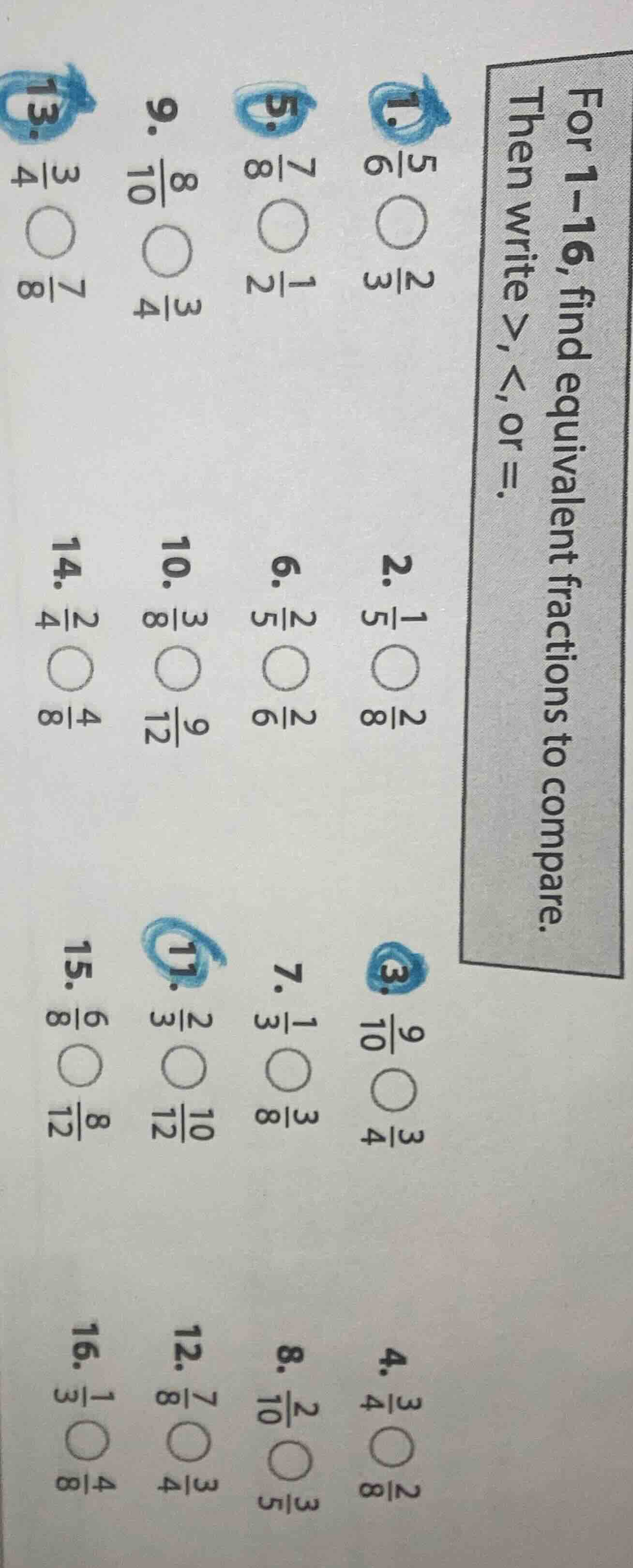
for 1 - 16, find equivalent fractions to compare. then write >, <, or =.
- $\frac{5}{6}$ $circ$ $\frac{2}{3}$
- $\frac{1}{5}$ $circ$ $\frac{2}{8}$
- $\frac{9}{10}$ $circ$ $\frac{3}{4}$
- $\frac{3}{4}$ $circ$ $\frac{2}{8}$
- $\frac{7}{8}$ $circ$ $\frac{1}{2}$
- $\frac{2}{5}$ $circ$ $\frac{2}{6}$
- $\frac{1}{3}$ $circ$ $\frac{3}{8}$
- $\frac{2}{10}$ $circ$ $\frac{3}{5}$
- $\frac{8}{10}$ $circ$ $\frac{3}{4}$
- $\frac{3}{8}$ $circ$ $\frac{9}{12}$
- $\frac{2}{3}$ $circ$ $\frac{10}{12}$
- $\frac{7}{8}$ $circ$ $\frac{3}{4}$
- $\frac{3}{4}$ $circ$ $\frac{7}{8}$
- $\frac{2}{4}$ $circ$ $\frac{4}{8}$
- $\frac{6}{8}$ $circ$ $\frac{8}{12}$
- $\frac{1}{3}$ $circ$ $\frac{4}{8}$
Let's solve these fraction comparison problems one by one. We'll use the method of finding equivalent fractions with a common denominator to compare them.
Problem 1: $\boldsymbol{\frac{5}{6} \circ \frac{2}{3}}$
Step 1: Find a common denominator
The denominators are 6 and 3. The least common denominator (LCD) is 6.
Step 2: Convert $\frac{2}{3}$ to an equivalent fraction with denominator 6
To convert $\frac{2}{3}$ to a fraction with denominator 6, we multiply the numerator and denominator by 2: $\frac{2 \times 2}{3 \times 2} = \frac{4}{6}$
Step 3: Compare the numerators
Now we compare $\frac{5}{6}$ and $\frac{4}{6}$. Since $5 > 4$, we have $\frac{5}{6} > \frac{4}{6}$, so $\frac{5}{6} > \frac{2}{3}$.
Problem 2: $\boldsymbol{\frac{1}{5} \circ \frac{2}{8}}$
Step 1: Simplify $\frac{2}{8}$
$\frac{2}{8} = \frac{1}{4}$ (dividing numerator and denominator by 2)
Step 2: Find a common denominator for $\frac{1}{5}$ and $\frac{1}{4}$
The LCD of 5 and 4 is 20.
Step 3: Convert both fractions to equivalent fractions with denominator 20
- $\frac{1}{5} = \frac{1 \times 4}{5 \times 4} = \frac{4}{20}$
- $\frac{1}{4} = \frac{1 \times 5}{4 \times 5} = \frac{5}{20}$
Step 4: Compare the numerators
Since $4 < 5$, we have $\frac{4}{20} < \frac{5}{20}$, so $\frac{1}{5} < \frac{2}{8}$.
Problem 3: $\boldsymbol{\frac{9}{10} \circ \frac{3}{4}}$
Step 1: Find the LCD of 10 and 4
The prime factors of 10 are $2 \times 5$ and of 4 are $2 \times 2$. So the LCD is $2 \times 2 \times 5 = 20$.
Step 2: Convert both fractions to equivalent fractions with denominator 20
- $\frac{9}{10} = \frac{9 \times 2}{10 \times 2} = \frac{18}{20}$
- $\frac{3}{4} = \frac{3 \times 5}{4 \times 5} = \frac{15}{20}$
Step 3: Compare the numerators
Since $18 > 15$, we have $\frac{18}{20} > \frac{15}{20}$, so $\frac{9}{10} > \frac{3}{4}$.
Problem 4: $\boldsymbol{\frac{3}{4} \circ \frac{2}{8}}$
Step 1: Simplify $\frac{2}{8}$
$\frac{2}{8} = \frac{1}{4}$ (dividing numerator and denominator by 2)
Step 2: Compare $\frac{3}{4}$ and $\frac{1}{4}$
Since the denominators are the same and $3 > 1$, we have $\frac{3}{4} > \frac{1}{4}$, so $\frac{3}{4} > \frac{2}{8}$.
Problem 5: $\boldsymbol{\frac{7}{8} \circ \frac{1}{2}}$
Step 1: Find the LCD of 8 and 2
The LCD is 8.
Step 2: Convert $\frac{1}{2}$ to an equivalent fraction with denominator 8
$\frac{1}{2} = \frac{1 \times 4}{2 \times 4} = \frac{4}{8}$
Step 3: Compare the numerators
Since $7 > 4$, we have $\frac{7}{8} > \frac{4}{8}$, so $\frac{7}{8} > \frac{1}{2}$.
Problem 6: $\boldsymbol{\frac{2}{5} \circ \frac{2}{6}}$
Step 1: Analyze the fractions
Both fractions have the same numerator (2). When the numerators are the same, the fraction with the smaller denominator is larger.
Step 2: Compare the denominators
Since $5 < 6$, we have $\frac{2}{5} > \frac{2}{6}$.
Problem 7: $\boldsymbol{\frac{1}{3} \circ \frac{3}{8}}$
Step 1: Find the LCD of 3 and 8
The LCD is 24.
Step 2: Convert both fractions to equivalent fractions with denominator 24
- $\frac{1}{3} = \frac{1 \times 8}{3 \times 8} = \frac{8}{24}$
- $\frac{3}{8} = \frac{3 \times 3}{8 \times 3} = \frac{9}{24}$
Step 3: Compare the numerators
Since $8 < 9$, we have $\frac{8}{24} < \frac{9}{24}$, so $\frac{1}{3} < \frac{3}{8}$.
Problem 8: $\boldsymbol{\frac{2}{10} \circ \frac{3}{5}}$
Step 1: Simplify $\frac{2}{10}$
$\frac{2}{10} = \frac{1}{5}$ (dividing numerator and denominator by 2)
Step 2: Compare $\frac{1}{5}$ and $\frac{3}{5}$
Since the denominators are the same and $1 < 3$, we have $\frac{1}{5} < \frac{3}{5…

Snap & solve any problem in the app
Get step-by-step solutions on Sovi AI
Photo-based solutions with guided steps
Explore more problems and detailed explanations
Let's solve these fraction comparison problems one by one. We'll use the method of finding equivalent fractions with a common denominator to compare them.
Problem 1: $\boldsymbol{\frac{5}{6} \circ \frac{2}{3}}$
Step 1: Find a common denominator
The denominators are 6 and 3. The least common denominator (LCD) is 6.
Step 2: Convert $\frac{2}{3}$ to an equivalent fraction with denominator 6
To convert $\frac{2}{3}$ to a fraction with denominator 6, we multiply the numerator and denominator by 2: $\frac{2 \times 2}{3 \times 2} = \frac{4}{6}$
Step 3: Compare the numerators
Now we compare $\frac{5}{6}$ and $\frac{4}{6}$. Since $5 > 4$, we have $\frac{5}{6} > \frac{4}{6}$, so $\frac{5}{6} > \frac{2}{3}$.
Problem 2: $\boldsymbol{\frac{1}{5} \circ \frac{2}{8}}$
Step 1: Simplify $\frac{2}{8}$
$\frac{2}{8} = \frac{1}{4}$ (dividing numerator and denominator by 2)
Step 2: Find a common denominator for $\frac{1}{5}$ and $\frac{1}{4}$
The LCD of 5 and 4 is 20.
Step 3: Convert both fractions to equivalent fractions with denominator 20
- $\frac{1}{5} = \frac{1 \times 4}{5 \times 4} = \frac{4}{20}$
- $\frac{1}{4} = \frac{1 \times 5}{4 \times 5} = \frac{5}{20}$
Step 4: Compare the numerators
Since $4 < 5$, we have $\frac{4}{20} < \frac{5}{20}$, so $\frac{1}{5} < \frac{2}{8}$.
Problem 3: $\boldsymbol{\frac{9}{10} \circ \frac{3}{4}}$
Step 1: Find the LCD of 10 and 4
The prime factors of 10 are $2 \times 5$ and of 4 are $2 \times 2$. So the LCD is $2 \times 2 \times 5 = 20$.
Step 2: Convert both fractions to equivalent fractions with denominator 20
- $\frac{9}{10} = \frac{9 \times 2}{10 \times 2} = \frac{18}{20}$
- $\frac{3}{4} = \frac{3 \times 5}{4 \times 5} = \frac{15}{20}$
Step 3: Compare the numerators
Since $18 > 15$, we have $\frac{18}{20} > \frac{15}{20}$, so $\frac{9}{10} > \frac{3}{4}$.
Problem 4: $\boldsymbol{\frac{3}{4} \circ \frac{2}{8}}$
Step 1: Simplify $\frac{2}{8}$
$\frac{2}{8} = \frac{1}{4}$ (dividing numerator and denominator by 2)
Step 2: Compare $\frac{3}{4}$ and $\frac{1}{4}$
Since the denominators are the same and $3 > 1$, we have $\frac{3}{4} > \frac{1}{4}$, so $\frac{3}{4} > \frac{2}{8}$.
Problem 5: $\boldsymbol{\frac{7}{8} \circ \frac{1}{2}}$
Step 1: Find the LCD of 8 and 2
The LCD is 8.
Step 2: Convert $\frac{1}{2}$ to an equivalent fraction with denominator 8
$\frac{1}{2} = \frac{1 \times 4}{2 \times 4} = \frac{4}{8}$
Step 3: Compare the numerators
Since $7 > 4$, we have $\frac{7}{8} > \frac{4}{8}$, so $\frac{7}{8} > \frac{1}{2}$.
Problem 6: $\boldsymbol{\frac{2}{5} \circ \frac{2}{6}}$
Step 1: Analyze the fractions
Both fractions have the same numerator (2). When the numerators are the same, the fraction with the smaller denominator is larger.
Step 2: Compare the denominators
Since $5 < 6$, we have $\frac{2}{5} > \frac{2}{6}$.
Problem 7: $\boldsymbol{\frac{1}{3} \circ \frac{3}{8}}$
Step 1: Find the LCD of 3 and 8
The LCD is 24.
Step 2: Convert both fractions to equivalent fractions with denominator 24
- $\frac{1}{3} = \frac{1 \times 8}{3 \times 8} = \frac{8}{24}$
- $\frac{3}{8} = \frac{3 \times 3}{8 \times 3} = \frac{9}{24}$
Step 3: Compare the numerators
Since $8 < 9$, we have $\frac{8}{24} < \frac{9}{24}$, so $\frac{1}{3} < \frac{3}{8}$.
Problem 8: $\boldsymbol{\frac{2}{10} \circ \frac{3}{5}}$
Step 1: Simplify $\frac{2}{10}$
$\frac{2}{10} = \frac{1}{5}$ (dividing numerator and denominator by 2)
Step 2: Compare $\frac{1}{5}$ and $\frac{3}{5}$
Since the denominators are the same and $1 < 3$, we have $\frac{1}{5} < \frac{3}{5}$, so $\frac{2}{10} < \frac{3}{5}$.
Problem 9: $\boldsymbol{\frac{8}{10} \circ \frac{3}{4}}$
Step 1: Simplify $\frac{8}{10}$
$\frac{8}{10} = \frac{4}{5}$ (dividing numerator and denominator by 2)
Step 2: Find the LCD of 5 and 4
The LCD is 20.
Step 3: Convert both fractions to equivalent fractions with denominator 20
- $\frac{4}{5} = \frac{4 \times 4}{5 \times 4} = \frac{16}{20}$
- $\frac{3}{4} = \frac{3 \times 5}{4 \times 5} = \frac{15}{20}$
Step 4: Compare the numerators
Since $16 > 15$, we have $\frac{16}{20} > \frac{15}{20}$, so $\frac{8}{10} > \frac{3}{4}$.
Problem 10: $\boldsymbol{\frac{3}{8} \circ \frac{9}{12}}$
Step 1: Simplify $\frac{9}{12}$
$\frac{9}{12} = \frac{3}{4}$ (dividing numerator and denominator by 3)
Step 2: Find the LCD of 8 and 4
The LCD is 8.
Step 3: Convert $\frac{3}{4}$ to an equivalent fraction with denominator 8
$\frac{3}{4} = \frac{3 \times 2}{4 \times 2} = \frac{6}{8}$
Step 4: Compare the numerators
Since $3 < 6$, we have $\frac{3}{8} < \frac{6}{8}$, so $\frac{3}{8} < \frac{9}{12}$.
Problem 11: $\boldsymbol{\frac{2}{3} \circ \frac{10}{12}}$
Step 1: Simplify $\frac{10}{12}$
$\frac{10}{12} = \frac{5}{6}$ (dividing numerator and denominator by 2)
Step 2: Find the LCD of 3 and 6
The LCD is 6.
Step 3: Convert $\frac{2}{3}$ to an equivalent fraction with denominator 6
$\frac{2}{3} = \frac{2 \times 2}{3 \times 2} = \frac{4}{6}$
Step 4: Compare the numerators
Since $4 < 5$, we have $\frac{4}{6} < \frac{5}{6}$, so $\frac{2}{3} < \frac{10}{12}$.
Problem 12: $\boldsymbol{\frac{7}{8} \circ \frac{3}{4}}$
Step 1: Find the LCD of 8 and 4
The LCD is 8.
Step 2: Convert $\frac{3}{4}$ to an equivalent fraction with denominator 8
$\frac{3}{4} = \frac{3 \times 2}{4 \times 2} = \frac{6}{8}$
Step 3: Compare the numerators
Since $7 > 6$, we have $\frac{7}{8} > \frac{6}{8}$, so $\frac{7}{8} > \frac{3}{4}$.
Problem 13: $\boldsymbol{\frac{3}{4} \circ \frac{7}{8}}$
Step 1: Find the LCD of 4 and 8
The LCD is 8.
Step 2: Convert $\frac{3}{4}$ to an equivalent fraction with denominator 8
$\frac{3}{4} = \frac{3 \times 2}{4 \times 2} = \frac{6}{8}$
Step 3: Compare the numerators
Since $6 < 7$, we have $\frac{6}{8} < \frac{7}{8}$, so $\frac{3}{4} < \frac{7}{8}$.
Problem 14: $\boldsymbol{\frac{2}{4} \circ \frac{4}{8}}$
Step 1: Simplify both fractions
- $\frac{2}{4} = \frac{1}{2}$ (dividing numerator and denominator by 2)
- $\frac{4}{8} = \frac{1}{2}$ (dividing numerator and denominator by 4)
Step 2: Compare the fractions
Since both simplify to $\frac{1}{2}$, we have $\frac{2}{4} = \frac{4}{8}$.
Problem 15: $\boldsymbol{\frac{6}{8} \circ \frac{8}{12}}$
Step 1: Simplify both fractions
- $\frac{6}{8} = \frac{3}{4}$ (dividing numerator and denominator by 2)
- $\frac{8}{12} = \frac{2}{3}$ (dividing numerator and denominator by 4)
Step 2: Find the LCD of 4 and 3
The LCD is 12.
Step 3: Convert both fractions to equivalent fractions with denominator 12
- $\frac{3}{4} = \frac{3 \times 3}{4 \times 3} = \frac{9}{12}$
- $\frac{2}{3} = \frac{2 \times 4}{3 \times 4} = \frac{8}{12}$
Step 4: Compare the numerators
Since $9 > 8$, we have $\frac{9}{12} > \frac{8}{12}$, so $\frac{6}{8} > \frac{8}{12}$.
Problem 16: $\boldsymbol{\frac{1}{3} \circ \frac{4}{8}}$
Step 1: Simplify $\frac{4}{8}$
$\frac{4}{8} = \frac{1}{2}$ (dividing numerator and denominator by 4)
Step 2: Find the LCD of 3 and 2
The LCD is 6.
Step 3: Convert both fractions to equivalent fractions with denominator 6
- $\frac{1}{3} = \frac{1 \times 2}{3 \times 2} = \frac{2}{6}$
- $\frac{1}{2} = \frac{1 \times 3}{2 \times 3} = \frac{3}{6}$
Step 4: Compare the numerators
Since $2 < 3$, we have $\frac{2}{6} < \frac{3}{6}$, so $\frac{1}{3} < \frac{4}{8}$.
Final Answers:
- $\frac{5}{6} \boldsymbol{>} \frac{2}{3}$
- $\frac{1}{5} \boldsymbol{<} \frac{2}{8}$
- $\frac{9}{10} \boldsymbol{>} \frac{3}{4}$
- $\frac{3}{4} \boldsymbol{>} \frac{2}{8}$
- $\frac{7}{8} \boldsymbol{>} \frac{1}{2}$
- $\frac{2}{5} \boldsymbol{>} \frac{2}{6}$
- $\frac{1}{3} \boldsymbol{<} \frac{3}{8}$
- $\frac{2}{10} \boldsymbol{<} \frac{3}{5}$
- $\frac{8}{10} \boldsymbol{>} \frac{3}{4}$
- $\frac{3}{8} \boldsymbol{<} \frac{9}{12}$
- $\frac{2}{3} \boldsymbol{<} \frac{10}{12}$
- $\frac{7}{8} \boldsymbol{>} \frac{3}{4}$
- $\frac{3}{4} \boldsymbol{<} \frac{7}{8}$
- $\frac{2}{4} \boldsymbol{=} \frac{4}{8}$
- $\frac{6}{8} \boldsymbol{>} \frac{8}{12}$
- $\frac{1}{3} \boldsymbol{<} \frac{4}{8}$