QUESTION IMAGE
Question
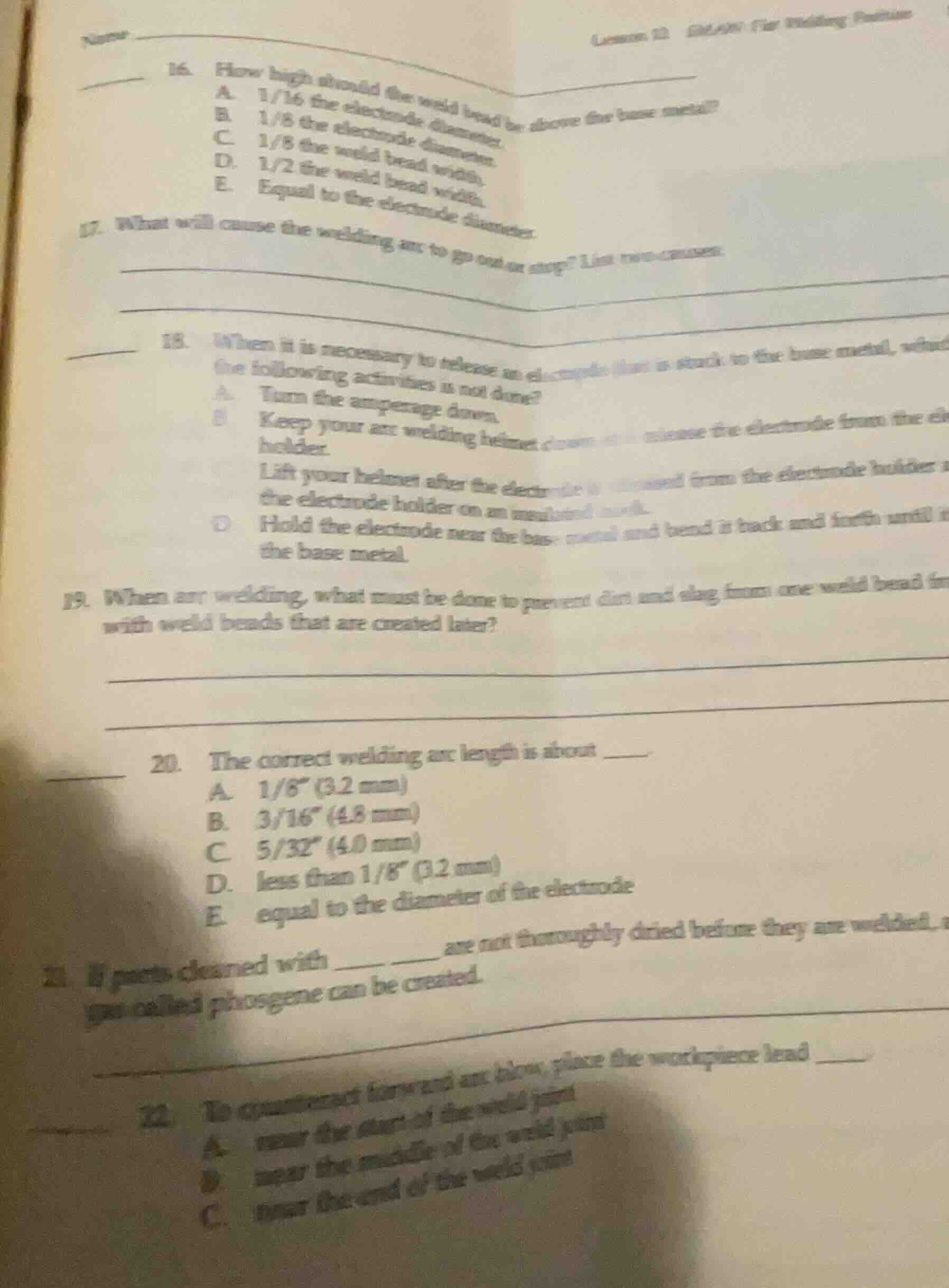
- how high should the weld bead be above the base metal?
a. 1/16 the electrode diameter.
b. 1/8 the electrode diameter.
c. 1/8 the weld bead width.
d. 1/2 the weld bead width.
e. equal to the electrode diameter.
- what will cause the welding arc to go out or stop? list two causes.
- when it is necessary to release an electrode that is stuck to the base metal, which of the following activities is not done?
a. turn the amperage down.
b. keep your arc welding helmet down as you release the electrode from the electrode holder.
lift your helmet after the electrode is released from the electrode holder and place the electrode holder on an insulated hook.
c. hold the electrode near the base metal and bend it back and forth until it breaks free from the base metal.
- when arc welding, what must be done to prevent dirt and slag from one weld bead from mixing with weld beads that are created later?
- the correct welding arc length is about _____.
a. 1/8\ (3.2 mm)
b. 3/16\ (4.8 mm)
c. 5/32\ (4.0 mm)
d. less than 1/8\ (3.2 mm)
e. equal to the diameter of the electrode
- if parts cleaned with ___ ___ are not thoroughly dried before they are welded, a gas called phosgene can be created.
- to counteract forward arc blow, place the workpiece lead _____.
a. near the start of the weld joint
b. near the middle of the weld joint
c. near the end of the weld joint
- For proper welding, the weld bead height above base metal follows standard guidelines related to electrode diameter.
- Welding arc interruption has common, documented causes related to equipment and technique.
- Safety and proper procedure dictate which action to avoid when freeing a stuck electrode.
- Preventing cross-contamination between weld beads requires standard surface preparation.
- Correct arc length is a key welding standard tied to electrode size.
- Certain cleaning agents produce toxic phosgene when heated if not dried.
- Counteracting arc blow uses a standard workpiece lead placement technique.

Snap & solve any problem in the app
Get step-by-step solutions on Sovi AI
Photo-based solutions with guided steps
Explore more problems and detailed explanations
- A. 1/16 the electrode diameter.
- 1. A loose or damaged electrode holder connection
- Low or inconsistent welding current supply
- C. Lift your helmet after the electrode is released from the electrode holder and place the electrode holder on an insulated hook.
- All existing weld beads must be thoroughly cleaned (chipped, wire-brushed) to remove all dirt, slag, and contaminants before laying new weld beads.
- E. equal to the diameter of the electrode
- chlorinated solvents (e.g., trichloroethylene)
- C. near the end of the weld joint