QUESTION IMAGE
Question
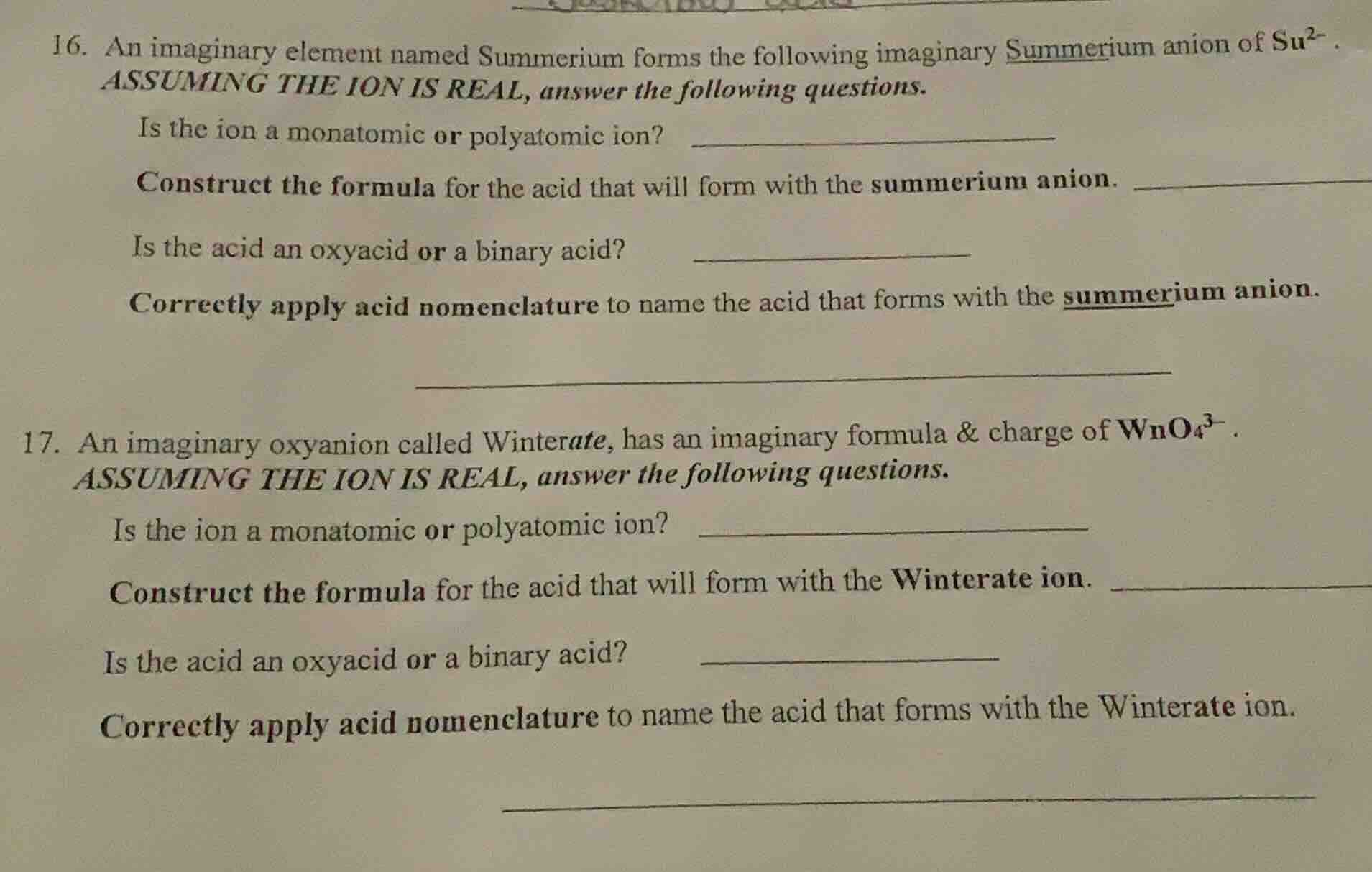
- an imaginary element named summerium forms the following imaginary summerium anion of su²⁻. assuming the ion is real, answer the following questions. is the ion a monatomic or polyatomic ion? construct the formula for the acid that will form with the summerium anion. is the acid an oxyacid or a binary acid? correctly apply acid nomenclature to name the acid that forms with the summerium anion. 17. an imaginary oxyanion called winterate, has an imaginary formula & charge of wno₄³⁻. assuming the ion is real, answer the following questions. is the ion a monatomic or polyatomic ion? construct the formula for the acid that will form with the winterate ion. is the acid an oxyacid or a binary acid? correctly apply acid nomenclature to name the acid that forms with the winterate ion.
Brief Explanations
For Question 16:
- Monatomic ions consist of a single atom; the ion $\text{Su}^{2-}$ only has the Summerium atom, so it is monatomic.
- To form a neutral acid, the $2-$ charge of $\text{Su}^{2-}$ is balanced by 2 $\text{H}^+$ ions.
- Binary acids only contain hydrogen and one other element, which matches the acid here.
- For binary acids, we use the prefix "hydro-", the root of the anion name, and the suffix "-ic acid".
For Question 17:
- Polyatomic ions contain multiple atoms; $\text{WnO}_4^{3-}$ has both Winterium and oxygen atoms, so it is polyatomic.
- To form a neutral acid, the $3-$ charge of $\text{WnO}_4^{3-}$ is balanced by 3 $\text{H}^+$ ions.
- Oxyacids contain hydrogen, another element, and oxygen, which matches this acid.
- For oxyanions ending in "-ate", the corresponding acid uses the root of the oxyanion name with the suffix "-ic acid".

Snap & solve any problem in the app
Get step-by-step solutions on Sovi AI
Photo-based solutions with guided steps
Explore more problems and detailed explanations
Question 16
- Monatomic ion
- $\text{H}_2\text{Su}$
- Binary acid
- Hydrosummeric acid
Question 17
- Polyatomic ion
- $\text{H}_3\text{WnO}_4$
- Oxyacid
- Winteric acid