QUESTION IMAGE
Question
- (select more than one) which of the following are reasons many african americans stayed in the south after the civil war?
a. lack of money needed to move to the north or west
b. job opportunities for unskilled workers in the north
c. they had ties with family that kept them there
d. they faced less violence and danger in southern states.
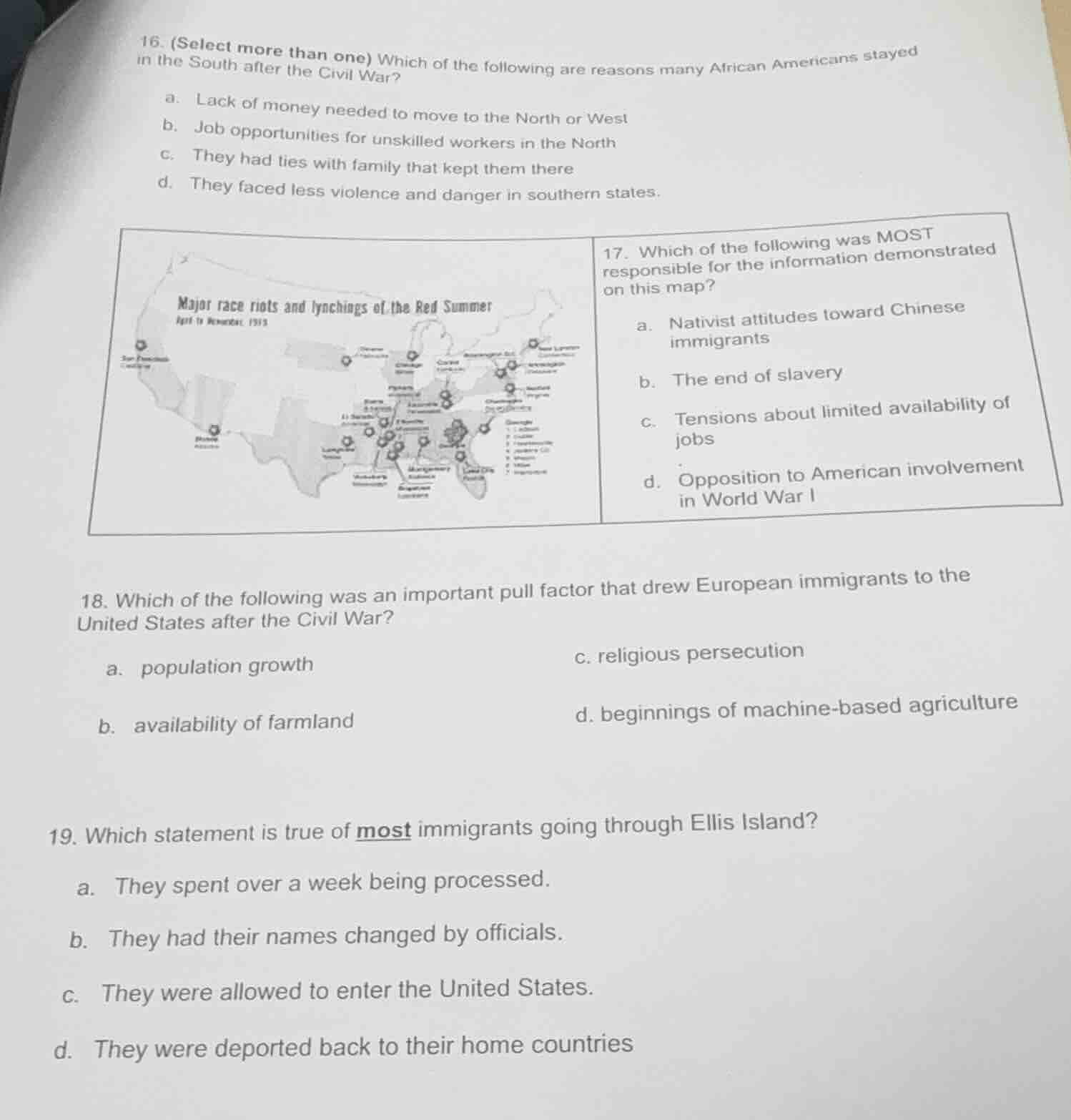
- which of the following was most responsible for the information demonstrated on this map?
map: major race riots and lynchings of the red summer, apr to november, 1919
a. nativist attitudes toward chinese immigrants
b. the end of slavery
c. tensions about limited availability of jobs
d. opposition to american involvement in world war i
- which of the following was an important pull factor that drew european immigrants to the united states after the civil war?
a. population growth\tc. religious persecution
b. availability of farmland\td. beginnings of machine - based agriculture
- which statement is true of most immigrants going through ellis island?
a. they spent over a week being processed.
b. they had their names changed by officials.
c. they were allowed to enter the united states.
d. they were deported back to their home countries
Question 16:
- Option a: Many African Americans had no savings to cover relocation costs to the North/West.
- Option c: Strong family and community bonds in the South discouraged movement.
- Option b is incorrect; limited unskilled jobs in the North were a push, not a stay factor.
- Option d is incorrect; the South had intense racial violence post-Civil War.
Question 17:
The map shows the 1919 Red Summer, a wave of racial riots and lynchings. These were driven by competition for jobs between Black Americans (migrating North in the Great Migration) and white workers amid post-WWI economic strain.
- Option a is incorrect; the map focuses on Black-white tensions, not Chinese immigrants.
- Option b is incorrect; slavery ended decades before 1919.
- Option d is incorrect; opposition to WWI was unrelated to these racial attacks.
Question 18:
Pull factors attract immigrants to a new country. Abundant, affordable farmland in the U.S. drew European immigrants seeking economic opportunity.
- Option a is a U.S. domestic trend, not a pull factor.
- Option c is a push factor (driving immigrants out of Europe).
- Option d is a European economic change that pushed immigrants away.
Question 19:
Ellis Island processing was designed to admit most immigrants; only a small fraction (around 2%) were deported for health or legal reasons.
- Option a is incorrect; most were processed in hours to a day.
- Option b is incorrect; name changes were rare and usually initiated by immigrants.
- Option d is incorrect; deportation was uncommon.

Snap & solve any problem in the app
Get step-by-step solutions on Sovi AI
Photo-based solutions with guided steps
Explore more problems and detailed explanations
- a. Lack of money needed to move to the North or West, c. They had ties with family that kept them there
- c. Tensions about limited availability of jobs
- b. availability of farmland
- c. They were allowed to enter the United States.