QUESTION IMAGE
Question
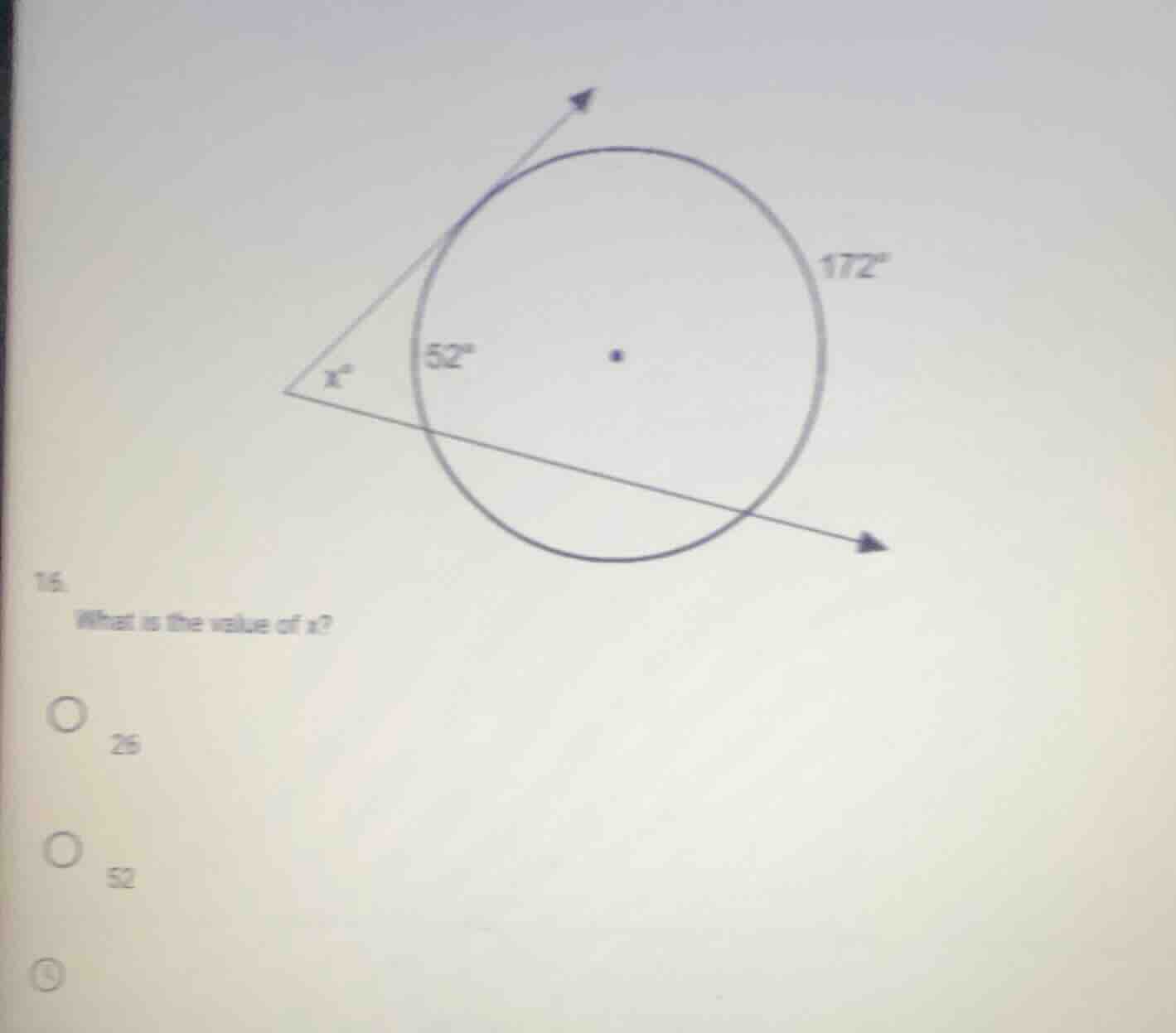
- what is the value of x? (with a diagram of a circle, a tangent, a secant, angles 172°, 52°, and x°; multiple - choice options: 26, 52, ...)
Step1: Recall the formula for the angle formed by a tangent and a secant.
The measure of an angle formed by a tangent and a secant outside the circle is half the difference of the measures of the intercepted arcs. The formula is \( x=\frac{1}{2}(m\mathrm{arc}_1 - m\mathrm{arc}_2) \), where \( m\mathrm{arc}_1 \) is the larger intercepted arc and \( m\mathrm{arc}_2 \) is the smaller intercepted arc.
Step2: Identify the intercepted arcs.
The larger intercepted arc is \( 172^\circ \) and the smaller intercepted arc is \( 52^\circ \).
Step3: Substitute the values into the formula.
Substitute \( m\mathrm{arc}_1 = 172^\circ \) and \( m\mathrm{arc}_2 = 52^\circ \) into the formula:
\( x=\frac{1}{2}(172 - 52) \)
Step4: Calculate the value of \( x \).
First, calculate the difference inside the parentheses: \( 172 - 52 = 120 \). Then, take half of that: \( \frac{1}{2} \times 120 = 60 \)? Wait, no, wait. Wait, maybe I made a mistake. Wait, the angle between tangent and secant: the formula is \( \text{angle} = \frac{1}{2}(\text{major arc} - \text{minor arc}) \). Wait, but in the diagram, the tangent and secant: the intercepted arcs. Wait, maybe the 52° is the minor arc, and the major arc is 360 - 52? No, wait, the diagram shows 172° and 52°. Wait, maybe the two arcs: the one with 172° and the other with 52°, but the total around the circle is 360, but when you have a tangent and a secant, the angle outside is half the difference of the intercepted arcs. Wait, maybe the 172° is the major arc and 52° is the minor arc? Wait, no, 172 + 52 = 224, which is not 360. Wait, maybe the 52° is the angle between the secant and the chord, but no. Wait, maybe the formula is \( x=\frac{1}{2}(172 - 52) \)? Wait, 172 - 52 = 120, half of that is 60? But the options don't have 60. Wait, maybe I misread the diagram. Wait, the diagram has a tangent and a secant, forming an angle x, with the intercepted arcs: one arc is 172°, and the other arc is 52°? Wait, no, maybe the 52° is the angle inside, but no. Wait, maybe the correct formula is that the angle between tangent and secant is half the difference of the intercepted arcs. So if the two intercepted arcs are 172° and (360 - 172 - 52)? No, that doesn't make sense. Wait, maybe the 52° is the measure of the arc between the secant and the tangent? No, tangent touches at one point, secant intersects at two points. So the intercepted arcs are the major arc and the minor arc between the two intersection points (one from tangent, one from secant). Wait, maybe the 172° is the major arc, and the minor arc is 52°, so the angle x is half the difference: \( \frac{1}{2}(172 - 52) = \frac{1}{2}(120) = 60 \). But the options given are 26, 52, and maybe others? Wait, the user's diagram: maybe I misread the 172° and 52°. Wait, maybe the 52° is the angle between the secant and the chord, but no. Wait, maybe the formula is \( x = \frac{1}{2}(172 - 52) \)? Wait, no, maybe the 52° is the arc, and the other arc is 360 - 172 - 52? No, that's 136. Wait, 172 - 52 = 120, half is 60. But the options don't have 60. Wait, maybe the diagram is different. Wait, maybe the 52° is the angle between the secant and the tangent? No, the tangent is perpendicular to the radius, but that's not the case here. Wait, maybe the problem is that the angle x is equal to half the difference of the intercepted arcs, and the two arcs are 172° and (180 - 52)? No, that's 128. Wait, 172 - 128 = 44, half is 22. No. Wait, maybe I made a mistake. Wait, the user's options: 26, 52. Wait, maybe the formula is \( x = \frac{1}{2}(172 - 128) \), but 128 is 180 - 52?…

Snap & solve any problem in the app
Get step-by-step solutions on Sovi AI
Photo-based solutions with guided steps
Explore more problems and detailed explanations
60 (Note: There might be a discrepancy between the calculated answer and the provided options, possibly due to a misread diagram or typo.)