QUESTION IMAGE
Question
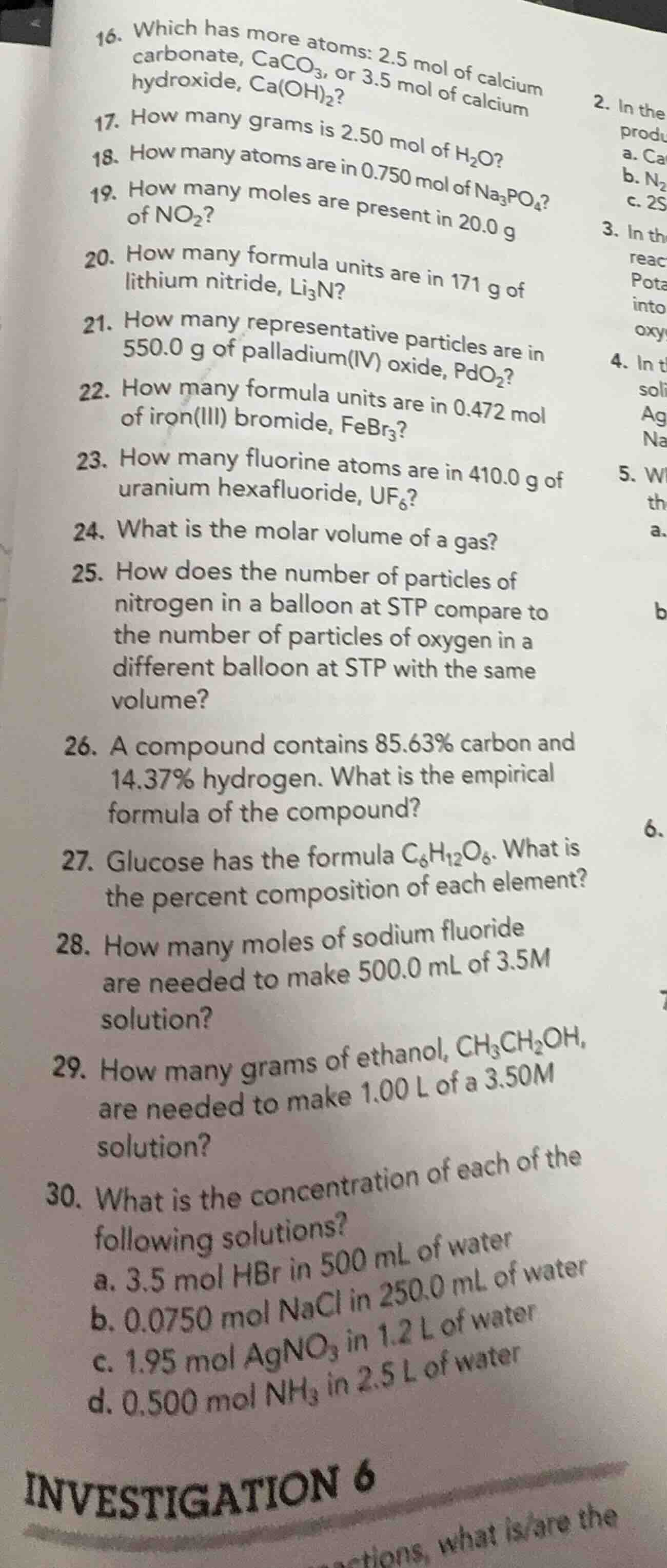
- which has more atoms: 2.5 mol of calcium carbonate, $\text{caco}_3$, or 3.5 mol of calcium hydroxide, $\text{ca(oh)}_2$?
- how many grams is 2.50 mol of $\text{h}_2\text{o}$?
- how many atoms are in 0.750 mol of $\text{na}_3\text{po}_4$?
- how many moles are present in 20.0 g of $\text{no}_2$?
- how many formula units are in 171 g of lithium nitride, $\text{li}_3\text{n}$?
- how many representative particles are in 550.0 g of palladium(iv) oxide, $\text{pdo}_2$?
- how many formula units are in 0.472 mol of iron(iii) bromide, $\text{febr}_3$?
- how many fluorine atoms are in 410.0 g of uranium hexafluoride, $\text{uf}_6$?
- what is the molar volume of a gas?
- how does the number of particles of nitrogen in a balloon at stp compare to the number of particles of oxygen in a different balloon at stp with the same volume?
- a compound contains 85.63% carbon and 14.37% hydrogen. what is the empirical formula of the compound?
- glucose has the formula $\text{c}_6\text{h}_{12}\text{o}_6$. what is the percent composition of each element?
- how many moles of sodium fluoride are needed to make 500.0 ml of 3.5m solution?
- how many grams of ethanol, $\text{ch}_3\text{ch}_2\text{oh}$, are needed to make 1.00 l of a 3.50m solution?
- what is the concentration of each of the following solutions?
a. 3.5 mol $\text{hbr}$ in 500 ml of water
b. 0.0750 mol $\text{nacl}$ in 250.0 ml of water
c. 1.95 mol $\text{agno}_3$ in 1.2 l of water
d. 0.500 mol $\text{nh}_3$ in 2.5 l of water
investigation 6
---
Question 16
Step1: Count atoms per formula unit
$\text{CaCO}_3$: $1+1+3=5$ atoms; $\text{Ca(OH)}_2$: $1+2+2=5$ atoms
Step2: Calculate total atoms for each
$2.5\ \text{mol} \times 5 \times 6.022\times10^{23}\ \text{atoms/mol} = 7.5275\times10^{24}\ \text{atoms}$
$3.5\ \text{mol} \times 5 \times 6.022\times10^{23}\ \text{atoms/mol} = 1.05385\times10^{25}\ \text{atoms}$
Step3: Compare the two values
$1.05385\times10^{25} > 7.5275\times10^{24}$
---
Question 17
Step1: Find molar mass of $\text{H}_2\text{O}$
$M = (2\times1.008) + 16.00 = 18.016\ \text{g/mol}$
Step2: Calculate mass from moles
$m = n \times M = 2.50\ \text{mol} \times 18.016\ \text{g/mol}$
---
Question 18
Step1: Count atoms per formula unit
$\text{Na}_3\text{PO}_4$: $3+1+4=8$ atoms
Step2: Calculate total atoms
$\text{Total atoms} = 0.750\ \text{mol} \times 8 \times 6.022\times10^{23}\ \text{atoms/mol}$
---
Question 19
Step1: Find molar mass of $\text{NO}_2$
$M = 14.01 + (2\times16.00) = 46.01\ \text{g/mol}$
Step2: Calculate moles from mass
$n = \frac{m}{M} = \frac{20.0\ \text{g}}{46.01\ \text{g/mol}}$
---
Question 20
Step1: Find molar mass of $\text{Li}_3\text{N}$
$M = (3\times6.94) + 14.01 = 34.83\ \text{g/mol}$
Step2: Calculate moles of $\text{Li}_3\text{N}$
$n = \frac{171\ \text{g}}{34.83\ \text{g/mol}}$
Step3: Find formula units
$\text{Formula units} = n \times 6.022\times10^{23}\ \text{units/mol}$
---
Question 21
Step1: Find molar mass of $\text{PdO}_2$
$M = 106.42 + (2\times16.00) = 138.42\ \text{g/mol}$
Step2: Calculate moles of $\text{PdO}_2$
$n = \frac{550.0\ \text{g}}{138.42\ \text{g/mol}}$
Step3: Find representative particles
$\text{Particles} = n \times 6.022\times10^{23}\ \text{particles/mol}$
---
Question 22
Step1: Relate moles to formula units
$\text{Formula units} = n \times 6.022\times10^{23}\ \text{units/mol}$
Step2: Substitute the given moles
$\text{Formula units} = 0.472\ \text{mol} \times 6.022\times10^{23}\ \text{units/mol}$
---
Question 23
Step1: Find molar mass of $\text{UF}_6$
$M = 238.03 + (6\times19.00) = 352.03\ \text{g/mol}$
Step2: Calculate moles of $\text{UF}_6$
$n = \frac{410.0\ \text{g}}{352.03\ \text{g/mol}}$
Step3: Calculate moles of F atoms
$n_{\text{F}} = n \times 6$
Step4: Calculate total F atoms
$\text{F atoms} = n_{\text{F}} \times 6.022\times10^{23}\ \text{atoms/mol}$
---
Question 24
Step1: Define molar volume at STP
Molar volume is the volume occupied by 1 mole of a gas at standard temperature and pressure (STP: 1 atm, 273.15 K).
Step2: State the standard value
At STP, 1 mole of any ideal gas occupies 22.4 L.
---
Question 25
Step1: Apply Avogadro's Law
Avogadro's Law states that equal volumes of gases at the same temperature and pressure contain equal numbers of particles.
Step2: Compare the two samples
Both balloons have the same volume at STP, so they have the same number of particles.
---
Question 26
Step1: Assume 100g sample, find moles
$n_{\text{C}} = \frac{85.63\ \text{g}}{12.01\ \text{g/mol}} \approx 7.13\ \text{mol}$
$n_{\text{H}} = \frac{14.37\ \text{g}}{1.008\ \text{g/mol}} \approx 14.26\ \text{mol}$
Step2: Find mole ratio
$\frac{n_{\text{H}}}{n_{\text{C}}} = \frac{14.26}{7.13} = 2$
Step3: Write empirical formula
The ratio $\text{C:H} = 1:2$, so empirical formula is $\text{CH}_2$.
---
Question 27
Step1: Find molar mass of glucose
$M = (6\times12.01) + (12\times1.008) + (6\times16.00) = 180.156\ \text{g/mol}$
Step2: Calculate % composition of C
$\% \text{C} = \frac{6\times12.01}{180.156…

Snap & solve any problem in the app
Get step-by-step solutions on Sovi AI
Photo-based solutions with guided steps
Explore more problems and detailed explanations
- 3.5 mol of calcium hydroxide ($\text{Ca(OH)}_2$) has more atoms.
- $45.0\ \text{g}$
- $3.61\times10^{24}\ \text{atoms}$
- $0.435\ \text{mol}$
- $2.96\times10^{24}\ \text{formula units}$
- $2.40\times10^{24}\ \text{representative particles}$
- $2.84\times10^{23}\ \text{formula units}$
- $4.30\times10^{24}\ \text{fluorine atoms}$
- At standard temperature and pressure (STP, 1 atm and 273.15 K), the molar volume of any ideal gas is 22.4 liters per mole.
- The number of nitrogen particles is equal to the number of oxygen particles.
- $\text{CH}_2$
- $\% \text{C} = 40.00\%$, $\% \text{H} = 6.71\%$, $\% \text{O} = 53.29\%$
- $1.8\ \text{mol}$
- $161\ \text{g}$
- a. $7.0\ \text{M}$; b. $0.300\ \text{M}$; c. $1.6\ \text{M}$; d. $0.20\ \text{M}$