QUESTION IMAGE
Question
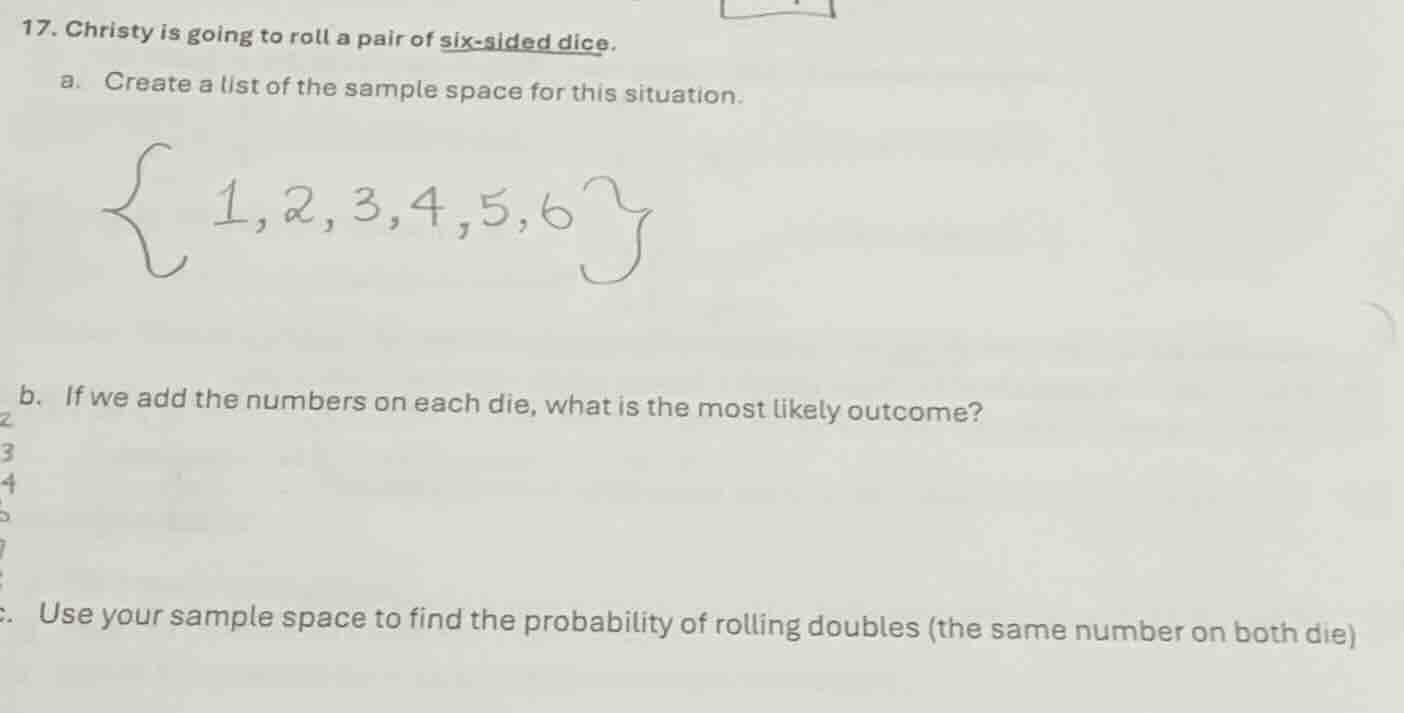
- christy is going to roll a pair of six - sided dice.
a. create a list of the sample space for this situation.
b. if we add the numbers on each die, what is the most likely outcome?
c. use your sample space to find the probability of rolling doubles (the same number on both die)
Part a
Step1: Define sample space for two dice
When rolling two six - sided dice, each die can show a number from 1 to 6. The sample space \(S\) consists of all ordered pairs \((x,y)\) where \(x\) is the result of the first die and \(y\) is the result of the second die.
So the sample space is \(\{(1,1),(1,2),(1,3),(1,4),(1,5),(1,6),(2,1),(2,2),(2,3),(2,4),(2,5),(2,6),(3,1),(3,2),(3,3),(3,4),(3,5),(3,6),(4,1),(4,2),(4,3),(4,4),(4,5),(4,6),(5,1),(5,2),(5,3),(5,4),(5,5),(5,6),(6,1),(6,2),(6,3),(6,4),(6,5),(6,6)\}\)
Step1: Calculate the sum for each pair
For each pair \((x,y)\) in the sample space, calculate \(x + y\):
- For \((1,1)\), sum \(= 2\); \((1,2)\) sum \(= 3\); \((1,3)\) sum \(= 4\); \((1,4)\) sum \(= 5\); \((1,5)\) sum \(= 6\); \((1,6)\) sum \(= 7\)
- For \((2,1)\) sum \(= 3\); \((2,2)\) sum \(= 4\); \((2,3)\) sum \(= 5\); \((2,4)\) sum \(= 6\); \((2,5)\) sum \(= 7\); \((2,6)\) sum \(= 8\)
- For \((3,1)\) sum \(= 4\); \((3,2)\) sum \(= 5\); \((3,3)\) sum \(= 6\); \((3,4)\) sum \(= 7\); \((3,5)\) sum \(= 8\); \((3,6)\) sum \(= 9\)
- For \((4,1)\) sum \(= 5\); \((4,2)\) sum \(= 6\); \((4,3)\) sum \(= 7\); \((4,4)\) sum \(= 8\); \((4,5)\) sum \(= 9\); \((4,6)\) sum \(= 10\)
- For \((5,1)\) sum \(= 6\); \((5,2)\) sum \(= 7\); \((5,3)\) sum \(= 8\); \((5,4)\) sum \(= 9\); \((5,5)\) sum \(= 10\); \((5,6)\) sum \(= 11\)
- For \((6,1)\) sum \(= 7\); \((6,2)\) sum \(= 8\); \((6,3)\) sum \(= 9\); \((6,4)\) sum \(= 10\); \((6,5)\) sum \(= 11\); \((6,6)\) sum \(= 12\)
Step2: Count the frequency of each sum
- Sum of 2: 1 time
- Sum of 3: 2 times
- Sum of 4: 3 times
- Sum of 5: 4 times
- Sum of 6: 5 times
- Sum of 7: 6 times
- Sum of 8: 5 times
- Sum of 9: 4 times
- Sum of 10: 3 times
- Sum of 11: 2 times
- Sum of 12: 1 time
The sum with the highest frequency is 7.
Step1: Identify the number of doubles
The doubles in the sample space are \((1,1),(2,2),(3,3),(4,4),(5,5),(6,6)\). So there are 6 favorable outcomes.
Step2: Find the total number of outcomes
From the sample space in part (a), the total number of possible outcomes when rolling two dice is \(6\times6 = 36\).
Step3: Calculate the probability
The probability \(P\) of an event is given by the formula \(P=\frac{\text{Number of favorable outcomes}}{\text{Total number of outcomes}}\). So \(P(\text{rolling doubles})=\frac{6}{36}=\frac{1}{6}\)

Snap & solve any problem in the app
Get step-by-step solutions on Sovi AI
Photo-based solutions with guided steps
Explore more problems and detailed explanations
\(\{(1,1),(1,2),(1,3),(1,4),(1,5),(1,6),(2,1),(2,2),(2,3),(2,4),(2,5),(2,6),(3,1),(3,2),(3,3),(3,4),(3,5),(3,6),(4,1),(4,2),(4,3),(4,4),(4,5),(4,6),(5,1),(5,2),(5,3),(5,4),(5,5),(5,6),(6,1),(6,2),(6,3),(6,4),(6,5),(6,6)\}\)