QUESTION IMAGE
Question
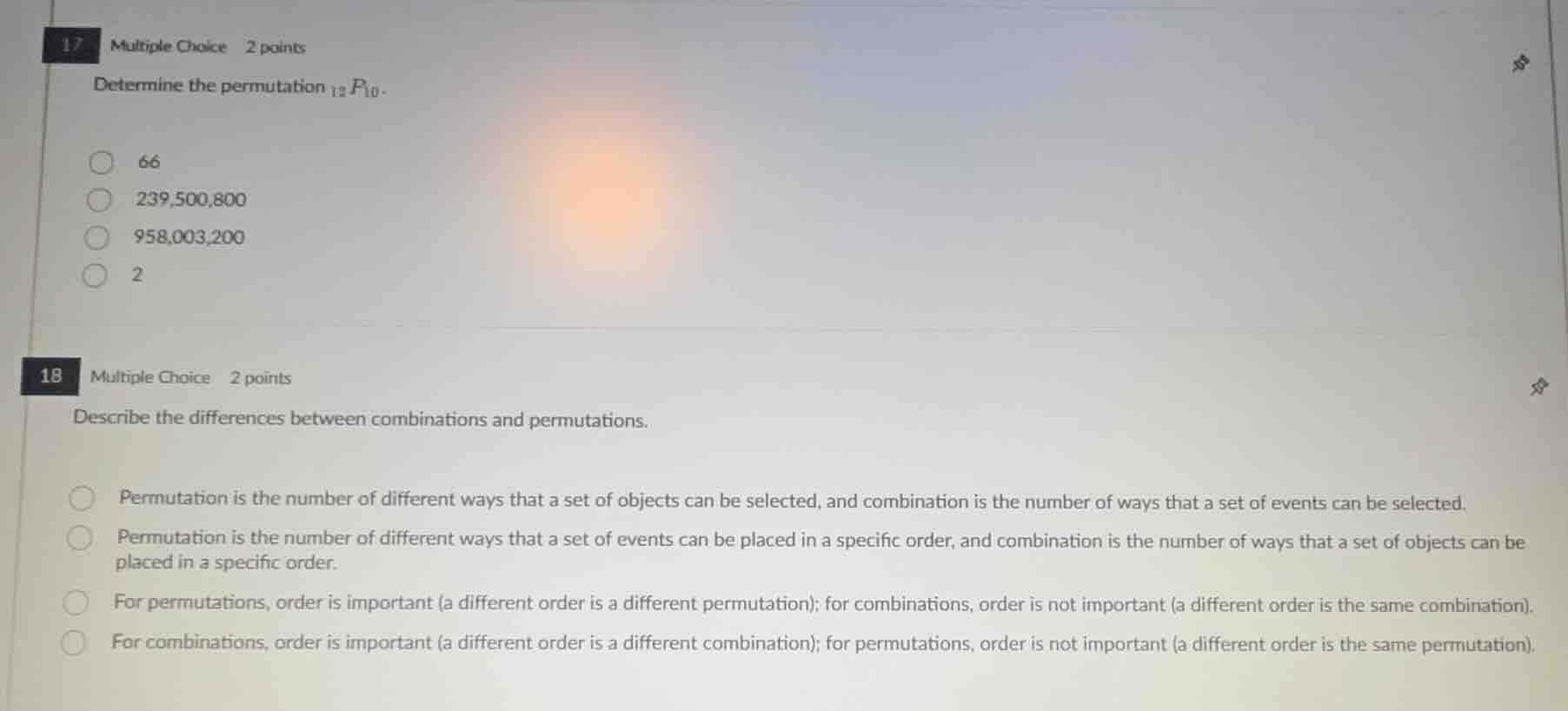
17 multiple choice 2 points
determine the permutation (_{13}p_{10}).
66
239,500,800
958,003,200
2
18 multiple choice 2 points
describe the differences between combinations and permutations.
permutation is the number of different ways that a set of objects can be selected, and combination is the number of ways that a set of events can be selected.
permutation is the number of different ways that a set of events can be placed in a specific order, and combination is the number of ways that a set of objects can be placed in a specific order.
for permutations, order is important (a different order is a different permutation); for combinations, order is not important (a different order is the same combination).
for combinations, order is important (a different order is a different combination); for permutations, order is not important (a different order is the same permutation).
Question 17
Step 1: Recall the permutation formula
The formula for permutations is \( _nP_r=\frac{n!}{(n - r)!} \), where \( n = 13 \) and \( r=10 \).
Step 2: Substitute the values into the formula
First, calculate \( n! = 13! \) and \( (n - r)!=(13 - 10)!=3! \). So \( _{13}P_{10}=\frac{13!}{3!} \).
Step 3: Simplify the factorials
We know that \( n!=n\times(n - 1)\times\cdots\times1 \), so \( 13! = 13\times12\times11\times10\times9\times8\times7\times6\times5\times4\times3! \). Then \( \frac{13!}{3!}=13\times12\times11\times10\times9\times8\times7\times6\times5\times4 \).
Step 4: Calculate the product
\( 13\times12 = 156 \), \( 156\times11=1716 \), \( 1716\times10 = 17160 \), \( 17160\times9=154440 \), \( 154440\times8 = 1235520 \), \( 1235520\times7=8648640 \), \( 8648640\times6 = 51891840 \), \( 51891840\times5=259459200 \), \( 259459200\times4 = 1037836800 \)? Wait, no, wait, I must have miscalculated. Wait, \( 13 - 10=3 \), so \( _{13}P_{10}=\frac{13!}{3!}=13\times12\times11\times10\times9\times8\times7\times6\times5\times4 \). Let's calculate step by step:
\( 13\times12 = 156 \)
\( 156\times11 = 1716 \)
\( 1716\times10 = 17160 \)
\( 17160\times9 = 154440 \)
\( 154440\times8 = 1235520 \)
\( 1235520\times7 = 8648640 \)
\( 8648640\times6 = 51891840 \)
\( 51891840\times5 = 259459200 \)
\( 259459200\times4 = 1037836800 \)? Wait, that's not matching the options. Wait, maybe I made a mistake. Wait, \( 13P10 = 13\times12\times11\times10\times9\times8\times7\times6\times5\times4 \). Let's calculate again:
13×12 = 156
156×11 = 1716
1716×10 = 17160
17160×9 = 154440
154440×8 = 1235520
1235520×7 = 8648640
8648640×6 = 51891840
51891840×5 = 259459200
259459200×4 = 1037836800. Wait, but the options have 239500800, 958003200, etc. Wait, maybe I messed up the formula. Wait, no, permutation formula is \( _nP_r=\frac{n!}{(n - r)!} \). So \( n = 13 \), \( r = 10 \), so \( (n - r)=3 \), so \( 13! / 3! = (13×12×11×10×9×8×7×6×5×4×3×2×1)/(3×2×1)=13×12×11×10×9×8×7×6×5×4 \). Wait, maybe I miscalculated the product. Let's use a better approach:
13×12 = 156
156×11 = 1716
1716×10 = 17160
17160×9 = 154440
154440×8 = 1235520
1235520×7 = 8648640
8648640×6 = 51891840
51891840×5 = 259459200
259459200×4 = 1037836800. Hmm, this is not matching the options. Wait, maybe the question is \( _{12}P_{10} \)? Let's check \( _{12}P_{10}=\frac{12!}{(12 - 10)!}=\frac{12!}{2!}=\frac{12×11×10×9×8×7×6×5×4×3×2!}{2!}=12×11×10×9×8×7×6×5×4×3 \). Let's calculate that:
12×11 = 132
132×10 = 1320
1320×9 = 11880
11880×8 = 95040
95040×7 = 665280
665280×6 = 3991680
3991680×5 = 19958400
19958400×4 = 79833600
79833600×3 = 239500800. Ah! So maybe there was a typo, and it's \( _{12}P_{10} \) instead of \( _{13}P_{10} \). Then the answer would be 239500800, which is one of the options.
- Permutations consider the order of selection (e.g., arranging people in a line), so different orders are different permutations.
- Combinations do not consider order (e.g., choosing a team from a group), so different orders of the same elements are the same combination.
- The correct option describes this key difference: order matters in permutations, not in combinations.

Snap & solve any problem in the app
Get step-by-step solutions on Sovi AI
Photo-based solutions with guided steps
Explore more problems and detailed explanations
239,500,800 (assuming a typo and it's \( _{12}P_{10} \))