QUESTION IMAGE
Question
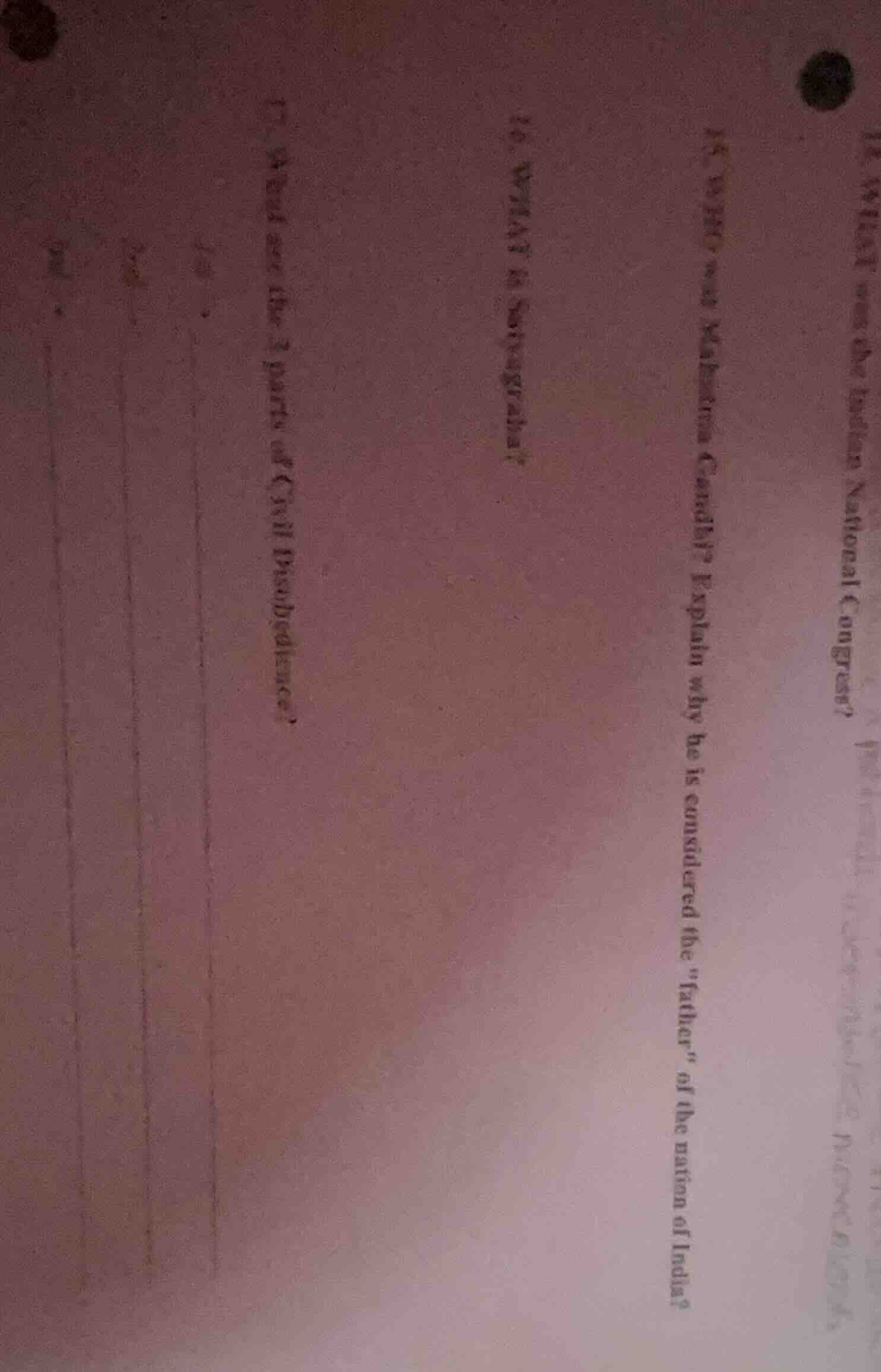
- what are the 3 parts of civil disobedience?
- what is satyagraha?
- who was mahatma gandhi? explain why he is considered the \father\ of the nation of india?
- what are the indian national congress?
Response
To address the question "What are the 3 parts of Civil Disobedience?", we analyze it as follows:
Brief Explanations
The concept of Civil Disobedience, often associated with figures like Mahatma Gandhi, typically has three main parts (though interpretations can vary slightly). These are:
- Non - Cooperation: This involves refusing to cooperate with institutions or systems that are perceived as unjust. For example, in the Indian context, this could mean boycotting British - made goods, educational institutions, and government services.
- Non - Violence (Ahimsa): The use of peaceful means to protest against injustice. It emphasizes that even in the face of oppression, one should not resort to violence. This is a core principle as it distinguishes civil disobedience from other forms of protest that may involve force.
- Satyagraha (Truth - Force): This is about seeking truth and using the power of truth to bring about change. It involves standing firmly for what one believes is right, through peaceful and honest means, and being willing to suffer for that truth rather than inflicting suffering on others.

Snap & solve any problem in the app
Get step-by-step solutions on Sovi AI
Photo-based solutions with guided steps
Explore more problems and detailed explanations
The three parts of Civil Disobedience (often associated with Gandhian thought) are:
- Non - Cooperation (refusing to cooperate with unjust systems).
- Non - Violence (Ahimsa, using peaceful means of protest).
- Satyagraha (Truth - Force, standing for truth through peaceful and honest means).