QUESTION IMAGE
Question
- 18 in, 5 in, 5 in, 17 in, 5 in, 5 in
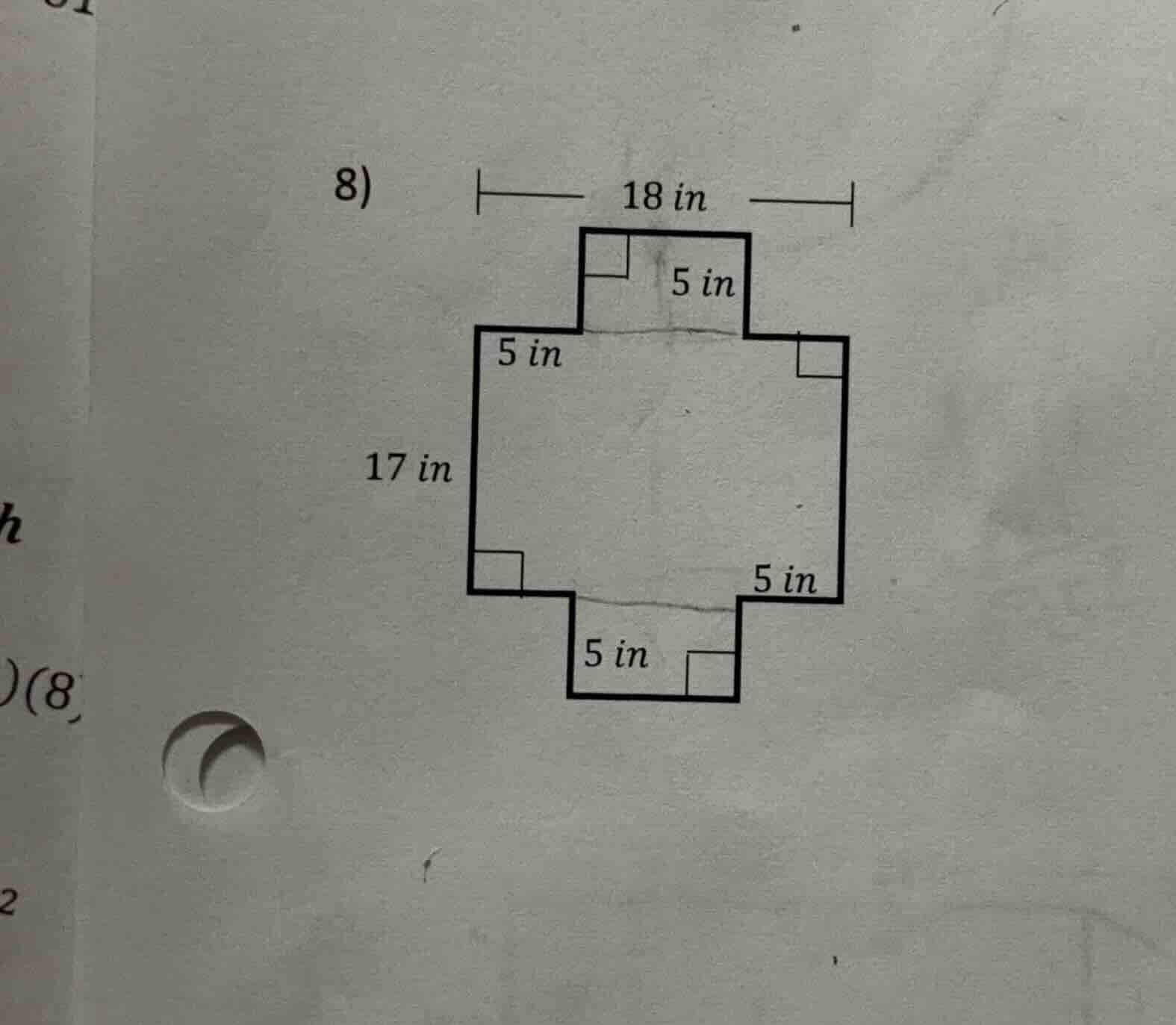
To find the area of this composite figure, we can use the method of subtracting the areas of the missing parts from the area of the larger rectangle (or we can also think of it as adding the areas of the main rectangle and the two small squares, but let's check the dimensions first). Wait, actually, looking at the figure, the main part seems to be a rectangle with length 18 in and height 17 in, but there are some indentations and protrusions. Wait, no, maybe a better approach is to consider the figure as a combination of a central rectangle and two squares (the top protrusion and the bottom protrusion, each of side 5 in). Wait, let's analyze the dimensions:
First, let's find the length and width of the main rectangle. Wait, the horizontal length is 18 in. The vertical height: the main vertical side is 17 in, but there is a 5 in protrusion at the top and a 5 in protrusion at the bottom? Wait, no, looking at the right side, the vertical segment is 5 in, and the left side is 17 in. Wait, maybe the figure can be considered as a rectangle with length 18 in and height 17 in, plus a square of 5x5 at the top and a square of 5x5 at the bottom? Wait, no, maybe not. Wait, actually, the figure has a central rectangle, and then a square on top (5x5) and a square at the bottom (5x5). Wait, let's check the horizontal length: the top square has a horizontal length that is equal to the width of the square, but the total horizontal length is 18 in. Wait, maybe the central rectangle has a length of 18 in and a height of 17 in, and then we have two squares (top and bottom) each of 5x5. Wait, but let's calculate the area:
Area of central rectangle: length × height = 18 in × 17 in = 306 in²
Area of top square: 5 in × 5 in = 25 in²
Area of bottom square: 5 in × 5 in = 25 in²
Total area = 306 + 25 + 25 = 356 in²? Wait, no, maybe that's not correct. Wait, maybe the figure is a rectangle with length 18 in and height 17 in, but with a square cut out? No, the top has a protrusion, not a cut. Wait, let's look at the right angle marks. The top part is a square of 5x5, the bottom part is a square of 5x5, and the middle is a rectangle. Wait, the middle rectangle: horizontal length 18 in, vertical height: 17 in - 5 in (top square) - 5 in (bottom square)? No, that can't be. Wait, maybe I'm overcomplicating. Let's use the method of adding all the parts:
- The main rectangle: length = 18 in, height = 17 in. Area = 18 * 17 = 306 in².
- The top square: side = 5 in. Area = 5 * 5 = 25 in².
- The bottom square: side = 5 in. Area = 5 * 5 = 25 in².
Total area = 306 + 25 + 25 = 356 in². Wait, but let's check if the top square's horizontal length is equal to the width of the main rectangle. The top square is attached to the main rectangle, so its horizontal length should be equal to the width of the square, which is 5 in, but the main rectangle's horizontal length is 18 in. Wait, that doesn't make sense. Wait, maybe the figure is a rectangle with length 18 in and height 17 in, and then two squares (each 5x5) are added on top and bottom. Wait, but the horizontal length of the top square: is it 5 in? Then the main rectangle's horizontal length would be 18 in, and the top square is 5 in wide, so that's okay. Similarly, the bottom square is 5 in wide. So total area is 1817 + 55 + 5*5 = 306 + 25 + 25 = 356 in².
Alternatively, another approach: the figure can be seen as a rectangle with length 18 in and height (17 + 5 + 5) = 27 in? No, that's not right. Wait, no, the left side is 17 in, the right side has a 5 in segment. Wait, maybe the vertical height is 17 + 5 + 5 =…

Snap & solve any problem in the app
Get step-by-step solutions on Sovi AI
Photo-based solutions with guided steps
Explore more problems and detailed explanations
To find the area of this composite figure, we can use the method of subtracting the areas of the missing parts from the area of the larger rectangle (or we can also think of it as adding the areas of the main rectangle and the two small squares, but let's check the dimensions first). Wait, actually, looking at the figure, the main part seems to be a rectangle with length 18 in and height 17 in, but there are some indentations and protrusions. Wait, no, maybe a better approach is to consider the figure as a combination of a central rectangle and two squares (the top protrusion and the bottom protrusion, each of side 5 in). Wait, let's analyze the dimensions:
First, let's find the length and width of the main rectangle. Wait, the horizontal length is 18 in. The vertical height: the main vertical side is 17 in, but there is a 5 in protrusion at the top and a 5 in protrusion at the bottom? Wait, no, looking at the right side, the vertical segment is 5 in, and the left side is 17 in. Wait, maybe the figure can be considered as a rectangle with length 18 in and height 17 in, plus a square of 5x5 at the top and a square of 5x5 at the bottom? Wait, no, maybe not. Wait, actually, the figure has a central rectangle, and then a square on top (5x5) and a square at the bottom (5x5). Wait, let's check the horizontal length: the top square has a horizontal length that is equal to the width of the square, but the total horizontal length is 18 in. Wait, maybe the central rectangle has a length of 18 in and a height of 17 in, and then we have two squares (top and bottom) each of 5x5. Wait, but let's calculate the area:
Area of central rectangle: length × height = 18 in × 17 in = 306 in²
Area of top square: 5 in × 5 in = 25 in²
Area of bottom square: 5 in × 5 in = 25 in²
Total area = 306 + 25 + 25 = 356 in²? Wait, no, maybe that's not correct. Wait, maybe the figure is a rectangle with length 18 in and height 17 in, but with a square cut out? No, the top has a protrusion, not a cut. Wait, let's look at the right angle marks. The top part is a square of 5x5, the bottom part is a square of 5x5, and the middle is a rectangle. Wait, the middle rectangle: horizontal length 18 in, vertical height: 17 in - 5 in (top square) - 5 in (bottom square)? No, that can't be. Wait, maybe I'm overcomplicating. Let's use the method of adding all the parts:
- The main rectangle: length = 18 in, height = 17 in. Area = 18 * 17 = 306 in².
- The top square: side = 5 in. Area = 5 * 5 = 25 in².
- The bottom square: side = 5 in. Area = 5 * 5 = 25 in².
Total area = 306 + 25 + 25 = 356 in². Wait, but let's check if the top square's horizontal length is equal to the width of the main rectangle. The top square is attached to the main rectangle, so its horizontal length should be equal to the width of the square, which is 5 in, but the main rectangle's horizontal length is 18 in. Wait, that doesn't make sense. Wait, maybe the figure is a rectangle with length 18 in and height 17 in, and then two squares (each 5x5) are added on top and bottom. Wait, but the horizontal length of the top square: is it 5 in? Then the main rectangle's horizontal length would be 18 in, and the top square is 5 in wide, so that's okay. Similarly, the bottom square is 5 in wide. So total area is 1817 + 55 + 5*5 = 306 + 25 + 25 = 356 in².
Alternatively, another approach: the figure can be seen as a rectangle with length 18 in and height (17 + 5 + 5) = 27 in? No, that's not right. Wait, no, the left side is 17 in, the right side has a 5 in segment. Wait, maybe the vertical height is 17 + 5 + 5 = 27? No, that doesn't match. Wait, maybe I made a mistake. Let's look at the coordinates or the segments:
- The left side: 17 in (vertical)
- The right side: 5 in (vertical)
- The top horizontal: 18 in
- The top protrusion: 5 in (vertical) and 5 in (horizontal, since it's a square)
- The bottom protrusion: 5 in (vertical) and 5 in (horizontal)
Wait, maybe the correct way is to calculate the area as the area of the rectangle with length 18 in and height 17 in, plus the area of the top square (5x5) and the area of the bottom square (5x5). So:
Area = (18 17) + (5 5) + (5 * 5) = 306 + 25 + 25 = 356 square inches.
Yes, that makes sense. So the area is 356 in².