QUESTION IMAGE
Question
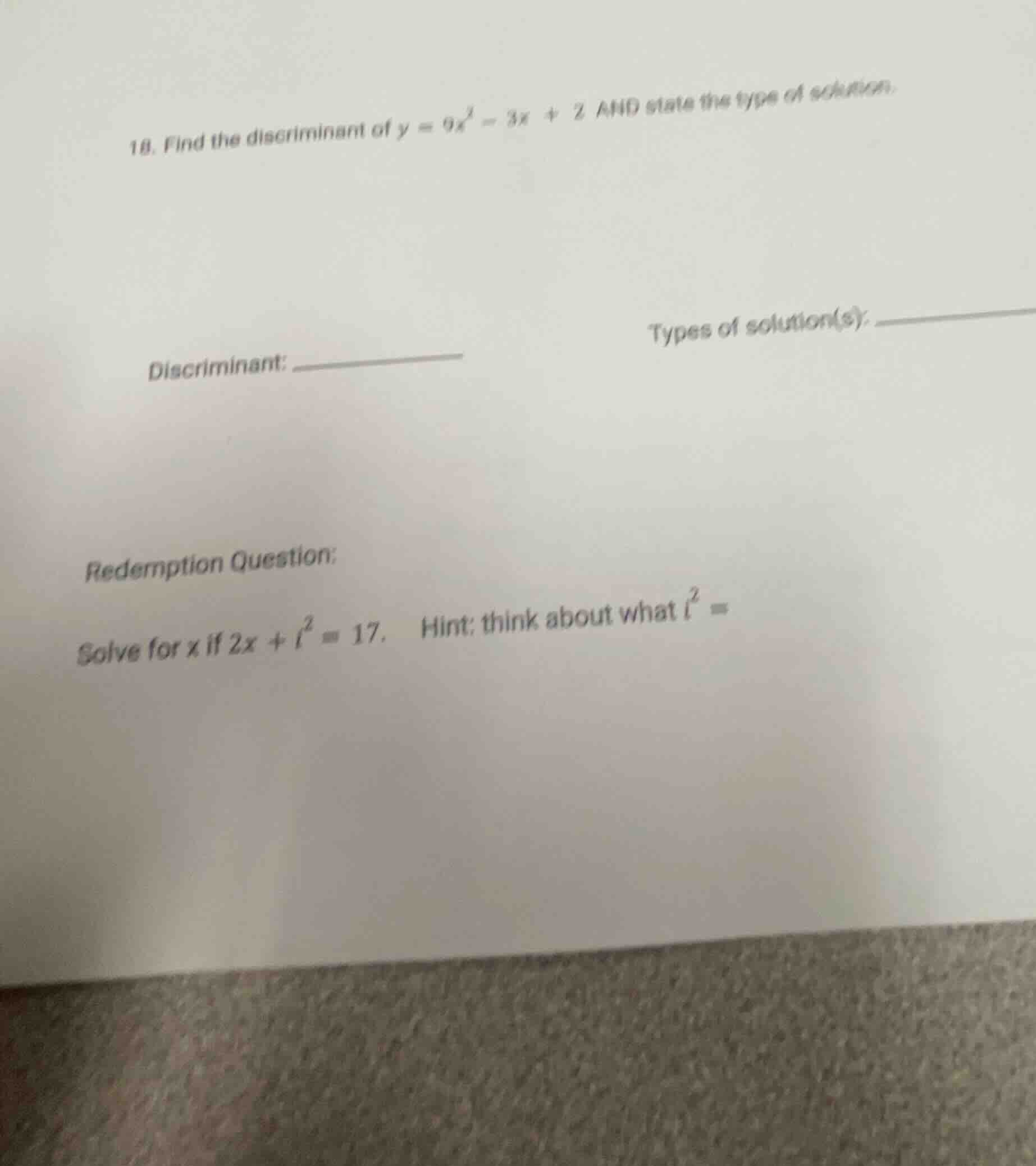
- find the discriminant of $y = 9x^2 - 3x + 2$ and state the type of solution.
discriminant: ______________
types of solution(s): ______________
redemption question:
solve for $x$ if $2x + i^2 = 17$. hint: think about what $i^2 = $
Problem 1: Find the discriminant of \( y = 9x^2 - 3x + 2 \) and state the type of solution.
Step 1: Recall the discriminant formula
For a quadratic equation in the form \( ax^2 + bx + c = 0 \), the discriminant \( D \) is given by \( D = b^2 - 4ac \).
In the equation \( y = 9x^2 - 3x + 2 \), we have \( a = 9 \), \( b = -3 \), and \( c = 2 \).
Step 2: Calculate the discriminant
Substitute the values of \( a \), \( b \), and \( c \) into the discriminant formula:
\[
\]
Step 3: Determine the type of solution
- If \( D > 0 \), the quadratic has two distinct real solutions.
- If \( D = 0 \), the quadratic has one real solution (a repeated root).
- If \( D < 0 \), the quadratic has two complex conjugate solutions (no real solutions).
Since \( D = -63 < 0 \), the quadratic equation \( 9x^2 - 3x + 2 = 0 \) has two complex conjugate solutions (or two non - real solutions).
Step 1: Recall the value of \( i^2 \)
We know that in the complex number system, \( i^2=-1\).
Step 2: Substitute \( i^2 = - 1 \) into the equation
Substitute \( i^2=-1\) into the equation \( 2x + i^2 = 17 \), we get:
\( 2x-1 = 17 \)
Step 3: Solve for \( x \)
Add 1 to both sides of the equation:
\( 2x-1 + 1=17 + 1\)
\( 2x=18 \)
Divide both sides by 2:
\( x=\frac{18}{2}=9 \)

Snap & solve any problem in the app
Get step-by-step solutions on Sovi AI
Photo-based solutions with guided steps
Explore more problems and detailed explanations
Discriminant: \(-63\)
Types of solution(s): Two complex conjugate solutions (or two non - real solutions)