QUESTION IMAGE
Question
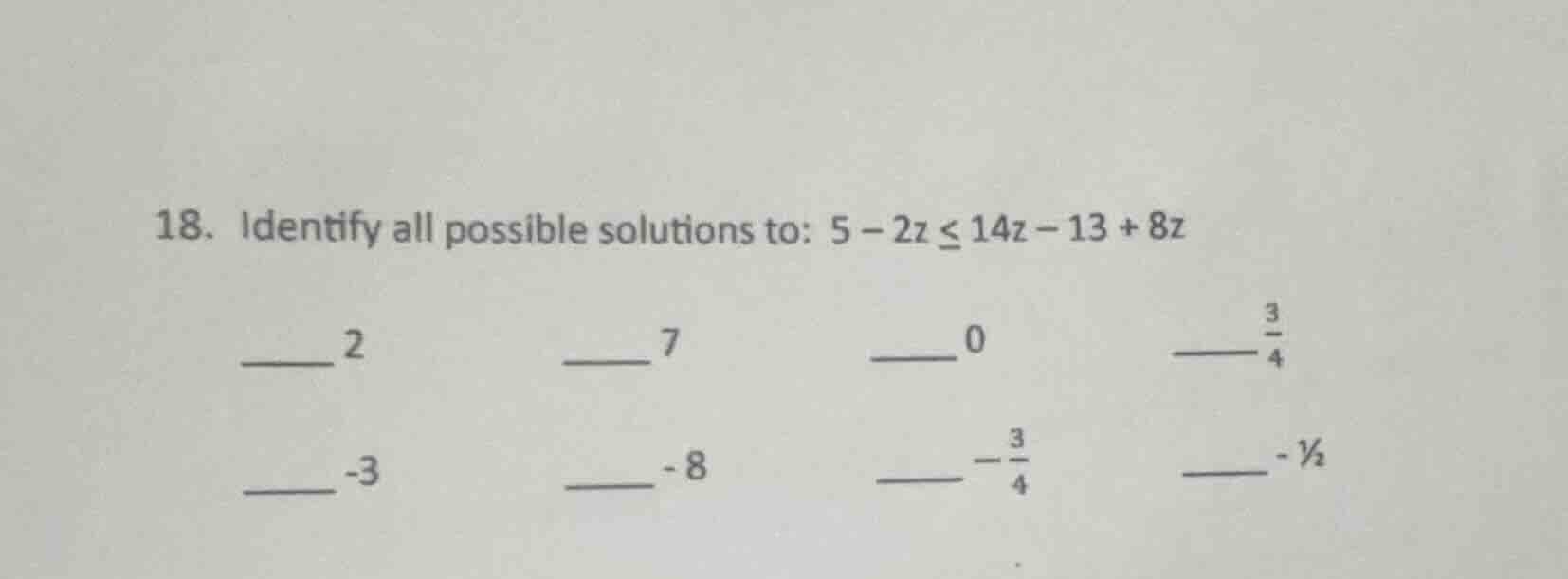
- identify all possible solutions to: $5 - 2z \leq 14z - 13 + 8z$
\\_\\_\\_\\_ 2 \quad \\_\\_\\_\\_ 7 \quad \\_\\_\\_\\_ 0 \quad \\_\\_\\_\\_ $\frac{3}{4}$
\\_\\_\\_\\_ -3 \quad \\_\\_\\_\\_ -8 \quad \\_\\_\\_\\_ $-\frac{3}{4}$ \quad \\_\\_\\_\\_ $-\frac{1}{2}$
Step1: Combine like terms on the right
The right - hand side of the inequality \(5 - 2z\leq14z - 13+8z\) has \(14z\) and \(8z\) as like terms. Combining them, we get \(14z + 8z=22z\). So the inequality becomes \(5-2z\leq22z - 13\).
Step2: Add \(2z\) to both sides
To get all the \(z\) terms on one side, we add \(2z\) to both sides of the inequality \(5-2z\leq22z - 13\). Using the addition property of inequalities (adding the same number to both sides of an inequality does not change the direction of the inequality), we have \(5-2z + 2z\leq22z-13 + 2z\), which simplifies to \(5\leq24z-13\).
Step3: Add 13 to both sides
Now, we add 13 to both sides of the inequality \(5\leq24z - 13\). Using the addition property of inequalities, we get \(5 + 13\leq24z-13 + 13\), which simplifies to \(18\leq24z\).
Step4: Divide both sides by 24
We divide both sides of the inequality \(18\leq24z\) by 24. Since 24 is a positive number, the direction of the inequality remains the same. So \(\frac{18}{24}\leq z\), and simplifying \(\frac{18}{24}\) (dividing numerator and denominator by 6) gives \(\frac{3}{4}\leq z\).
Now we check each value:
- For \(z = 2\): \(\frac{3}{4}\leq2\) is true.
- For \(z = 7\): \(\frac{3}{4}\leq7\) is true.
- For \(z = 0\): \(\frac{3}{4}\leq0\) is false.
- For \(z=\frac{3}{4}\): \(\frac{3}{4}\leq\frac{3}{4}\) is true (since the inequality is non - strict).
- For \(z=-3\): \(\frac{3}{4}\leq - 3\) is false.
- For \(z = - 8\): \(\frac{3}{4}\leq - 8\) is false.
- For \(z=-\frac{3}{4}\): \(\frac{3}{4}\leq-\frac{3}{4}\) is false.
- For \(z =-\frac{1}{2}\): \(\frac{3}{4}\leq-\frac{1}{2}\) is false.

Snap & solve any problem in the app
Get step-by-step solutions on Sovi AI
Photo-based solutions with guided steps
Explore more problems and detailed explanations
The solutions among the given values are \(2\), \(7\), \(\frac{3}{4}\)
So we mark the boxes for \(2\), \(7\), and \(\frac{3}{4}\) as correct.