QUESTION IMAGE
Question
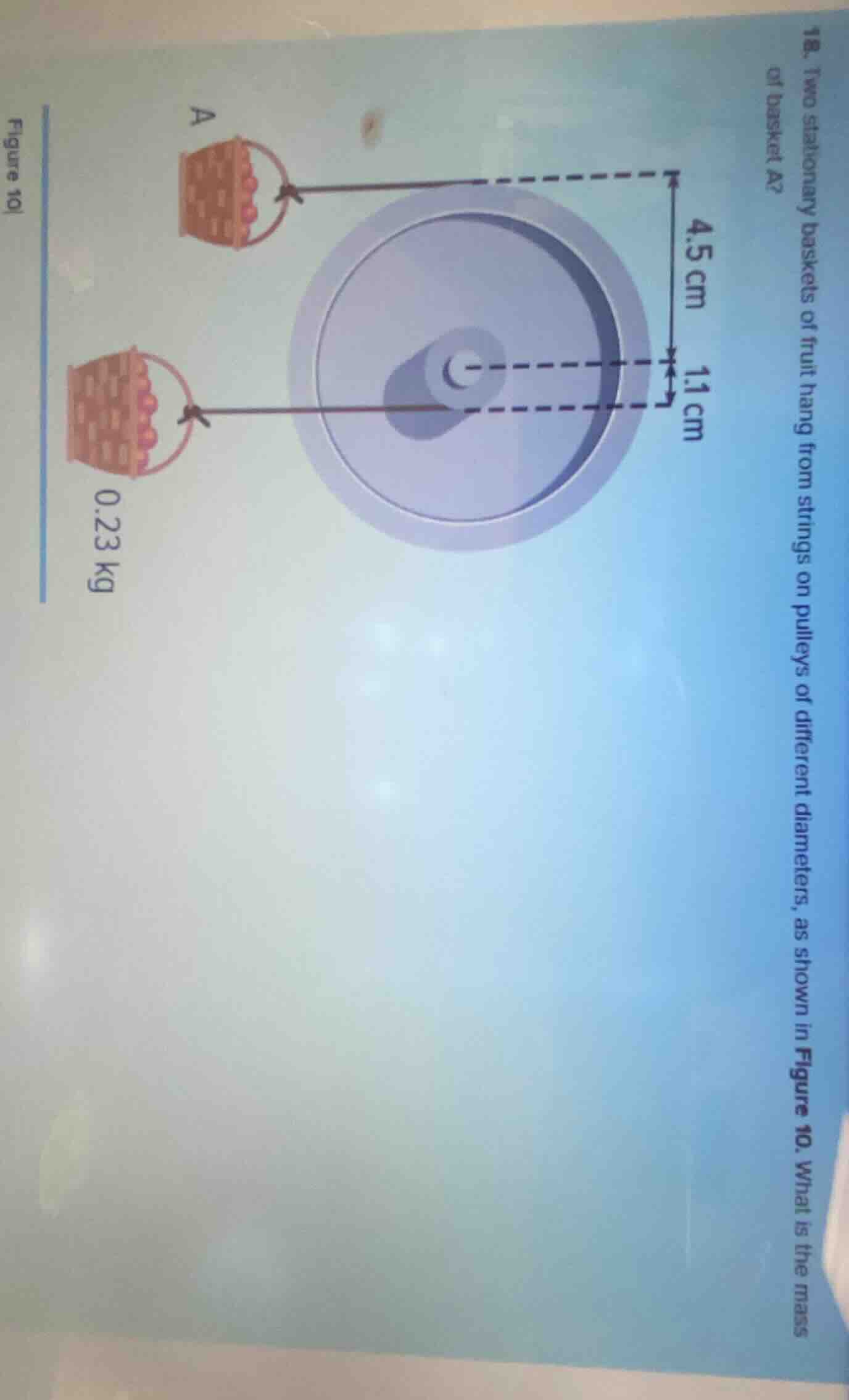
- two stationary baskets of fruit hang from strings on pulleys of different diameters, as shown in figure 10. what is the mass of basket a?
figure 10
(an image showing two baskets, one labeled 0.23 kg, with pulley radii 4.5 cm and 1.1 cm)
Step1: Recall Torque Equilibrium
For the pulley system to be in equilibrium, the torques on both sides must be equal. Torque \(\tau = rF\), where \(r\) is the radius (distance from the axis) and \(F\) is the force (weight, \(F = mg\)). Let \(m_1 = 0.23\space kg\), \(r_1 = 4.5\space cm\), \(r_2 = 1.1\space cm\), and \(m_2\) be the mass of basket A. The torques \(\tau_1 = \tau_2\), so \(r_1m_1g = r_2m_2g\). The \(g\) cancels out.
Step2: Solve for \(m_2\)
Rearrange the formula: \(m_2=\frac{r_1m_1}{r_2}\). Substitute \(r_1 = 4.5\space cm\), \(m_1 = 0.23\space kg\), \(r_2 = 1.1\space cm\).
\(m_2=\frac{4.5\times0.23}{1.1}\)
Calculate numerator: \(4.5\times0.23 = 1.035\)
Then divide: \(m_2=\frac{1.035}{1.1}\approx0.94\space kg\) (rounded to two decimal places)

Snap & solve any problem in the app
Get step-by-step solutions on Sovi AI
Photo-based solutions with guided steps
Explore more problems and detailed explanations
The mass of basket A is approximately \(\boldsymbol{0.94\space kg}\) (or more precisely \(\frac{4.5\times0.23}{1.1}\space kg\approx0.94\space kg\))