QUESTION IMAGE
Question
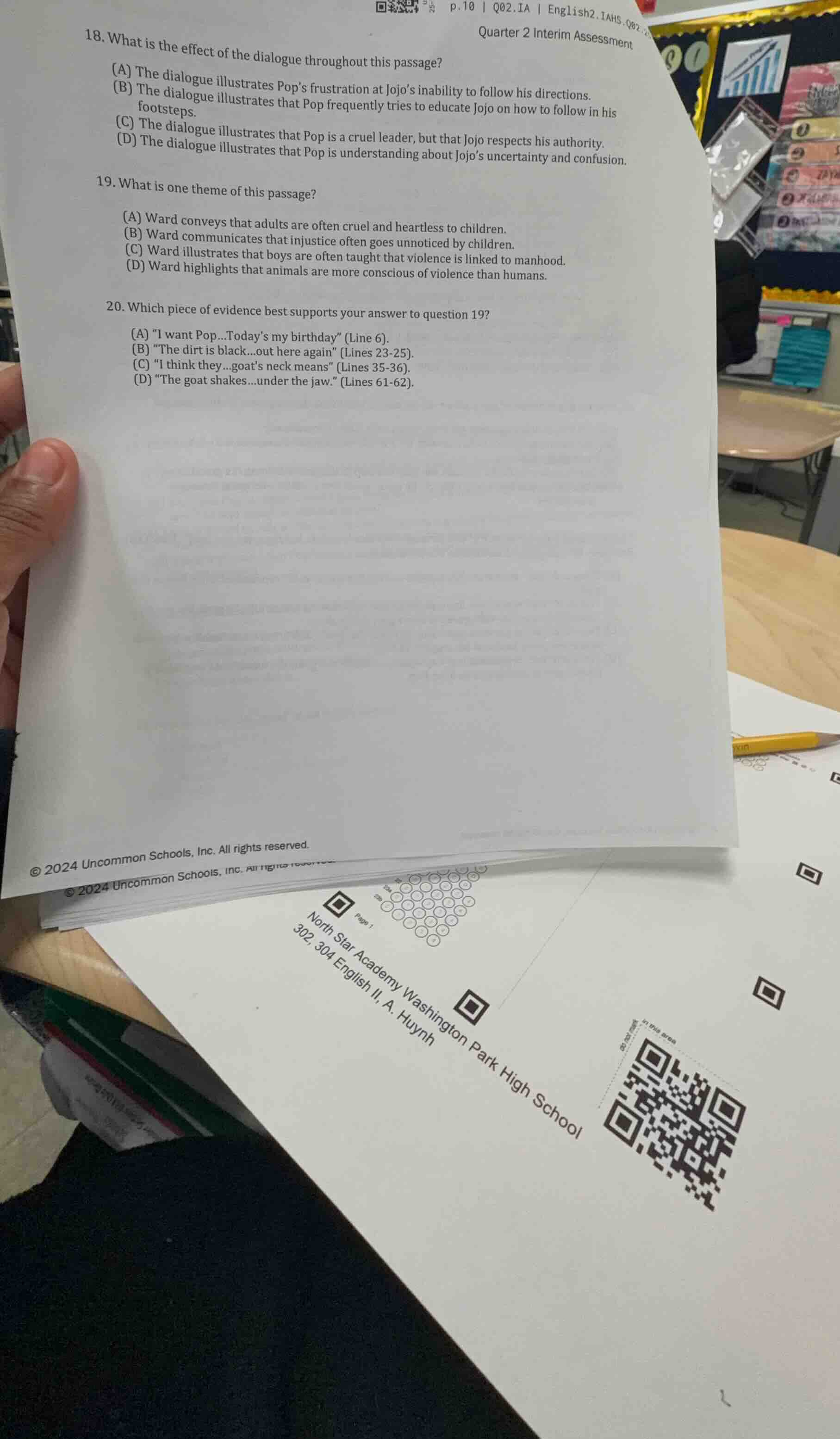
- what is the effect of the dialogue throughout this passage?
(a) the dialogue illustrates pop’s frustration at jojo’s inability to follow his directions.
(b) the dialogue illustrates that pop frequently tries to educate jojo on how to follow in his footsteps.
(c) the dialogue illustrates that pop is a cruel leader, but that jojo respects his authority.
(d) the dialogue illustrates that pop is understanding about jojo’s uncertainty and confusion.
- what is one theme of this passage?
(a) ward conveys that adults are often cruel and heartless to children.
(b) ward communicates that injustice often goes unnoticed by children.
(c) ward illustrates that boys are often taught that violence is linked to manhood.
(d) ward highlights that animals are more conscious of violence than humans.
- which piece of evidence best supports your answer to question 19?
(a) “i want pop…today’s my birthday” (line 6).
(b) “the dirt is black…out here again” (lines 23 - 25).
(c) “i think they…goat’s neck means” (lines 35 - 36).
(d) “the goat shakes…under the jaw.” (lines 61 - 62).
To solve these questions, we would need the passage that these questions are referring to (since they are about analyzing a passage's dialogue, theme, and evidence). Without the passage, we can't provide specific answers, but here's how we would approach each if we had the passage:
Question 18 (Effect of Dialogue)
- Approach: Analyze the dialogue between Pop and Jojo. Look at Pop's tone, words, and Jojo's responses. Eliminate options that don't match the dialogue's content (e.g., if Pop is not cruel, eliminate C; if he's not frustrated but understanding, D might be correct, etc.).
Question 19 (Theme of the Passage)
- Approach: Identify the central message. Analyze options: A (adults cruel to kids) – check if passage shows this; B (injustice unnoticed by kids) – see if injustice is a focus and kids miss it; C (violence linked to manhood for boys) – check if male characters and violence/manhood are connected; D (animals more conscious of violence) – check animal vs. human awareness of violence.
Question 20 (Evidence for Question 19)
- Approach: For the chosen theme in Q19, find the quote that directly supports it. For example, if Q19 answer is C (violence and manhood), find a quote about boys, violence, and manhood (like option C's quote about a goat's neck and what it means, possibly relating to violence and manhood training).
Since the passage is not provided, please share the passage text so we can help you solve these questions with specific analysis!

Snap & solve any problem in the app
Get step-by-step solutions on Sovi AI
Photo-based solutions with guided steps
Explore more problems and detailed explanations
To solve these questions, we would need the passage that these questions are referring to (since they are about analyzing a passage's dialogue, theme, and evidence). Without the passage, we can't provide specific answers, but here's how we would approach each if we had the passage:
Question 18 (Effect of Dialogue)
- Approach: Analyze the dialogue between Pop and Jojo. Look at Pop's tone, words, and Jojo's responses. Eliminate options that don't match the dialogue's content (e.g., if Pop is not cruel, eliminate C; if he's not frustrated but understanding, D might be correct, etc.).
Question 19 (Theme of the Passage)
- Approach: Identify the central message. Analyze options: A (adults cruel to kids) – check if passage shows this; B (injustice unnoticed by kids) – see if injustice is a focus and kids miss it; C (violence linked to manhood for boys) – check if male characters and violence/manhood are connected; D (animals more conscious of violence) – check animal vs. human awareness of violence.
Question 20 (Evidence for Question 19)
- Approach: For the chosen theme in Q19, find the quote that directly supports it. For example, if Q19 answer is C (violence and manhood), find a quote about boys, violence, and manhood (like option C's quote about a goat's neck and what it means, possibly relating to violence and manhood training).
Since the passage is not provided, please share the passage text so we can help you solve these questions with specific analysis!