QUESTION IMAGE
Question
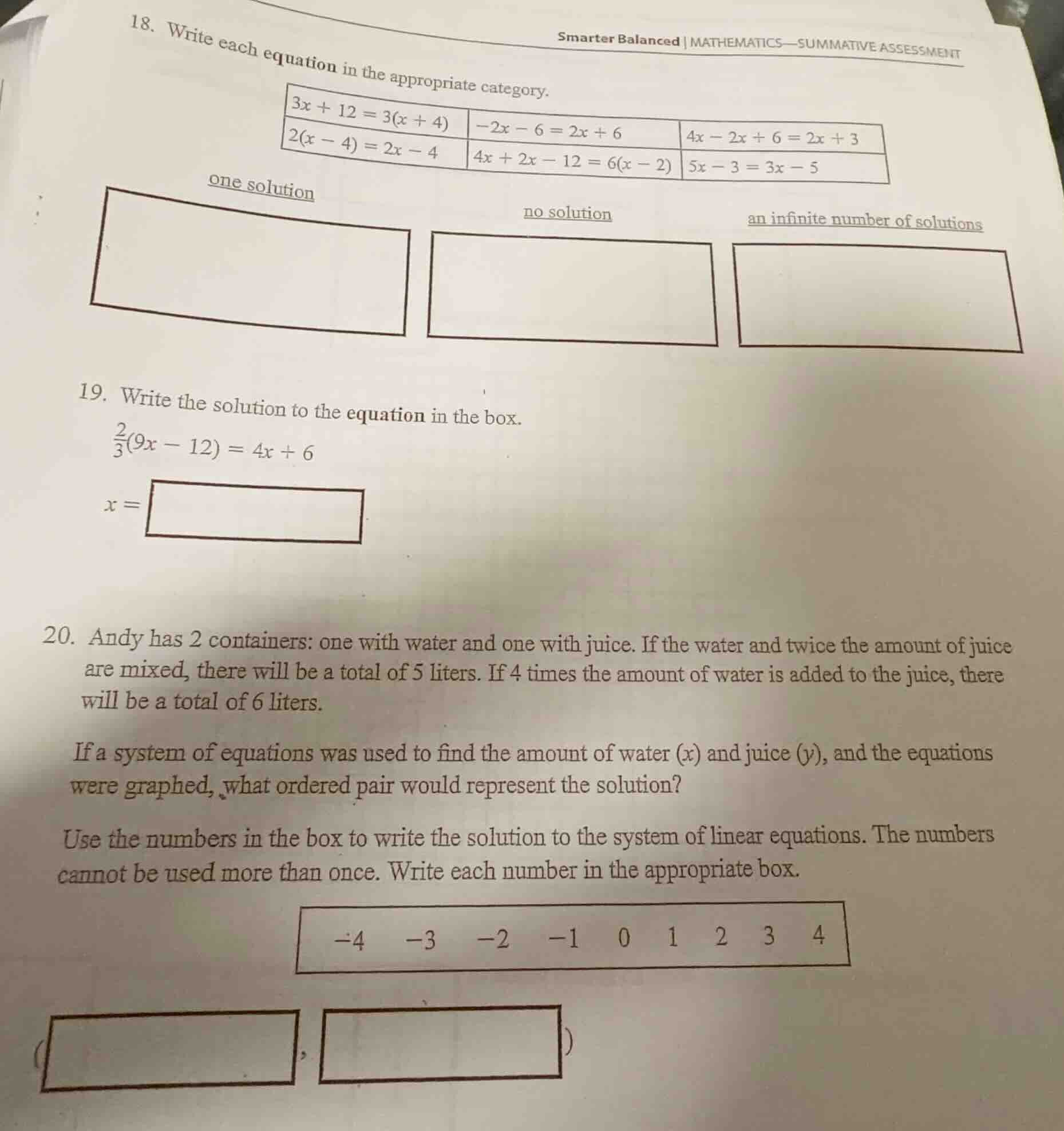
- write each equation in the appropriate category.
$3x + 12 = 3(x + 4)$ $-2x - 6 = 2x + 6$ $4x - 2x + 6 = 2x + 3$
$2(x - 4) = 2x - 4$ $4x + 2x - 12 = 6(x - 2)$ $5x - 3 = 3x - 5$
one solution no solution an infinite number of solutions
- write the solution to the equation in the box.
$\frac{2}{3}(9x - 12) = 4x + 6$
$x = \boxed{}$
- andy has 2 containers: one with water and one with juice. if the water and twice the amount of juice are mixed, there will be a total of 5 liters. if 4 times the amount of water is added to the juice, there will be a total of 6 liters.
if a system of equations was used to find the amount of water ($x$) and juice ($y$), and the equations were graphed, what ordered pair would represent the solution?
use the numbers in the box to write the solution to the system of linear equations. the numbers cannot be used more than once. write each number in the appropriate box.
$-4$ $-3$ $-2$ $-1$ $0$ $1$ $2$ $3$ $4$
$(\boxed{}, \boxed{})$
Question 18
To categorize each equation, we analyze the number of solutions by simplifying:
- \(3x + 12 = 3(x + 4)\):
- Simplify RHS: \(3x + 12\)
- Both sides are equal, so infinite solutions.
- \(-2x - 6 = 2x + 6\):
- Solve: \(-4x = 12 \implies x = -3\), one solution.
- \(4x - 2x + 6 = 2x + 3\):
- Simplify: \(2x + 6 = 2x + 3 \implies 6 = 3\) (false), no solution.
- \(2(x - 4) = 2x - 4\):
- Simplify: \(2x - 8 = 2x - 4 \implies -8 = -4\) (false), no solution.
- \(4x + 2x - 12 = 6(x - 2)\):
- Simplify: \(6x - 12 = 6x - 12\), infinite solutions.
- \(5x - 3 = 3x - 5\):
- Solve: \(2x = -2 \implies x = -1\), one solution.
Categorization:
- One solution: \(-2x - 6 = 2x + 6\), \(5x - 3 = 3x - 5\)
- No solution: \(4x - 2x + 6 = 2x + 3\), \(2(x - 4) = 2x - 4\)
- Infinite solutions: \(3x + 12 = 3(x + 4)\), \(4x + 2x - 12 = 6(x - 2)\)
Question 19
Solve \(\frac{2}{3}(9x - 12) = 4x + 6\):
- Multiply both sides by 3: \(2(9x - 12) = 12x + 18\)
- Simplify: \(18x - 24 = 12x + 18\)
- Subtract \(12x\): \(6x - 24 = 18\)
- Add 24: \(6x = 42\)
- Divide by 6: \(x = 7\)
Question 20
Let \(x\) = water (liters), \(y\) = juice (liters). The system:
- \(x + 2y = 5\)
- \(4x + y = 6\)
Solve using substitution or elimination. Let's use elimination:
- Multiply equation 2 by 2: \(8x + 2y = 12\)
- Subtract equation 1: \(7x = 7 \implies x = 1\)
- Substitute \(x = 1\) into equation 1: \(1 + 2y = 5 \implies 2y = 4 \implies y = 2\)
So the ordered pair is \((1, 2)\).
Final Answers:
Question 18:
- One solution: \(-2x - 6 = 2x + 6\), \(5x - 3 = 3x - 5\)
- No solution: \(4x - 2x + 6 = 2x + 3\), \(2(x - 4) = 2x - 4\)
- Infinite solutions: \(3x + 12 = 3(x + 4)\), \(4x + 2x - 12 = 6(x - 2)\)
Question 19:
\(x = \boxed{7}\)
Question 20:
\((\boxed{1}, \boxed{2})\)

Snap & solve any problem in the app
Get step-by-step solutions on Sovi AI
Photo-based solutions with guided steps
Explore more problems and detailed explanations
Question 18
To categorize each equation, we analyze the number of solutions by simplifying:
- \(3x + 12 = 3(x + 4)\):
- Simplify RHS: \(3x + 12\)
- Both sides are equal, so infinite solutions.
- \(-2x - 6 = 2x + 6\):
- Solve: \(-4x = 12 \implies x = -3\), one solution.
- \(4x - 2x + 6 = 2x + 3\):
- Simplify: \(2x + 6 = 2x + 3 \implies 6 = 3\) (false), no solution.
- \(2(x - 4) = 2x - 4\):
- Simplify: \(2x - 8 = 2x - 4 \implies -8 = -4\) (false), no solution.
- \(4x + 2x - 12 = 6(x - 2)\):
- Simplify: \(6x - 12 = 6x - 12\), infinite solutions.
- \(5x - 3 = 3x - 5\):
- Solve: \(2x = -2 \implies x = -1\), one solution.
Categorization:
- One solution: \(-2x - 6 = 2x + 6\), \(5x - 3 = 3x - 5\)
- No solution: \(4x - 2x + 6 = 2x + 3\), \(2(x - 4) = 2x - 4\)
- Infinite solutions: \(3x + 12 = 3(x + 4)\), \(4x + 2x - 12 = 6(x - 2)\)
Question 19
Solve \(\frac{2}{3}(9x - 12) = 4x + 6\):
- Multiply both sides by 3: \(2(9x - 12) = 12x + 18\)
- Simplify: \(18x - 24 = 12x + 18\)
- Subtract \(12x\): \(6x - 24 = 18\)
- Add 24: \(6x = 42\)
- Divide by 6: \(x = 7\)
Question 20
Let \(x\) = water (liters), \(y\) = juice (liters). The system:
- \(x + 2y = 5\)
- \(4x + y = 6\)
Solve using substitution or elimination. Let's use elimination:
- Multiply equation 2 by 2: \(8x + 2y = 12\)
- Subtract equation 1: \(7x = 7 \implies x = 1\)
- Substitute \(x = 1\) into equation 1: \(1 + 2y = 5 \implies 2y = 4 \implies y = 2\)
So the ordered pair is \((1, 2)\).
Final Answers:
Question 18:
- One solution: \(-2x - 6 = 2x + 6\), \(5x - 3 = 3x - 5\)
- No solution: \(4x - 2x + 6 = 2x + 3\), \(2(x - 4) = 2x - 4\)
- Infinite solutions: \(3x + 12 = 3(x + 4)\), \(4x + 2x - 12 = 6(x - 2)\)
Question 19:
\(x = \boxed{7}\)
Question 20:
\((\boxed{1}, \boxed{2})\)