QUESTION IMAGE
Question
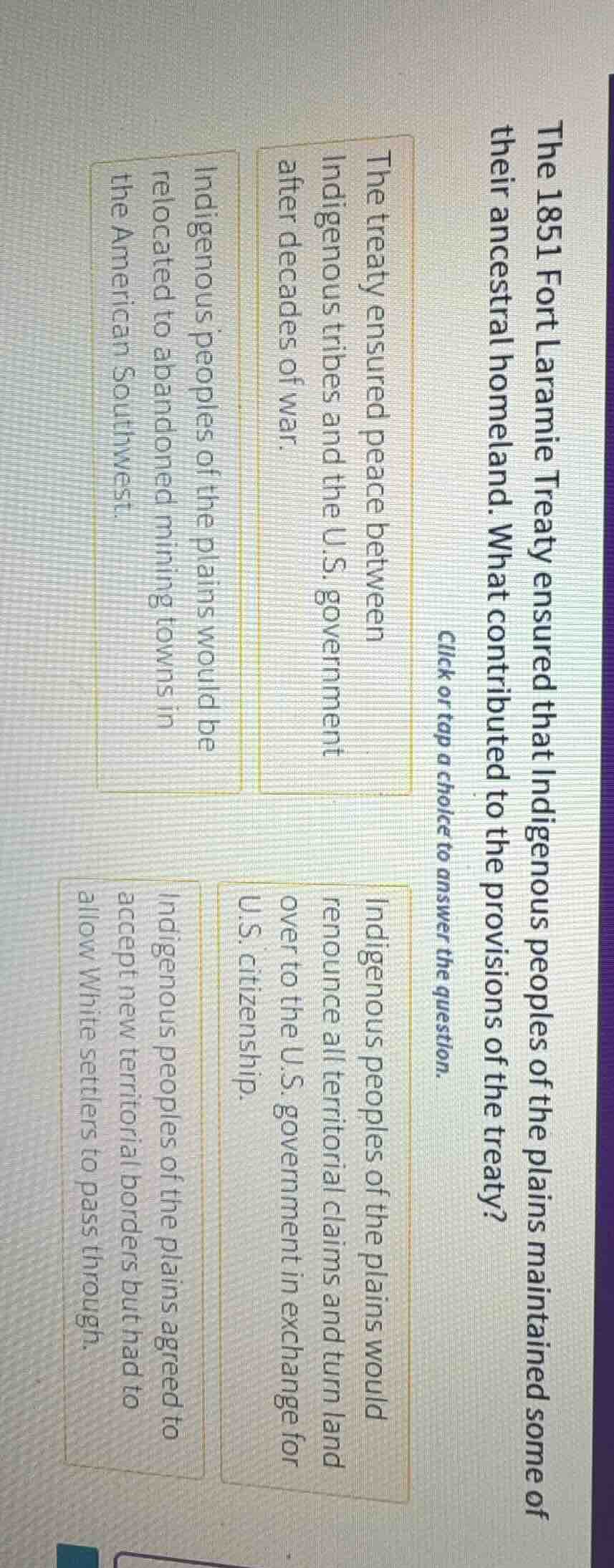
the 1851 fort laramie treaty ensured that indigenous peoples of the plains maintained some of their ancestral homeland. what contributed to the provisions of the treaty?
click or tap a choice to answer the question.
the treaty ensured peace between indigenous tribes and the u.s. government after decades of war.
indigenous peoples of the plains would be relocated to abandoned mining towns in the american southwest.
indigenous peoples of the plains would renounce all territorial claims and turn land over to the u.s. government in exchange for u.s. citizenship.
indigenous peoples of the plains agreed to accept new territorial borders but had to allow white settlers to pass through.
To determine the correct answer, we analyze each option:
- Option 1: The 1851 Fort Laramie Treaty was about establishing peace and defining territorial rights, not about decades of war afterward (the treaty aimed to prevent war), so this is incorrect.
- Option 2: Relocating to abandoned mining towns in the Southwest is not related to the 1851 Fort Laramie Treaty's provisions, so this is incorrect.
- Option 3: The 1851 Fort Laramie Treaty had provisions where Indigenous peoples of the plains renounced some territorial claims in exchange for certain guarantees, but not U.S. citizenship (citizenship for Indigenous peoples came later through other means), so this is incorrect.
- Option 4: The 1851 Fort Laramie Treaty included provisions where Indigenous peoples agreed to accept new territorial boundaries (reserving some lands for themselves) and allowed White settlers to pass through their territory on the Oregon Trail, which aligns with the treaty's terms.

Snap & solve any problem in the app
Get step-by-step solutions on Sovi AI
Photo-based solutions with guided steps
Explore more problems and detailed explanations
- Indigenous peoples of the plains agreed to accept new territorial borders but had to allow White settlers to pass through.